
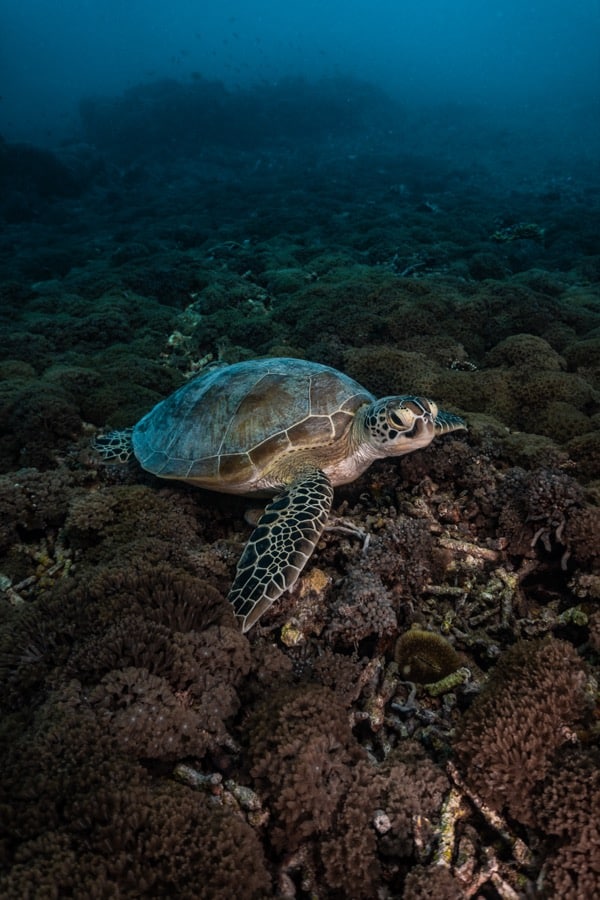
You are snorkeling or diving in crystal-clear water around the Gili Islands. A turtle suddenly appears beside you. It swims slowly and calmly only a few meters away.
And then the thought appears:
Can I touch it?
The answer is simple.
No — and honestly, you should not want to.
Turtles are one of the biggest reasons people fall in love with the underwater world. But part of protecting these animals means understanding that close encounters do not need physical contact to feel magical.
In fact, turtles are usually far more beautiful to watch when they are left completely undisturbed.
Why Touching Turtles Is Harmful
Many people think touching a turtle “just once” does not matter.
But imagine hundreds of people doing the same thing every day.
Sea turtles are wild animals. Constant touching, chasing, crowding, or blocking their path creates stress, even if they appear calm on the surface.
Turtles often come up for air very slowly and carefully. When people surround them for photos or try to touch them, it interrupts natural behavior and can exhaust the animal unnecessarily.
Turtle Tumours and Marine Health
One thing divers and snorkelers unfortunately see more frequently today is turtles with visible tumors.
These growths are usually linked to a disease called fibropapillomatosis. The disease creates large tumors around the eyes, neck, mouth, and flippers of sea turtles.
Some turtles continue living relatively normally. Others struggle badly once tumors affect vision, swimming, or feeding.
Scientists still study exactly why the disease spreads, but pollution, environmental stress, weakened ecosystems, and declining water quality are all believed to contribute.
Seeing a turtle with tumors underwater can be heartbreaking.
Especially because it reminds people very quickly that marine ecosystems are far more fragile than they sometimes appear.
The Problem With Turtle Tourism
The Gili Islands are famous for turtle encounters. And honestly, that is something very special.
But tourism also creates pressure.
Sometimes turtles get surrounded by dozens of snorkelers at once. People dive down toward them for photos. Others try to grab them or force close interactions for social media videos.
This is exactly why organizations like Green Fins promote responsible diving and snorkeling practices across marine tourism destinations worldwide.
Their message is simple:
- Observe marine life
- Do not touch
- Do not chase
- Do not feed
- Keep respectful distance
Good wildlife encounters happen naturally.
They do not need to be forced.
The Best Turtle Encounters Usually Happen Quietly

Interestingly, turtles often come closer when people stop chasing them.
Calm snorkelers and divers usually get the best experiences because marine animals feel less threatened. Floating quietly at the surface while a turtle slowly swims past you often feels far more memorable than trying to touch one.
And honestly, those peaceful moments are usually the ones people remember years later anyway.
Not the selfie.
Small Actions Matter
Protecting turtles is not only about avoiding physical contact.
Small choices help too:
- Use reef-safe sunscreen
- Never leave plastic behind
- Improve buoyancy while diving
- Choose responsible dive operators
- Respect marine life boundaries
- Avoid overcrowding animals for photos
None of these actions alone will save the ocean.
But together, they reduce pressure on ecosystems that are already struggling.