

Ask ten divers for their favourite dive site in the Gili Islands and chances are several of them will say Sunset Reef.
Not because it has the biggest sharks.
Also not because it has the strongest currents.
Not because it offers guaranteed encounters with rare marine life.
They love it because it has a little bit of everything.
Beautiful coral.
Excellent visibility.
Turtles.
Sharks.
Schools of fish.
And enough reef to explore for dozens of dives without ever seeing the same route twice.
Sunset Reef is one of the largest dive sites in the Gili Islands and one of the most diverse.
It is also one of the easiest places to get lost.
Fortunately, that hardly matters.
Wherever you end up, the reef is usually beautiful.
Where is Sunset Reef?
Sunset Reef is located on the southern side of Gili Trawangan.
The site sits away from the busier eastern and northern coasts and is known for healthy coral growth, clear water, and generally relaxed diving conditions.
Unlike Shark Point or Meno Wall, which have more defined routes, Sunset Reef stretches over a large area of reef and coral formations.
Even experienced guides can spend years exploring different sections of the site.
Every dive feels slightly different.
Why Is It Called Sunset Reef?
The name comes from its location on the sunset side of Gili Trawangan.
However, some people know the site by another name.
Manta Point.
This nickname causes a lot of confusion.
The truth is simple.
There is no manta cleaning station here.
Therefore there is no resident manta population.
And divers should not choose this site expecting manta rays.
The story behind the name is actually quite interesting.
During one of the first exploratory dives at the site many years ago, a diver reportedly encountered a manta ray. The name stuck and some operators still use it today.
While manta rays are extremely rare, they are not impossible.
More commonly, divers might encounter eagle rays or mobula rays passing through the blue.
These sightings are exciting when they happen, but they should be viewed as a bonus rather than an expectation.
What Does the Dive Site Look Like?
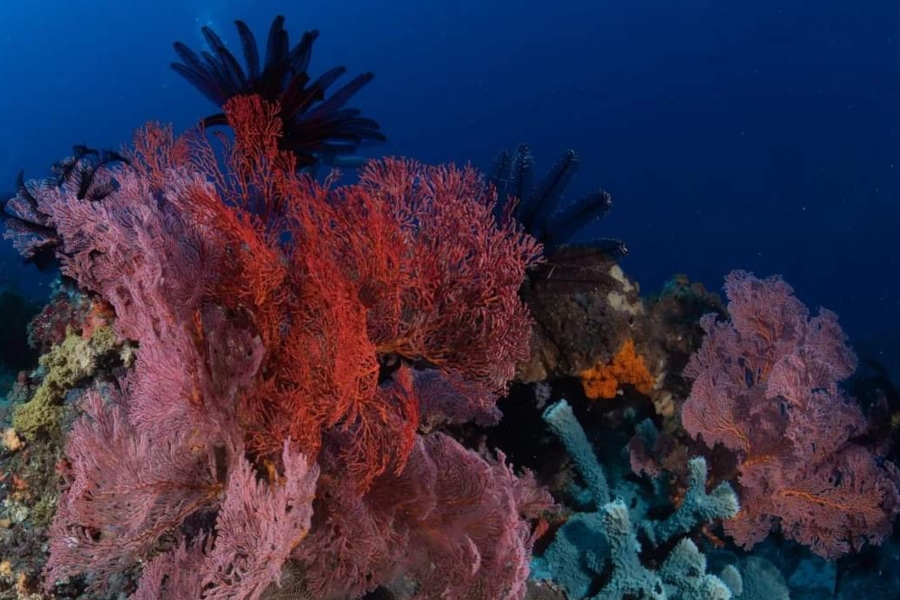
Sunset Reef is a classic coral reef dive.
The dive usually begins at around 10 metres.
This is partly because the shallower sections can experience surge, particularly when waves are running.
The movement is rarely dangerous, but it can make the dive less comfortable.
Starting slightly deeper allows divers to avoid most of the surge while immediately entering the healthiest sections of the reef.
For beginner divers, descent lines are often used to make the entry easier.
Once underwater, the reef stretches in every direction.
Hard corals dominate much of the site.
Large coral bommies rise from the seabed.
Table corals create shelter for schools of fish.
Colourful reef fish seem to occupy every available space.
The main reef edge is usually found around 18 to 20 metres.
Beyond this point, the reef gradually transitions into a sandy slope.
This area often produces some of the site’s most exciting encounters.
Sharks at Sunset Reef
Despite the misleading manta reputation, Sunset Reef is actually much better known for sharks.
Whitetip reef sharks are commonly found resting on the sandy areas near the reef edge.
Patient divers often discover them lying quietly beneath coral ledges or cruising slowly across the sand.
Juvenile whitetip reef sharks can frequently be found sheltering underneath coral formations.
These smaller sharks are often overlooked by divers who swim too quickly.
The shallower reef is also a good place to encounter blacktip reef sharks.
These elegant predators are particularly common around the top reef and often appear unexpectedly before disappearing back into the blue.
Overall, Sunset Reef provides some of the most reliable shark encounters in the Gili Islands.
Turtles Everywhere
If there is one animal that rivals the sharks for popularity, it is the turtles.
Sunset Reef is home to large numbers of both green and hawksbill turtles.
Hawksbill turtles are particularly common.
Many divers encounter multiple turtles during a single dive.
Some are feeding.
Some are resting beneath coral overhangs.
Others simply glide past as if completely uninterested in the divers around them.
The healthy reef provides an ideal habitat for these animals, which explains why they are seen so consistently.
Pelagic Visitors
Although the reef itself is the main attraction, larger fish occasionally visit.
Tuna are regular sightings and often appear hunting around schools of baitfish.
Trevallies are common.
Barracuda sometimes patrol the deeper sections.
On lucky dives, eagle rays or mobula rays may pass through.
You never quite know what might appear out of the blue.
Why Divers Love Sunset Reef
The biggest strength of Sunset Reef is balance.
It does not rely on a single attraction.
The site does not need mantas.
It does not need huge schools of sharks.
It does not need dramatic walls.
Instead, it offers consistently enjoyable diving.
The visibility is often excellent.
Currents are usually mild.
Marine life is abundant.
And the coral is among the healthiest in the region.
It is the type of dive site that appeals to almost everyone.
Beginners enjoy the calm conditions.
Photographers love the colourful reef.
Experienced divers appreciate the biodiversity.
Even diving the site every day, it never becomes boring.
Want to explore more? Check out our Complete Guide to Dive Sites in the Gili Islands for detailed information on every major dive site, including Shark Point, Halik Reef, Turtle City, Deep Turbo, Meno Wall, and many more.