

Kecinan Bay is one of the most interesting muck and macro diving sites near the Gili Islands.
Located on the northwest coast of Lombok, this large bay offers enough variety for two or even three dives and has become a favourite among macro photographers and critter hunters.
There are no dramatic walls, enormous coral gardens or spectacular pinnacles. Much of the bottom is sand, rubble and scattered structures. Yet spend a little time here and you quickly realise that Kecinan is hiding an extraordinary amount of life.
The secret is simple: slow down and look closely.
A Bay Full of Small Things
Kecinan changes considerably as you move through the bay.
The shallow areas contain seagrass where seahorses can often be found.
Further down, sandy and rubble-covered sections are interrupted by anchor lines, mooring blocks, artificial reef structures and scattered coral blocks.
None of these may look particularly exciting from a distance.
But look closer.
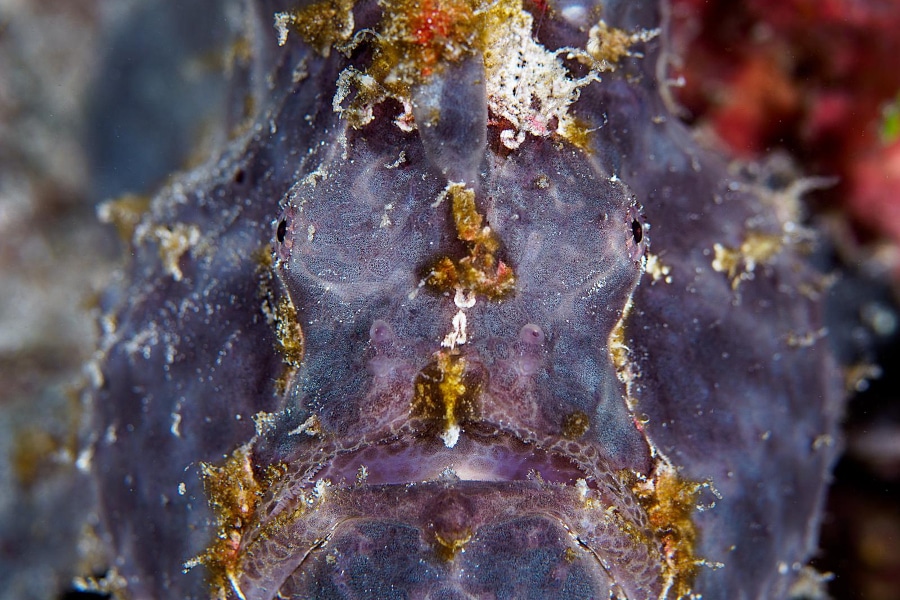
A rope can be home to a pipefish. A piece of rubble can hide a frogfish. Something that looks like a piece of seaweed might turn out to be a ghost pipefish. And an apparently empty patch of sand can suddenly reveal an octopus, a flying gurnard or a tiny scorpionfish.
This is what makes Kecinan so addictive.
Kecinan: A Macro Diving Favourite Near the Gili Islands
For divers exploring the Gili Islands and Lombok, Kecinan offers something very different from the coral reefs around Gili Meno, Gili Trawangan and Gili Air.
It is probably one of the favourite sites in the area for macro diving and underwater photography.
Instead of looking for large reef animals, you spend your time searching for small and often perfectly camouflaged creatures.
The site rewards patience. You may cover only a small area during an entire dive, but still encounter a surprising number of different species.
The First Dive: Start in the East
We usually begin the first dive towards the eastern side of the bay.
This section is mainly sand and rubble, with some coral blocks scattered around. The coral isn’t spectacular compared with some of the Gili Islands’ reef sites, but that isn’t really the point.
The most interesting features are the anchor lines and mooring blocks.
These structures have become miniature habitats, attracting an impressive collection of small marine life.
Pipefish and ghost pipefish can be found around them, while scorpionfish, frogfish and flying gurnards can hide remarkably well among the surrounding rubble.
Octopus are another possibility, and every careful search can produce something different.
As the dive progresses towards the middle of the bay, the anchor lines and structures continue to provide plenty of things to investigate.
For a macro photographer, this can easily turn into a very slow dive.
And that’s exactly how it should be.
The Second Dive: Continue Where You Stopped
Kecinan is unusual because you don’t necessarily need to start the second dive somewhere completely different.
We often jump in where we finished the first dive and continue exploring the bay.
The environment gradually changes as you move through the shallower sandy and seagrass areas. This is where the artificial reef structures become particularly interesting.
Some of these structures are now covered in coral and full of life, creating a completely different underwater landscape from the rubble and anchor lines further east.
And, of course, there are more critters.
Leaf fish and frogfish can be found among the structures, while seahorses are another reason to keep scanning the seagrass and surrounding habitat. Turtles can occasionally make an appearance too.
As you move deeper, you continue to find the familiar collection of macro subjects, alongside more coral blocks and established reef structures.
The Western Side: The Sand Is Alive
Towards the western side of Kecinan there are fewer anchor lines, but that doesn’t mean there is less to see.
In fact, this is where the character of the dive changes again.
The seabed is dominated by sand, but the sand is far from empty.
The sand is alive.
This is classic muck diving in Lombok: apparently ordinary surroundings hiding an extraordinary amount of marine life.
Why Photographers Love Kecinan
Kecinan is particularly rewarding for macro photography around the Gili Islands and Lombok because it offers such a wide variety of subjects within a relatively compact area.
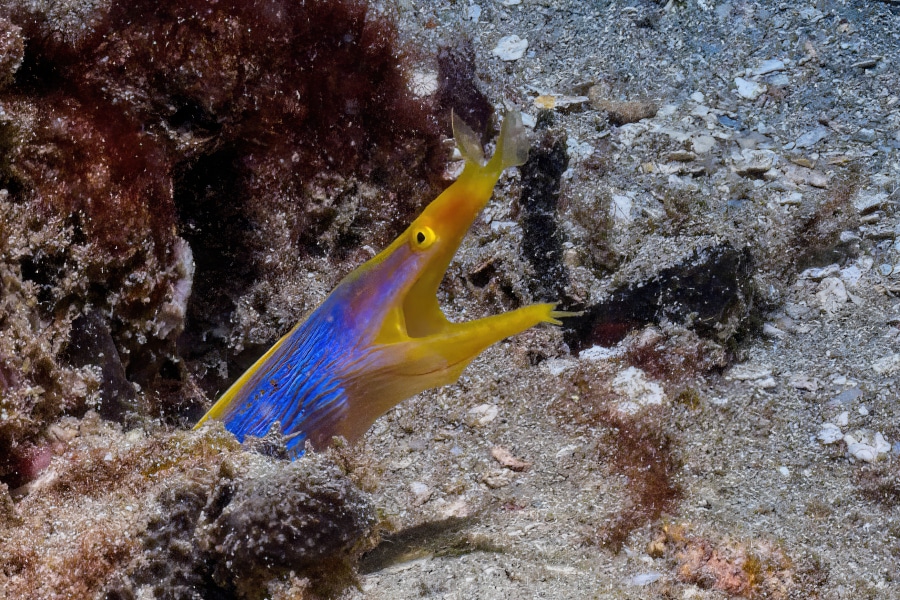
You can spend one dive looking for seahorses and pipefish and the next searching for frogfish, leaf fish, ghost pipefish or nudibranchs.
The challenge is not finding enough to photograph.
The challenge is deciding what to photograph first.
Buoyancy Matters
Kecinan also demonstrates why good buoyancy is so important when muck diving.
Much of the site consists of sand and rubble, which can easily be stirred up by an uncontrolled fin kick. Once the sediment is suspended, visibility can disappear quickly—and the divers behind you may have an even harder time seeing anything.
For photographers, this is particularly frustrating. You can spend several minutes finding the perfect subject only to ruin the shot with a cloud of sand.
Stay off the bottom, move slowly and use your buoyancy rather than your hands or fins to position yourself.
The better your buoyancy, the more you will see.
More Than Just a Macro Site
Kecinan is often described as a muck and macro dive site, and that’s certainly what makes it special. But the variety across the bay means that it isn’t simply one type of dive repeated over and over.
You have seagrass, sand, rubble, artificial reefs, mooring structures and coral blocks—all supporting slightly different communities of marine life.
That’s why we consider Kecinan one of those sites where you can keep coming back and still find something new.
And perhaps that’s the best description of Kecinan:
It doesn’t look like much at first. Then you start looking.