

If you’ve spent any time drifting along the sloping reefs of Gili Meno you’ve almost certainly locked eyes with a moray eel. A thick, speckled neck emerging from a dark crevice, needle-sharp teeth on display. The mouth rhythmically opening and closing like a villain in an underwater drama.
Moray eels have a reputation for looking perpetually grumpy—even menacing. But spend a little time watching them. You’ll discover that morays are actually some of the most misunderstood, fascinating, and biomechanically bizarre residents of our coral reefs.
Let’s dive into why meeting a moray on your next dive around the Gili Islands is one of the coolest reef encounters you can have.

First Things First: That “Threatening” Gape? They’re Just Catching Their Breath
The number one question our dive instructors get from open water students is: “Why was that giant eel snapping its jaws at me?”
Good news: it wasn’t preparing to take a bite out of your fins.
Unlike most reef fish, moray eels lack bony gill covers to pump water over their gills. To keep oxygen flowing through their bodies they must continuously gulp water and force it back through their throat.
That open-mouthed, toothy stare isn’t aggression—it’s the eel equivalent of breathing through its mouth.
As long as you give them respectful space, morays are placid, curious neighbors who are far more interested in hiding in their reef shelters than bothering divers.
Weird & Wonderful Moray Superpowers
Beyond their toothy grins, morays boast evolutionary adaptations straight out of science fiction:
Real-Life Alien Pharyngeal Jaws
Most fish hunt using suction, expanding their mouths rapidly to vacuum up unsuspecting prey. But moray eels hunt in narrow reef cracks where expanding a wide mouth is impossible. Their solution? A second, fully functional set of jaws hidden deep in their throat—called pharyngeal jaws.
When a moray snaps down on an octopus or fish, these inner jaws shoot forward from behind, grip the prey with backward-facing teeth, and pull it down into its stomach.
It’s the exact biological mechanism Ridley Scott’s team drew inspiration from for the Xenomorph in Alien!
Tying Themselves in Knots to Eat
Without pectoral or pelvic fins to hold down prey, an eel has to get creative. When a moray catches something too large to swallow whole it curls its muscular tail around its body and literally ties itself into an overhand knot.
By sliding the knot forward against the prey, it creates leverage to tear off manageable bites.
A Secret Handshake with Groupers
Morays don’t always hunt alone. If you keep a sharp eye out on the reef, you might see a roving coral trout or grouper swim right up to an eel’s den and violently shake its head. This isn’t a fight; it’s an invitation to go hunting together.
The grouper flushes prey off the open reef into the coral cracks, while the eel stalks the cracks and drives fish back into the open water.
Whoever gets the catch eats—a rare, celebrated example of cooperative cross-species hunting.
Scaleless & Slime-Protected
Run a finger across an eel (metaphorically speaking—please don’t touch!), and you won’t feel rough fish scales.
Morays are completely smooth, wrapped in a thick protective mucus layer rich in immune enzymes and antibacterial proteins. This natural slip-and-slide coating protects their skin from jagged coral and allows them to wedge into abrasive volcanic rock without a scratch.
Which Morays Can You Spot Around Gili Meno?
The Gili Islands are a haven for the moray family, ranging from gentle giants to tiny, jewel-toned macro wonders:
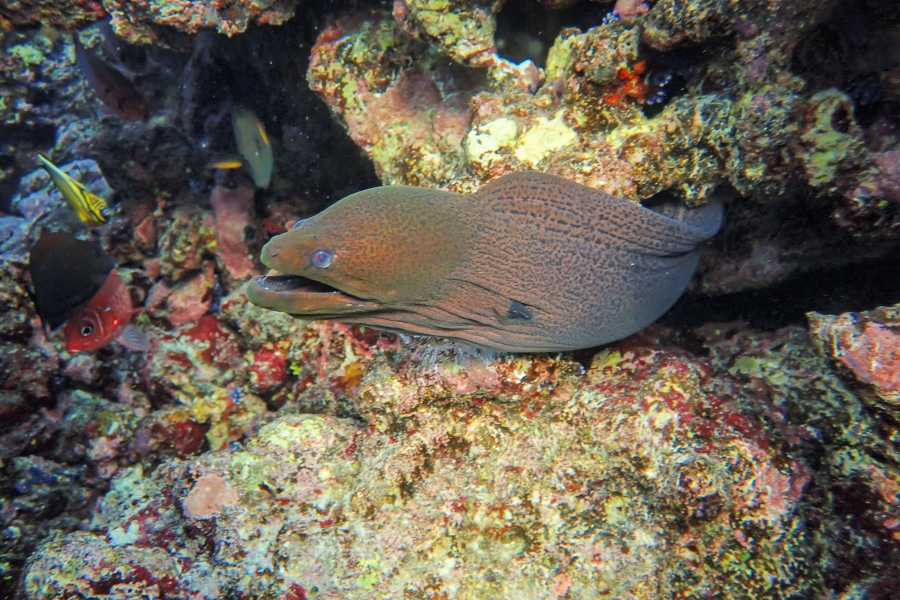
Giant Moray: The undisputed heavyweight champion of the reef. Reaching over 2 meters in length, these impressive eels are frequently spotted frequently.
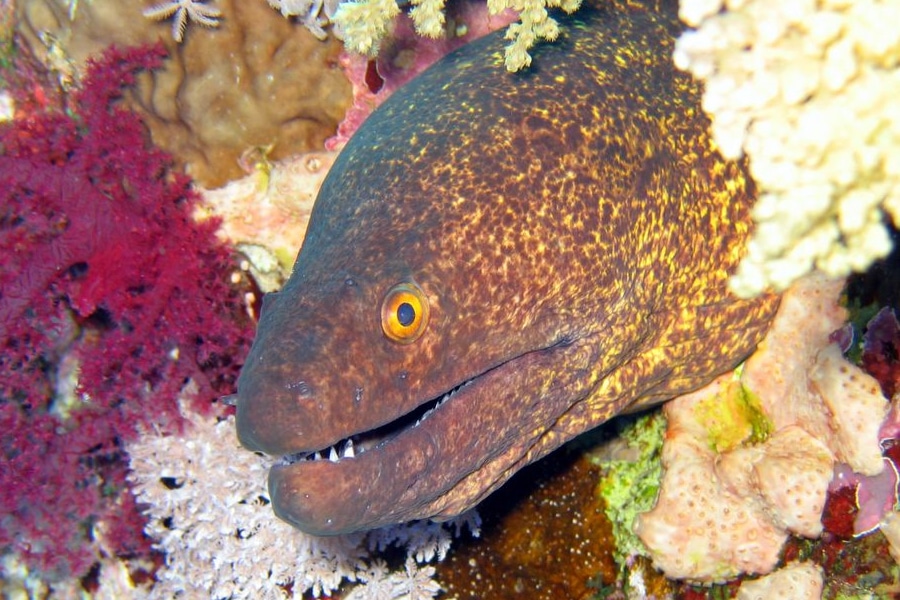
Yellowmargin Moray: Mottled yellow-brown with a distinct dark blotch over its gill opening. A common and curious sight on afternoon reef dives.
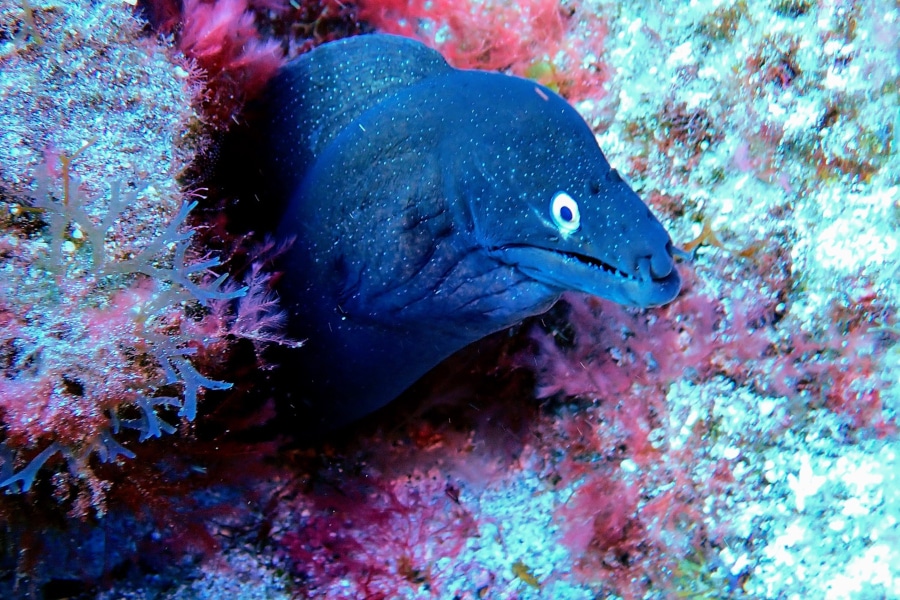
White-Eyed Moray: Easy to spot due to its smaller size, freckled pale body, and striking, pure-white irises that give it a ghost-like gaze.
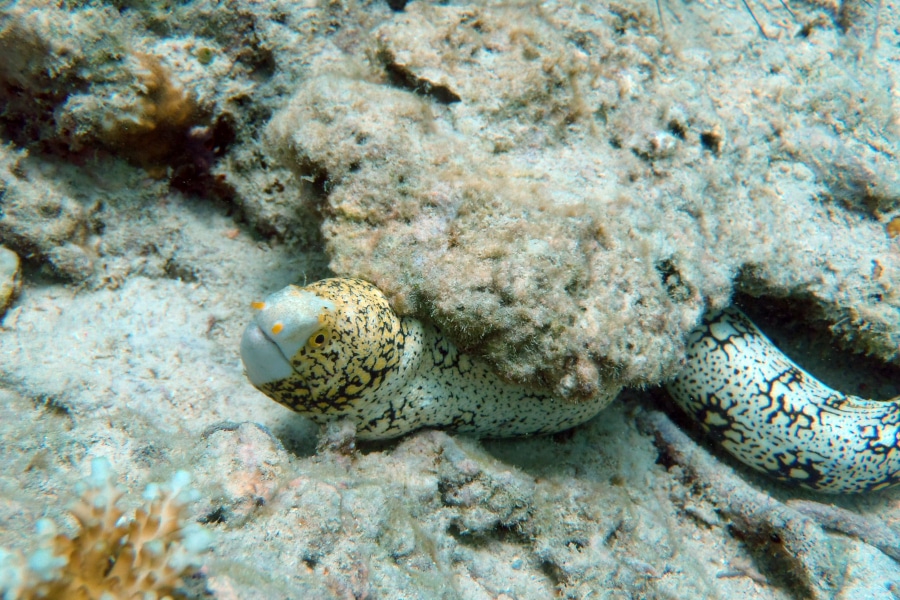
Snowflake Moray (: With its blunt nose and creamy body adorned with black and gold starbursts, this moray skips fish-hunting in favor of using flat, pebble-like teeth to crush reef crabs.
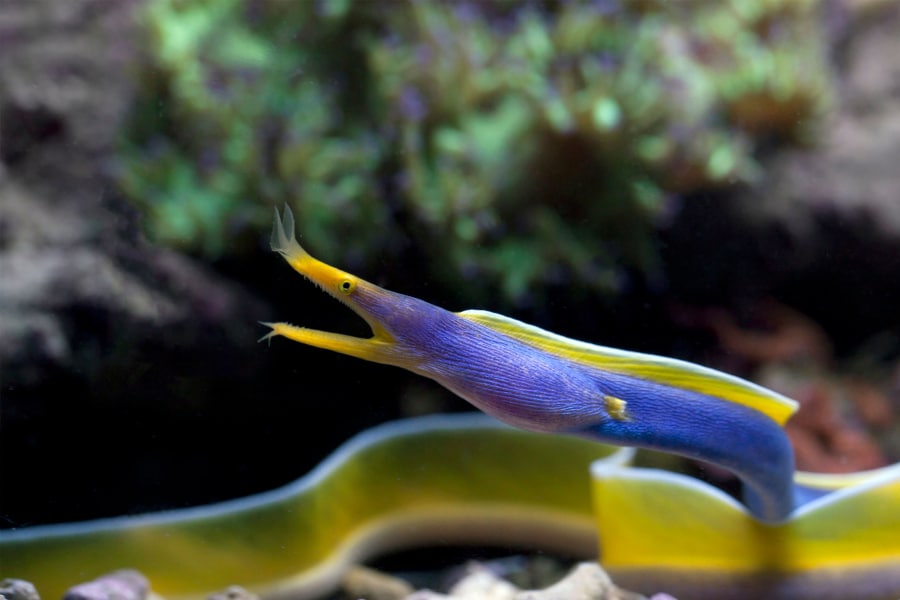
Ribbon Eel (Rhinomuraena quaesita): One of the crown jewels of macro diving in the Gilis. Slender, colorful, and featuring delicate flared nostrils that look like tiny fans, ribbon eels are sequential hermaphrodites: starting life jet-black with yellow racing stripes, transitioning into electric blue and yellow males, and finally becoming bright yellow females.
Top Dive Sites to Find Them (Right on Our Doorstep!)
Because Divine Divers is situated right on the tranquil shores of Gili Meno, we’re positioned within a 5-to-15 minute boat ride of the prime moray hangouts:
- Meno Wall & Bounty Wreck (Gili Meno): The vertical drop-offs and the artificial structure of the collapsed pontoon provide endless crevices, overhangs, and cleaner shrimp stations where big Giant and Yellowmargin morays love to rest.
Hans Reef (off Gili Air): A muck-and-macro playground. The sandy rubble slopes and coral patches here are the best place in the islands to look for Ribbon Eels poking their noses out of the sand.
Halik & Shark Point (Gili Trawangan): Deep canyons and sweeping bommies provide the perfect refuge for large morays sharing their homes with cleaner wrasse and dancing shrimp.
Spot a Moray on Your Next Dive
Whether you’re taking your first breaths on an Open Water course or exploring the deep walls as an experienced diver, watching a moray interact with cleaner shrimp at a reef station is pure underwater magic.
Drop by the dive shop at Divine Divers Gili Meno, ask our dive masters what’s been spotted this week, and let’s go explore the reefs together!