

Also known as Teluk Nara or Magic Pier, Teluk Nare is one of the most famous muck diving sites near the Gili Islands—and one of the most unusual.
Located in close proximity to Kecinan and Mentigi Bay, on the northwest coast of Lombok, the bay is only about 25 minutes by boat from Gili Meno. It offers an extraordinary concentration of small marine life.
The site is centred around a working jetty whose pilings, crossbeams and surrounding rubble have developed into an artificial reef. Colourful sponges, soft corals and other growth cover the structures, creating shelter for an impressive collection of critters.
But Teluk Nare has changed considerably over the years.
The harbour is no longer the small, quiet boat pier it once was. Today, it is a major speedboat hub for boats travelling between Lombok and the Gili Islands, and boat traffic can be severe. This makes choosing where and how to dive the site particularly important.
A Muck Dive Under a Working Harbour
The bottom around Teluk Nare consists largely of sand, silt and rubble. It isn’t a spectacular reef dive in the traditional sense. The attraction is what lives among the structures and on the seabed.
Look carefully and you may find several different species of frogfish, ghost pipefish, nudibranchs and other small marine life.
The rubble below the pier is just as interesting. Stargazers can bury themselves almost completely in the sand, while waspfish can be remarkably difficult to distinguish from dead leaves. Mantis shrimp and other small crustaceans can also be found among the rubble.
This is classic muck diving around the Gili Islands: the environment may look less than ordinary, but careful observation reveals an incredible amount of life.
Frogfish Everywhere
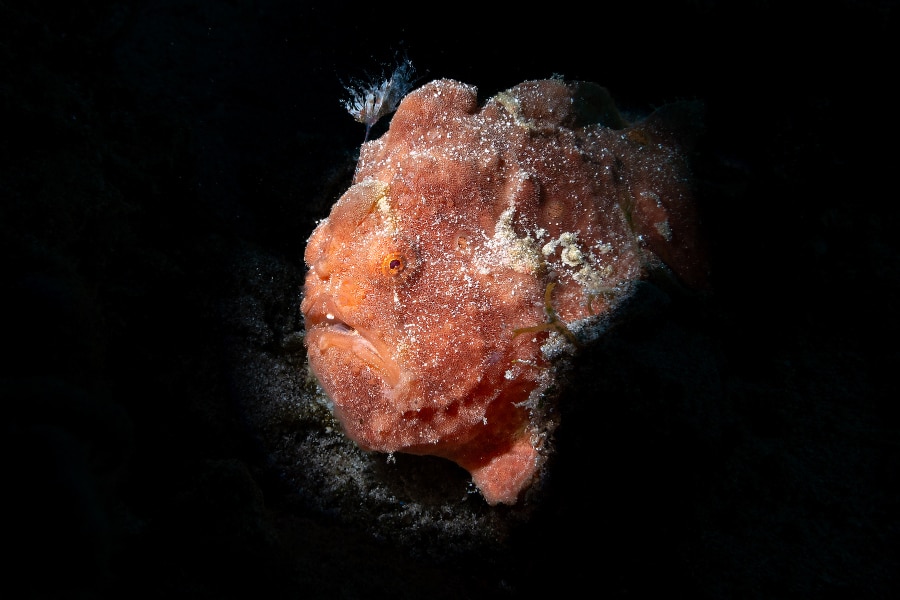
Frogfish are one of the major attractions at Teluk Nare.
The structures around the pier can harbour several different frogfish species and colour morphs, including painted frogfish, warty frogfish, hairy frogfish and giant frogfish.
Their camouflage makes them challenging to spot, which is part of the fun. Don’t simply look for the shape of a fish. Look for anything that seems slightly out of place—a sponge that appears to have a face, an unusual lump on a piling or a movement that shouldn’t be there.
A good guide can make a huge difference here.
Once you’ve found one frogfish, take your time. There is often no need to swim far before another interesting subject appears.
Ghost Pipefish and Nudibranchs
The growth on the pier also provides habitat for ghost pipefish, which can often be seen hovering around crinoids in their characteristic head-down position.
Nudibranchs are another highlight, with different species moving slowly across the sponge and coral-covered structures.
For macro photographers, this combination makes Teluk Nare particularly rewarding. The subjects are concentrated into a relatively small area, allowing you to spend a long time photographing without needing to cover large distances.
Why Boat Traffic Matters
This is an important difference between the Teluk Nare of the past and the site today.
The harbour is now a major speedboat hub, with constant boat movements between Lombok and the Gili Islands. Boat traffic can be severe, particularly around the central jetty.
For this reason, we consider it safer to dive towards the eastern or western ends of the bay rather than directly underneath the main jetty.
The traditional image of diving directly beneath a small wooden pier no longer reflects the reality of the site. The harbour is busy, and divers need to be particularly aware of boat movements.
Always follow your local dive guide’s instructions about where to enter, where to remain underwater and where it is safe to surface.
The marine life is worth seeing—but it isn’t worth taking unnecessary risks.
Rubbish and Unexpected Habitats
There is another, less attractive feature of Teluk Nare: rubbish is abundant around the site.
Old tyres, glass bottles and other discarded objects can be found among the sand and rubble. This is obviously not something we want to see in the ocean, and the rubbish itself should never be considered a positive part of the reef.
At the same time, after spending years underwater, some of these objects have become shelters for marine life.
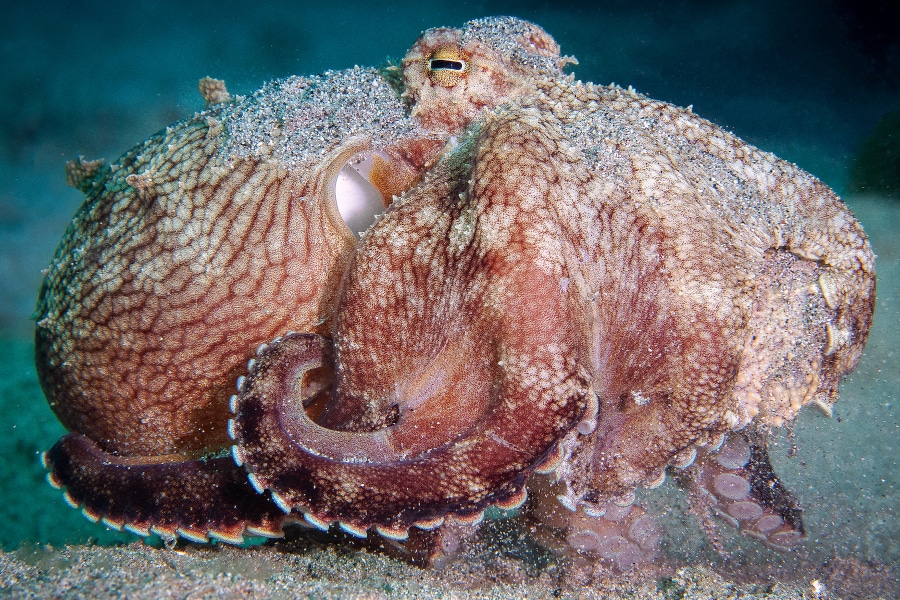
A car tyre can provide a hiding place for a critter, while an old glass bottle can become a home for an octopus. Other discarded objects become covered in sponges, hydroids and small corals and eventually form part of the habitat around the pier.
For a muck diver, this creates a strange underwater landscape where natural rubble, artificial structures and human debris all become places worth looking closely at.
That doesn’t mean we should move, add or deliberately leave anything behind. We simply observe the marine life that has already made use of what is there.
And at Teluk Nare, you quickly learn that even something as ordinary as an old tyre or bottle can be worth a second look.
A Shallow Site with Plenty of Time
Teluk Nare is relatively shallow, generally around 4–18 metres, and is often protected from strong currents.
This makes it particularly suitable for macro photography because you can spend a long time examining a single structure or subject without being pushed along by a strong drift.
Visibility can vary, however. The nearby river mouth brings sediment into the bay, and visibility is often around 8–15 metres, depending on conditions.
For macro photography, this is rarely a major problem. In fact, slightly reduced visibility can matter much less when your subject is only a few centimetres from the camera.
Dive for the critters, but respect the boats.