
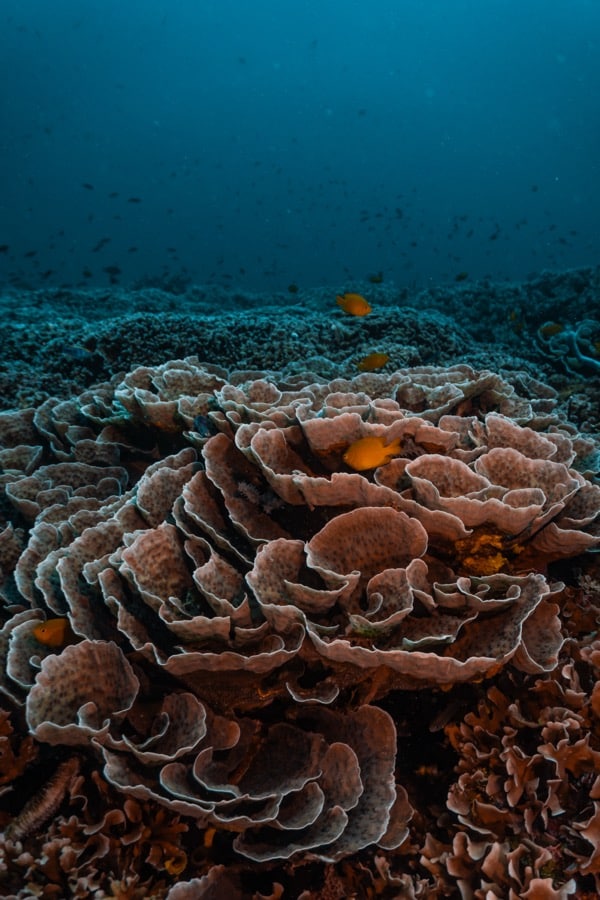
Most people remember the first healthy coral reef they ever saw.
The colors. The movement. The feeling that the entire reef is alive beneath you.
Then sometimes, only one dive later, you see another reef that looks completely different. Broken coral. Bleached patches. Plastic caught between reef structures.
And suddenly you realize how fragile these ecosystems really are.
Coral reefs are some of the most important ecosystems on Earth. They support marine life, protect coastlines, and provide food and income for millions of people. But they are also under enormous pressure worldwide.
Including here in the Gili Islands.
At Divine Divers Gili Meno, reef protection is something we think about every single day. Because living and diving around coral reefs makes it impossible not to notice how much they are changing.
Climate Change and Coral Bleaching
The biggest threat to coral reefs globally is rising ocean temperature.
Corals are extremely sensitive to heat. When water temperatures stay too warm for too long, corals become stressed and expel the algae that help keep them alive. This process is called coral bleaching.
The reef turns pale white and loses much of its energy source.
Sometimes reefs recover. Sometimes they do not.
Mass bleaching events have already affected reefs across Indonesia, including parts of the reefs surrounding the Gilis.
And honestly, this is the difficult part: individual travelers alone cannot solve climate change.
But that does not mean small actions are meaningless.
Plastic Pollution
Plastic is probably the most visible reef problem people notice immediately.
Plastic bags, fishing line, bottles, food packaging — all of it eventually finds its way into the ocean. Once there, it damages reefs, harms marine animals, and slowly breaks down into microplastics that become almost impossible to remove completely.
The Gili Islands have worked hard in recent years to reduce plastic waste, but like many tropical islands, waste management remains a challenge.
Ocean currents also bring trash from far beyond the islands themselves.
One thing many visitors notice is that conditions can change quickly. Some days the beaches look pristine. Other days, especially during certain currents or weather patterns, more debris washes ashore.
Poor Diving and Snorkeling Practices
Sometimes reef damage happens simply because people do not realize how fragile coral actually is.
Standing on coral. Touching marine life. Poor buoyancy while diving. Anchors dropped onto reefs. Feeding fish for photos.
Small actions repeated thousands of times create major damage over time.
This is especially important in busy marine tourism destinations like the Gilis, where reefs are visited daily by divers and snorkelers from around the world.
At Divine Divers Gili Meno, buoyancy control and responsible diving are heavily emphasized because protecting reefs starts underwater with diver behavior.
Sunscreen and Chemicals
Many people are surprised to learn that certain sunscreens can damage coral reefs.
Some chemical ingredients contribute to coral stress and reef degradation, especially in shallow tropical areas with heavy tourism.
That is why reef-safe sunscreen is becoming increasingly important in places like the Gilis.
And honestly, small changes like this really do matter when enough people make them consistently.
What Can We Actually Do?
This is the important part.
People often feel overwhelmed when talking about environmental problems. But reef protection does not only happen through giant global projects. It also happens through thousands of small decisions made every day.
Simple things help:
- Use reef-safe sunscreen
- Avoid single-use plastics
- Never touch coral or turtles
- Improve buoyancy while diving
- Choose environmentally responsible dive centers
- Refill water bottles instead of buying plastic ones
- Support local conservation projects
None of these actions alone will “save the reef.”
But together, they genuinely reduce pressure on fragile ecosystems.
Why Healthy Reefs Matter So Much
The reefs around the Gili Islands are the reason many people fall in love with this place in the first place.
Turtles. Reef fish. Coral gardens. Clear tropical water.
Without healthy reefs, much of that disappears.
And honestly, once you have floated above a beautiful reef while turtles swim past you in warm blue water, protecting the ocean stops feeling like an abstract environmental issue.
It starts feeling personal.