

Sharks are often described as dangerous predators, but underwater they are part of something much more important: a complex food web that keeps marine ecosystems functioning.
Around the Gili Islands, seeing a whitetip reef shark sleeping under a coral block or a blacktip reef shark cruising along the reef is not just an exciting dive encounter. Sharks are part of the natural balance of the ecosystem.
They influence which animals are abundant, where prey feed and how different parts of the food web interact. In turn, those relationships can affect the health and resilience of coral reefs.
The connection isn’t always as simple as “more sharks = more coral.” Different shark species play different roles, and their effects depend on the rest of the ecosystem. But removing important predators can alter food webs in ways that eventually affect the reef itself.
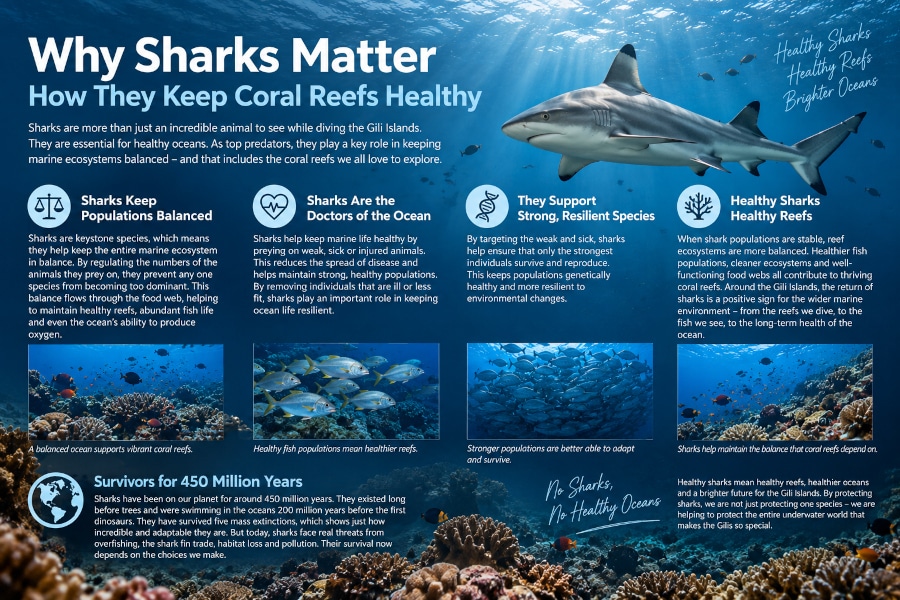
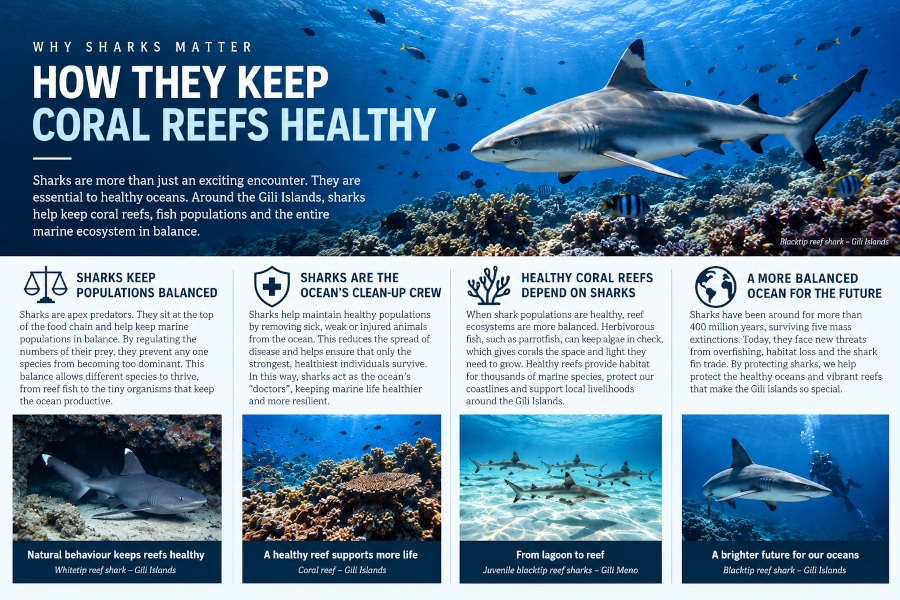
Sharks Help Keep Marine Populations in Balance
Sharks are predators, and that is exactly why they are important.
A healthy reef needs a balance between predators, smaller predatory fish, herbivores and the organisms growing on the reef. If one part of that system becomes unusually abundant, it can put pressure on everything below it.
Sharks help regulate populations of the animals they prey upon. Their presence creates natural pressure within the food web and can prevent particular species from becoming disproportionately abundant.
Scientists call these effects trophic interactions. Changes at the top of a food web can sometimes create a chain of effects further down the system. Research on coral reef ecosystems has shown that top predators can influence reef fish communities through these indirect effects.
That is why a reef is not simply a collection of individual species.
Everything is connected.
Sharks Can Help Keep Prey Populations Healthy
Predators don’t necessarily catch animals at random.
A sick, injured or weakened animal can be easier to catch than a healthy one. Sharks are therefore capable of removing individuals that are already compromised, although this should not be exaggerated into the idea that sharks deliberately “clean” the ocean.
Their role as predators and scavengers can nevertheless contribute to healthy population dynamics.
Removing sick or dead animals is also part of the natural recycling process of the ocean. Predators help move energy through the food web rather than allowing dead animals and nutrients to simply accumulate in one place.
This is one reason sharks are sometimes described as the “doctors of the ocean.”
It is a useful nickname, as long as we remember that sharks are not literally diagnosing disease or deliberately selecting only unhealthy animals.
Sharks and the Coral Reef Food Web
So what does all of this have to do with coral and a healthy coral reef?
Quite a lot.
Coral reefs depend heavily on herbivorous fish such as parrotfish, surgeonfish and other grazers. These animals eat algae growing on the reef.
That grazing is essential because fast-growing algae can compete with corals for space and light. When herbivores keep algae under control, corals have a better chance to grow and establish themselves.
Sharks are part of the larger food web surrounding these herbivores.
If removing predators changes the abundance or behaviour of other predators, that can affect herbivorous fish further down the food chain. In some ecosystems, this can create a trophic cascade: a change at the top eventually produces changes much further down.
It is not as simple as saying that every shark directly protects coral.
Instead, sharks are one part of the network of relationships that allows a reef ecosystem to function.
Healthy Sharks, Healthy Fish, Healthy Reefs
Imagine a coral reef as a huge underwater balancing act.
You have:
Sharks → Predatory Fish → Smaller Fish → Herbivores → Algae → Coral
This isn’t a single straight food chain. Real reefs are far more complicated, with hundreds of overlapping relationships.
But the principle is important.
Take away predators and the balance can change. Take away herbivores and algae can become harder to control. Lose healthy coral and the reef loses the three-dimensional habitat that provides shelter and food for countless other species.
A healthy reef therefore needs more than just healthy coral.
It needs the entire community.
Sharks Are Part of a Healthy Reef, Not the Enemy of It
There is a common misconception that having lots of predators must mean having fewer fish.
A healthy ecosystem doesn’t work that way.
Predators are part of the reason healthy populations can exist in the first place. They influence prey numbers, behaviour and distribution, helping prevent the food web from becoming dominated by a small number of species.
This balance is particularly important on coral reefs, where many different species compete for limited space and resources.
Large predators are also part of what makes a natural reef feel like a natural reef.
A reef without predators may still contain coral and colourful fish, but it can be a very different ecosystem.
Sharks Have Been Here for Hundreds of Millions of Years
Sharks are remarkably ancient animals.
The earliest shark-like animals appeared more than 400 million years ago, long before dinosaurs and even before trees evolved. Sharks survived multiple mass extinctions and adapted to enormous changes in the planet’s oceans.
Yet surviving for hundreds of millions of years doesn’t make sharks immune to modern threats.
Today, fishing pressure, habitat degradation, pollution and climate change are putting many shark species under serious pressure.
The difference is that these changes are happening incredibly quickly compared with the timescale over which sharks evolved.
What Happens When Sharks Disappear?
Removing sharks doesn’t necessarily cause one dramatic event that is immediately visible.
The changes can happen gradually.
Fewer sharks can mean changes in predator populations. Those changes can affect smaller fish. Changes in herbivore populations can alter the amount of algae on the reef. Changes in algae can affect coral growth and recruitment.
Not every reef will respond in exactly the same way. Ecosystems are complicated, and scientists continue to study how different shark species affect different habitats.
But one thing is clear: removing predators changes ecosystems.
Research from healthy coral reef systems has shown that large predators such as sharks are important components of complex food webs, while long-term monitoring shows that depleted populations of sharks and large herbivores can be a concern for ecosystem resilience.
Protecting Sharks Protects More Than Sharks
This is why shark conservation isn’t only about saving an animal that divers enjoy seeing.
When we protect sharks, we are protecting part of the system that supports the reef itself.
That means protecting:
- healthy predator populations
- reef fish communities
- herbivorous fish
- coral reefs
- seagrass and coastal habitats
- the wider marine food web
And ultimately, it means protecting the habitat on which so many other Gili Islands species depend.
What Can Divers Do?
You don’t need to be a marine biologist to help protect sharks.
As a diver or snorkeller, some of the simplest things you can do are:
- Never feed or chase sharks.
- Give resting sharks plenty of space.
- Support responsible dive operators and marine conservation projects.
- Don’t buy products made from shark fins or other shark parts.
- Reduce your impact on coral reefs.
- Support protected marine areas and local conservation efforts.
- Share accurate information about sharks rather than repeating scary myths about them.
The more people understand what sharks actually do, the easier it becomes to see them as an important part of the reef rather than something to fear.
Why Seeing Sharks in the Gili Islands Matters
Every time we see a whitetip resting in the sand or a blacktip cruising along the reef, we are seeing a small part of a much bigger system.
The shark depends on the reef.
Coral reefs depends on its fish.
The fish depend on the reef.
And all of it is connected.
That is why the return of sharks to the Gili Islands is worth celebrating.
Healthy shark populations don’t guarantee healthy coral reefs on their own. But healthy reefs need functioning food webs, and sharks are an important part of those webs.
The next time you see a shark on a Gili Islands dive, don’t just think about how exciting the encounter is.
Think about what that shark represents.
A living, functioning ocean.