


Coral reefs are home to an incredible diversity of fish. From tiny, colourful damselfish hiding among branching corals to large groupers cruising over the reef, every dive or snorkel trip offers an opportunity to discover something new.
But with hundreds of different species, identifying reef fish underwater can seem overwhelming. The good news is that you don’t need to memorise hundreds of names to get started. By learning to recognise a few key physical characteristics and behaviours, you can gradually narrow down your options and become a much better fish spotter.
The secret is to look beyond the colours. Body shape, mouth structure, fins, markings and swimming behaviour can all provide valuable clues.
Here are eight things to look for when identifying coral reef fish.
1. Start with the body shape
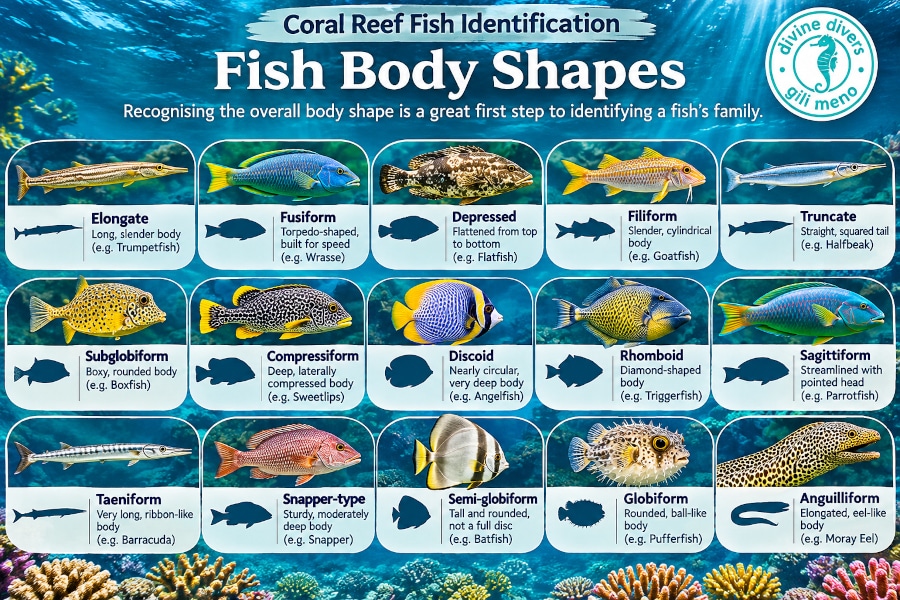
One of the easiest ways to identify a fish is by looking at its overall silhouette. Fish belonging to the same family often share similar body shapes, making this an excellent starting point.
Some common examples include:
Oval and laterally flattened: Surgeonfish, butterflyfish and angelfish.
Long and slender: Trumpetfish and many needlefish.
Diamond-shaped or angular: Triggerfish.
Short and stocky: Some groupers and pufferfish.
Flat and disc-shaped: Some batfish and other reef species.
Take a moment to observe the fish from the side. Is it long and narrow, deep and compressed, round or angular?
Even if you cannot identify the exact species, recognising its general body shape can help you narrow down the family.
2. Look at the mouth: What does it eat?
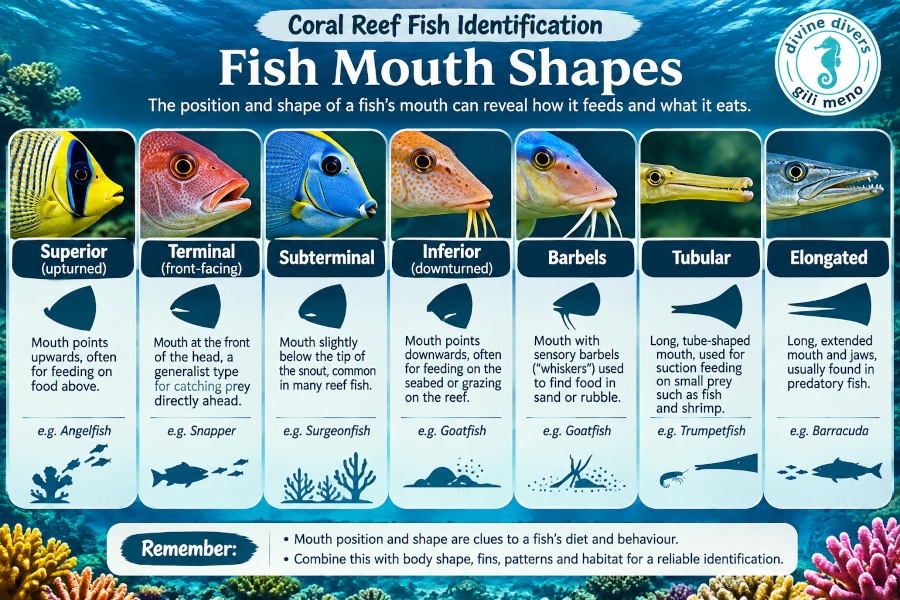
A fish’s mouth is more than just a feeding tool. Its position and shape can reveal a lot about its diet and ecological role.
Upturned mouths often indicate fish that feed on prey above them. Some ambush predators use this mouth position to catch animals swimming overhead.
Downward-facing mouths are commonly found in fish that feed close to the seabed or graze on algae growing on rocks and coral surfaces.
Forward-facing mouths are adapted for catching prey directly in front of the fish or picking food from the reef.
The shape of the mouth is equally important:
Beak-like mouths: Parrotfish have fused teeth that form a strong beak used to scrape algae from hard surfaces.
Small, pointed mouths: Often found in fish that pick tiny prey from the reef.
Large mouths: Common in predators that swallow relatively large prey.
Protruding mouths: Some species can extend their mouths forward to capture food.
Looking at the mouth can help you understand not only what a fish is, but also how it interacts with its environment.
3. Study the fins and tail
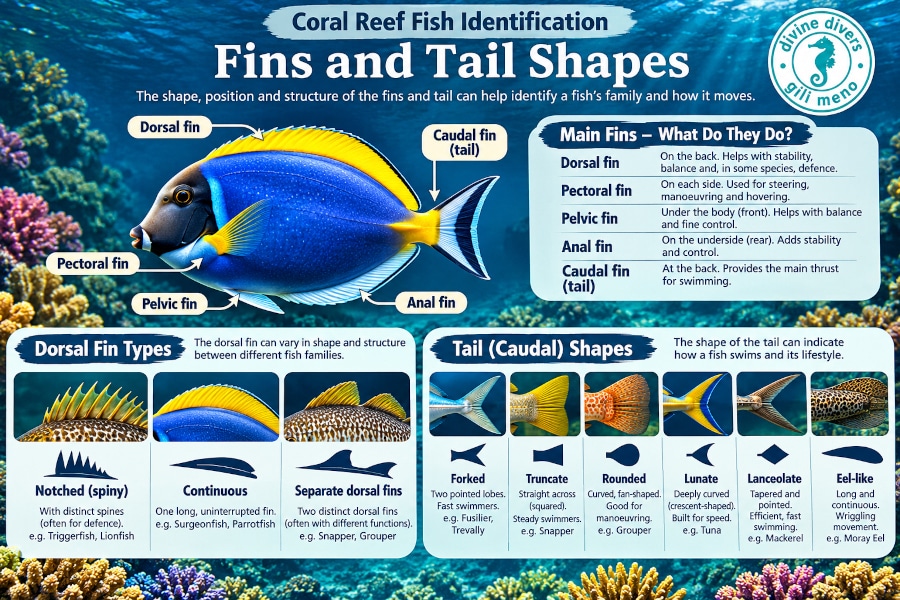
Fins are another important identification feature. Their shape, position and movement can help distinguish between fish families.
The dorsal fin runs along the back of the fish. It may be one continuous fin, divided into sections or equipped with prominent spines.
The caudal fin, or tail, comes in several distinctive shapes:
Deeply forked tails are common in many fast-swimming fish.
Rounded tails are found in fish that manoeuvre around complex reef environments.
Square or truncate tails appear in several reef fish families.
Paddle-shaped tails are found in fish with different swimming adaptations.
The pectoral fins, located on either side of the body, and the anal fin underneath the fish near the tail are also worth observing.
Once you start recognising these differences, you will notice that fish from different families often have very distinctive fin structures.
4. Look beyond the colours: Patterns and markings
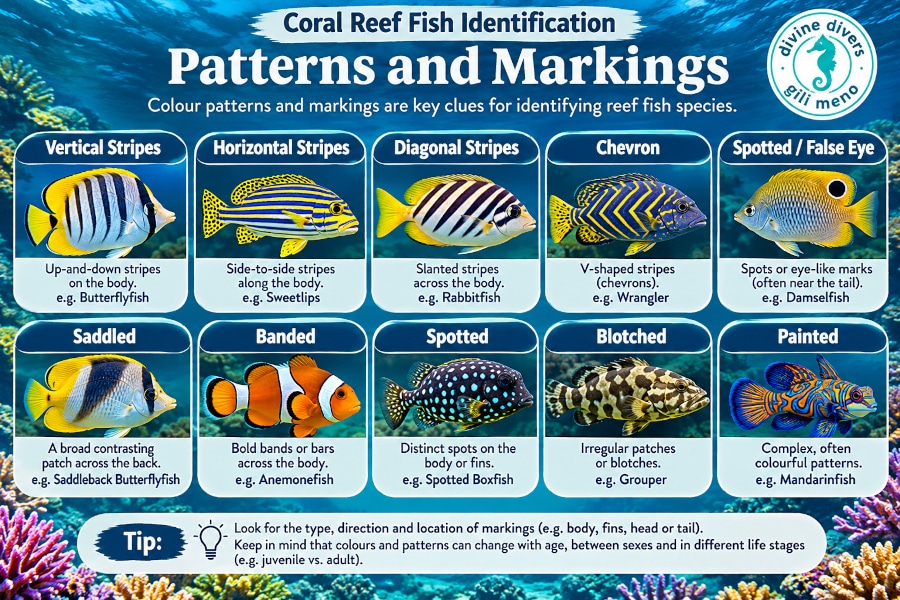
Colour is often the first thing we notice underwater, but patterns can be much more useful for identifying individual species.
Look carefully for:
Vertical or horizontal stripes.
Spots on the body or fins.
Bands across the face or eyes.
Contrasting colours around the tail.
Distinctive markings on the dorsal fin.
Dots, lines or geometric patterns.
Pay attention to where these markings appear. A spot near the tail or a stripe running through the eye can sometimes be the key to distinguishing between two very similar species.
Remember that colour can also be misleading. Many reef fish change appearance as they grow, and juveniles can look completely different from adults. Some species also have different colour phases, while lighting and depth can influence how their colours appear underwater.
5. Watch how the fish swims
Swimming behaviour provides another valuable identification clue.
Different fish use their fins and bodies in different ways:
Triggerfish can propel themselves using wave-like movements of their dorsal and anal fins.
Parrotfish use their pectoral fins to help manoeuvre around the reef, with their tails contributing to propulsion.
Trevallies are powerful swimmers that often move through open water.
Groupers frequently use short bursts of movement when hunting or moving between reef structures.
Notice whether the fish glides, hovers, moves in short bursts or constantly searches the reef for food.
Even from a distance, swimming style can help you narrow down the possibilities.
6. Consider the fish’s size and habitat
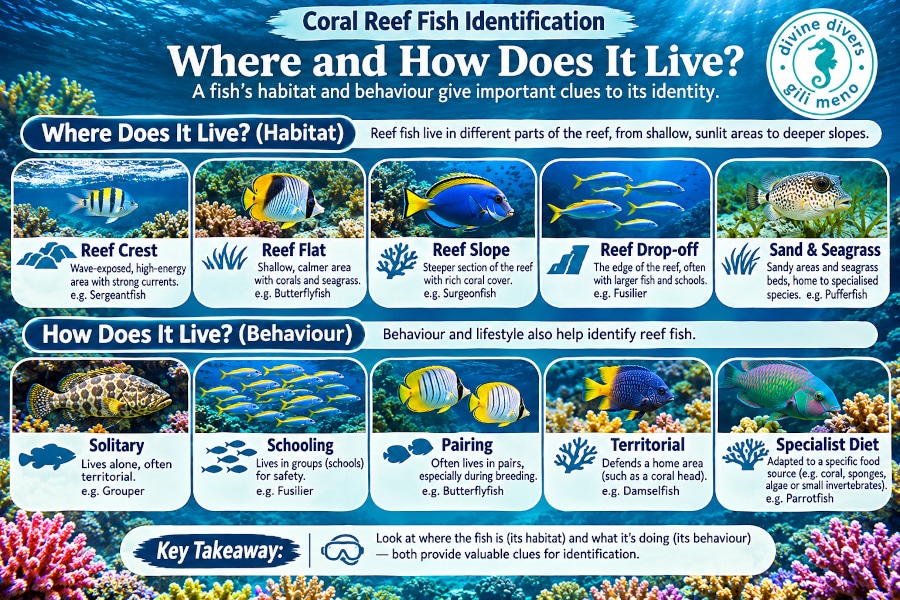
Size and location are useful additional clues when identifying reef fish.
Damselfish, for example, are generally small and often stay close to their territories among branching corals or rocky crevices. Trevallies can grow much larger and are often seen swimming through open water.
Habitat is equally important:
Some fish shelter among branching corals.
Others hide in crevices and rocky ledges.
Certain species rest on sandy bottoms.
Some graze directly on the reef.
Others spend much of their time swimming above the reef.
Also consider whether the fish is alone or in a school, defending a territory, hunting or feeding.
Size and habitat cannot confirm an identification on their own, but when combined with physical characteristics, they can make a big difference.
7. Take a photograph and use a fish identification guide
Even experienced divers cannot identify every fish they encounter. Coral reefs contain an enormous variety of species, and some look remarkably similar.
If possible, take a photograph showing the entire fish from the side, including its fins and tail.
Make a note of:
Approximate size.
Depth.
Location and habitat.
Swimming behaviour.
Distinctive markings.
Once you are back on the boat or on shore, compare your photograph with a reliable regional fish identification guide.
For diving around Indonesia, an Indo-Pacific field guide will generally be more useful than one focused on Caribbean reef species.
Automated fish identification tools can also suggest possibilities, but always compare several physical characteristics before settling on a species.
And don’t worry if you cannot identify every fish straight away. Sometimes getting the family right is already a great achievement.
8. Keep practising: The more you dive, the more you notice
Fish identification is a skill that develops with observation and experience.
At first, you might recognise only a handful of familiar species. Gradually, you will begin noticing differences in body shape, mouth structure, fin arrangements and markings that you previously overlooked.
Most importantly, remember that fish identification is about more than learning names. Understanding how fish feed, move and interact with their surroundings gives you a much deeper appreciation of the reef ecosystem.
So, on your next dive or snorkelling trip, take a little extra time to look closely. You might be surprised by how much you can discover just by looking a little differently.
Happy fish spotting!