

Part of our Gili Marine Life Guide | Diving with Divine Divers Gili Meno
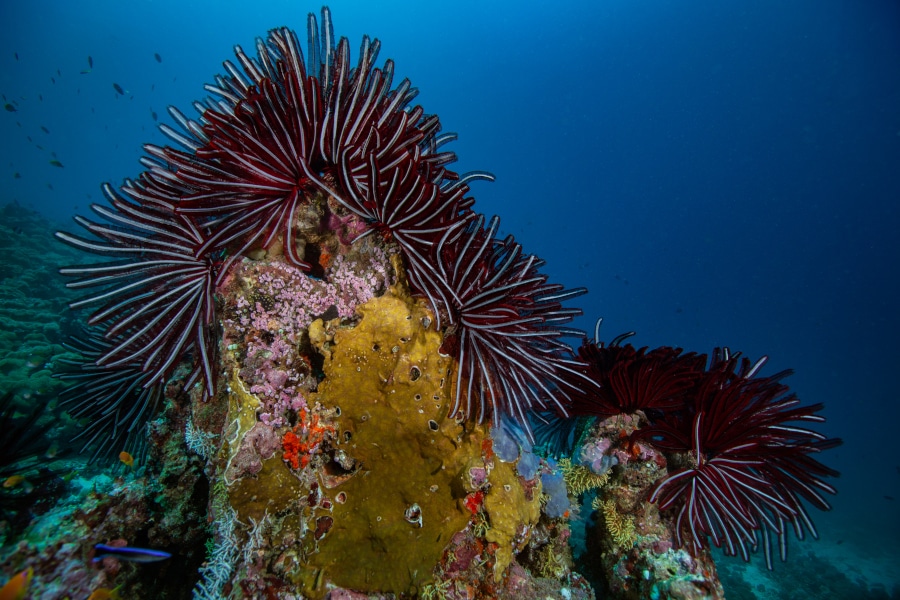
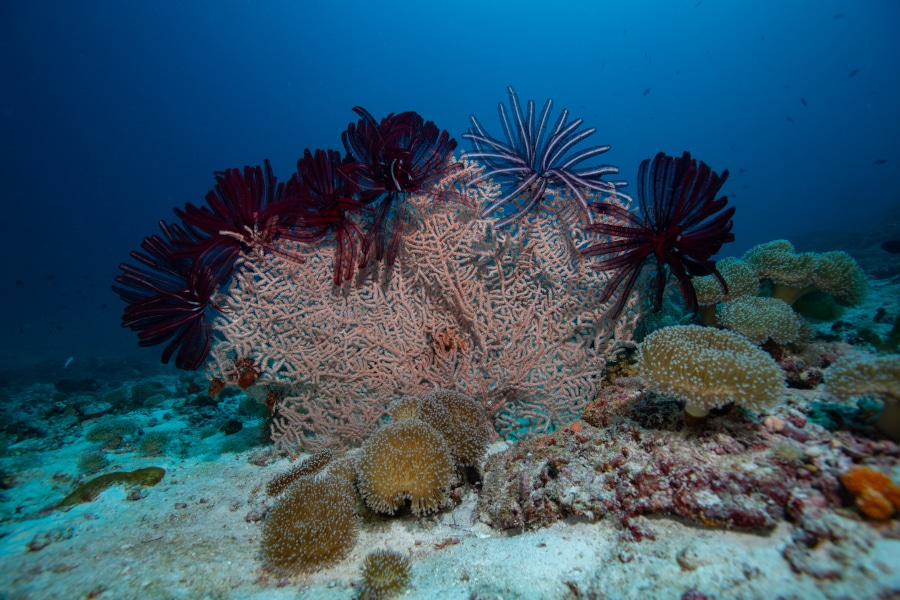
Perched on the highest point of an exposed coral bommie, an intricate bouquet of feathery plumes sways gently against the passing current. Colored in brilliant shades of crimson, gold, jet black, and neon yellow, it looks more like an exotic tropical flower than an animal.
Yet, watch it closely as twilight falls over the reef, and you might see something astonishing: the entire structure unhooks its grip from the rock, lifts into open water, and swims with rhythmic, mesmerizing grace.
These are feather stars—known scientifically as unstalked crinoids. They are living fossils whose lineage stretches back almost half a billion years, surviving five mass extinctions to become one of the most hypnotic sights across the Gili Islands.
Older Than Dinosaurs: The Story of Crinoids
Feather stars belong to the phylum Echinodermata, making them close cousins to sea stars, brittle stars, sea urchins, and sea cucumbers.
Their evolutionary roots run deep. Crinoids first appeared in prehistoric oceans roughly 480 million years ago during the Ordovician period. Throughout the Paleozoic era, vast underwater forests of “sea lilies”—crinoids anchored permanently to the seabed by long stalks—dominated the ocean floor. Their petrified stem segments are among the most abundant fossils found in limestone beds around the world.
While most stalked sea lilies died out or retreated into the abyssal deep sea, one branch evolved a game-changing adaptation: they ditched the permanent stalk. These unstalked modern crinoids—the feather stars—developed claw-like grasping feet called cirri, giving them the freedom to walk, reposition, and even swim across shallow tropical reefs.
How They Feed: Trapping Plankton on the Breeze
Feather stars are passive suspension filter-feeders, relying entirely on ocean currents to bring food to their doorsteps.
Their bodies are engineered like living radar dishes:
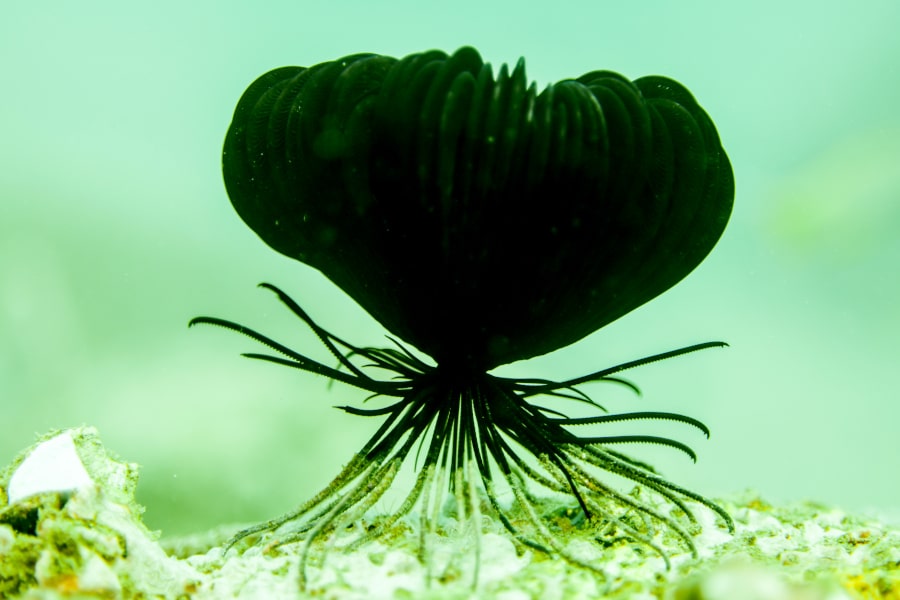
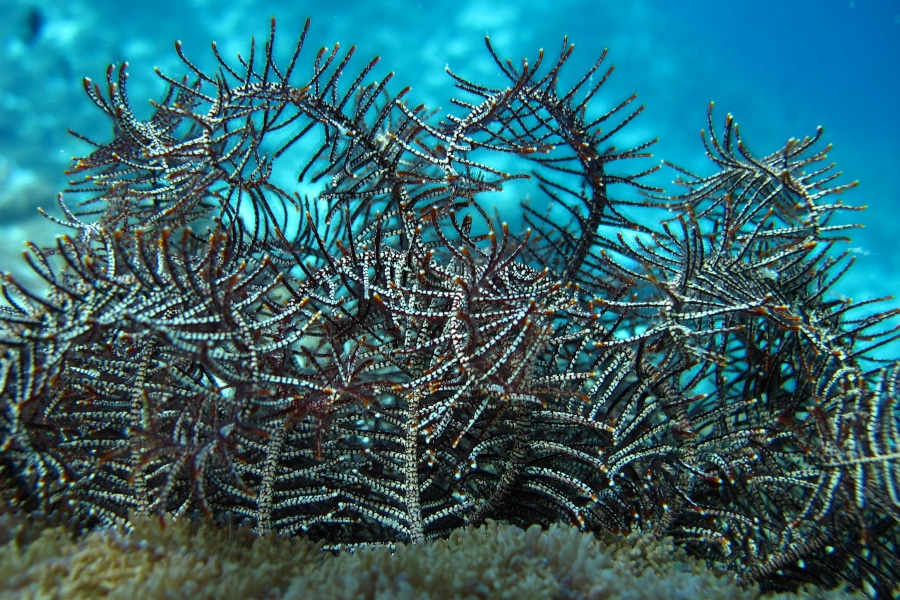
Pinnules and Tube Feet: Each feathery arm is lined with rows of tiny side branches called pinnules. These pinnules are covered in microscopic, mucus-coated tube feet arranged in groups of three.
The Living Conveyor Belt: As plankton and organic detritus drift through the plumes, the sticky tube feet snap inward to trap food particles.
Ciliated Food Grooves: Once trapped, the food is rolled into tiny mucus-coated balls and transferred into deep grooves running down the center of each arm. Microscopic beating hairs (cilia) line these grooves, acting like a continuous conveyor belt that drives the food straight into the mouth located at the center of the disc.
Because their mouths and anuses sit on the same side of their disc-shaped bodies, they have a U-shaped digestive tract, allowing waste to be expelled cleanly upward into the current away from their feeding arms.
Fascinating Facts About Feather Stars
They Can Actually Swim: While feather stars spend most of their time anchored to gorgonian sea fans, sponges, or coral outcrops, they are far from sessile. If a predatory fish or a stinging neighbor bothers them, they release their clawed cirri and swim by undulating their arms in alternating, hypnotic waves.
Rapid Limb Regeneration: Just like sea stars, feather stars possess incredible regenerative powers. If a hungry triggerfish bites off several arms, the crinoid can regrow complete, fully functional appendages in a matter of weeks.
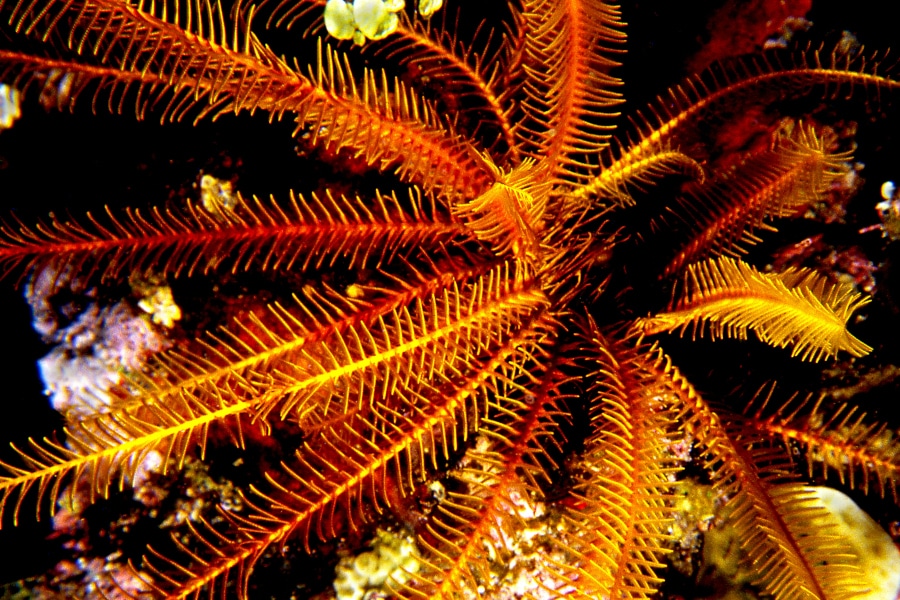
Dozens of Arms from Just Five: Though they maintain the classic five-fold symmetry of echinoderms, their initial five arms repeatedly split near the base, allowing mature feather stars to boast anywhere from 10 to over 200 individual arms.
Night Shift Performers: While many crinoids stay tucked under ledges during the bright glare of midday, they emerge en masse during dusk and night dives. As currents pick up, dozens of feather stars will climb to the highest perches on the reef to catch the nocturnal bloom of plankton.
Bustling Micro-Hotels: The Crinoid Commensal Community
For macro enthusiasts and underwater photographers, a feather star is never just a single animal—it is an entire apartment complex.
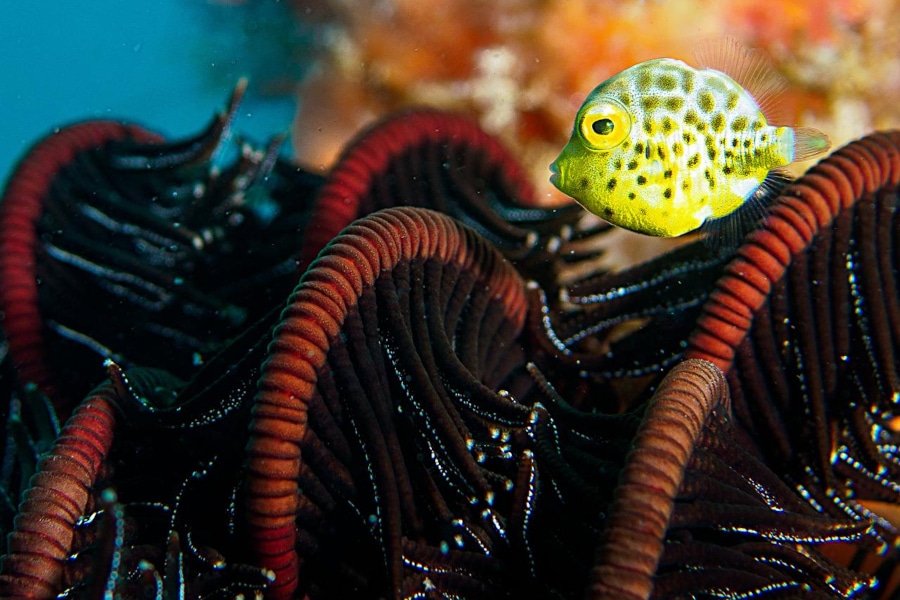
Because crinoids are armed with bitter chemicals and spiny skeletal plates, few predators eat them. Tiny marine creatures exploit this safety by living symbiotically among their arms, often evolving flawless mimicry:
Crinoid Clingfish: Tiny, slender fish that adopt the exact color, stripes, and pattern of their host feather star.
Crinoid Squat Lobsters: Brilliant, striped squat lobsters with flattened bodies and needle-thin claws that hide deep in the central disc.
Crinoid Commensal Shrimp: Nearly invisible shrimp that feed on mucus and excess plankton while blending seamlessly against the pinnules.
Next time you spot a vibrant feather star, shine a gentle dive light near the base of its arms. Look carefully, and you will almost certainly spot tiny eyes watching you from between the feathers.
Diver Etiquette: Admiring Feather Stars Safely
Look, Don’t Touch: Feather star arms are lined with thousands of microscopic hooks. If you brush against one with a wetsuit or glove, the arms will stick to your gear like Velcro, causing the animal to break off its fragile limbs in distress.
Maintain Perfect Buoyancy: Crinoids frequently choose narrow drop-offs and exposed pinnacles. Make sure your fins are well clear of the reef wall when hovering to search for crinoid shrimp.
Avoid Blinding Them with Lights: During night dives, avoid holding powerful video lights on a single crinoid for too long, as intense heat and bright beams can cause them to curl their arms shut.
Explore the Ancient Wonders of the Gilis with Divine Divers
From 480-million-year-old living fossils to cruising green turtles and stealthy reef sharks, every dive around Gili Meno connects you to the rich history of the ocean.
Whether you’re looking to slow down and discover hidden macro critters or glide along exhilarating drift walls, our experienced, small-group dive guides are here to give you an unforgettable island adventure.