

The Gili Islands are famous for their sea turtles. On almost any dive or snorkel trip, there is a good chance of encountering one.
Two species are commonly seen around the islands: green turtles and hawksbill turtles. They may look similar at first, but once you know what to look for, the differences are easy to spot.
Their appearance is only part of the story. Green and hawksbill turtles also behave differently, eat different foods and use the reef in different ways.
And there is something particularly special about the turtles around the Gilis: many are remarkably calm around divers and snorkellers.
Green vs Hawksbill Turtles: How Can You Tell Them Apart?
The easiest way to tell the two species apart is to look at the head, beak and shell.
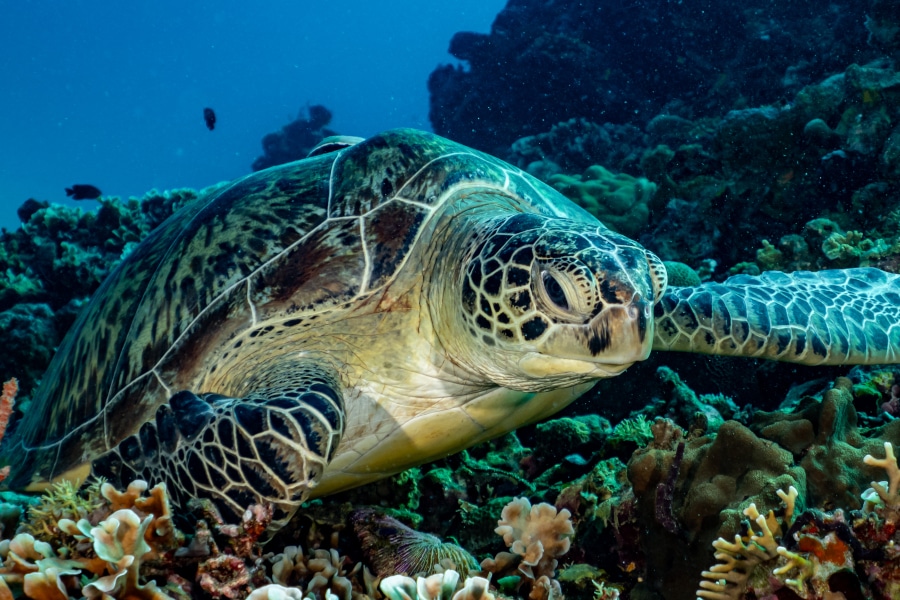
Green turtles usually have a rounded head and a smooth, relatively blunt face. Their shells are generally broad and rounded, with colours ranging from olive and brown to darker patterns.
Despite their name, the shell itself isn’t green. The name comes from the greenish colour of their body fat.
Green turtles are also generally larger than hawksbills. Around the Gili Islands, you will often see them slowly grazing along the reef or resting on the seabed.
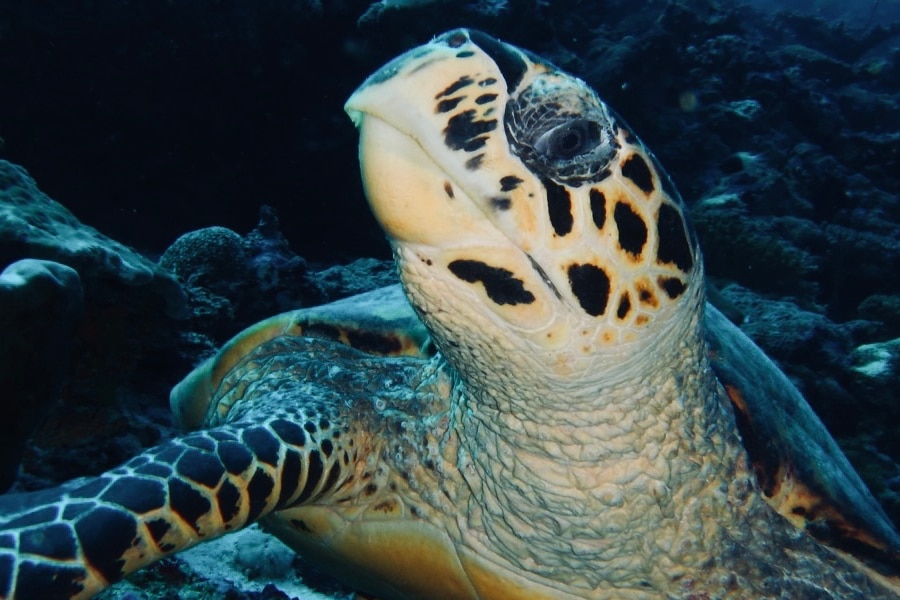
Hawksbill turtles are smaller and more distinctive. Their most obvious feature is their long, pointed, hawk-like beak. Also, their shell is usually more strongly patterned, with overlapping scutes that give it a slightly serrated appearance.
Their diet is different too. Hawksbills are closely associated with coral reefs and feed heavily on sponges, along with other reef organisms.
A simple rule underwater:
- Rounder head and blunt mouth = green turtle
- Pointed, hooked beak = hawksbill
- Large and broad = usually green
- Smaller and more slender = usually hawksbill
Green Turtles Around the Gili Islands
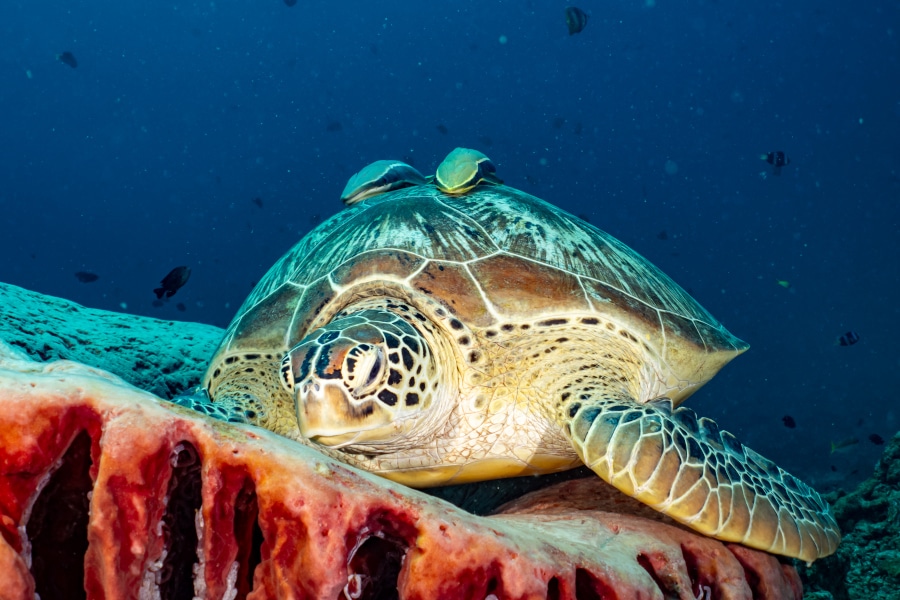
Green turtles are the turtles you are most likely to encounter around the Gili Islands.
While they feed around the reefs and seagrass areas, most of the turtles you encounter while diving are resting or sleeping. You may find one tucked beneath a coral overhang, resting on the seabed or sitting quietly on the reef.
Green turtles are generally very relaxed around divers. They are used to people passing by and often remain completely still while you observe them.
There is no need to chase them or get too close. Simply give them space and enjoy watching one of the Gilis’ most famous residents.
Hawksbill Turtles Around the Gili Islands
Hawksbills are less common than green turtles, but they are one of the most interesting encounters you can have.
Their pointed beak is perfectly adapted to picking food from the reef. They often move around coral formations, investigating cracks and holes where sponges and other organisms grow.
Compared with green turtles, hawksbills can appear more active and agile around the reef.
They are also critically endangered globally, largely because of historical hunting for their shell, as well as habitat loss, fishing impacts and other human pressures.
How Do Turtles Sleep Underwater?
One of the most surprising things about sea turtles is how long they can stay underwater.
When resting or sleeping, turtles can hold their breath for several hours. During normal activity, however, they generally spend much less time underwater before returning to the surface to breathe.
How Can You Tell a Male Turtle From a Female?
This is one of the easiest ways to identify the sex of an adult turtle underwater — if you can get a good view of its tail.
Adult male turtles have a much longer, thicker tail that extends well beyond the edge of the shell.
Females have a shorter tail, which usually doesn’t extend far beyond the shell.
There is one important limitation: this is most useful with sexually mature turtles. Young turtles are much harder to sex visually because they have not yet developed the obvious differences between males and females.
So if you see a large turtle with a very long tail, you may well be looking at a male.
Why Are the Turtles Around the Gilis So Tame?
There is a fascinating local reason why many Gili Islands turtles seem so comfortable around people.
The turtles around the Gilis were never traditionally hunted in the way they were in many other parts of the world.
As a result, generations of turtles have grown up without the same level of fear of humans. This helps explain why a turtle may continue feeding while a diver approaches, or calmly rest while snorkellers pass nearby.
But tame does not mean tame enough to touch.
A turtle that doesn’t swim away is not necessarily inviting interaction. It is simply tolerating your presence.
That makes responsible behaviour especially important.
Can I Touch a Turtle?
No. You should never touch a wild turtle.
It can be tempting when a turtle is sitting quietly on the reef, particularly when it doesn’t seem bothered by divers.
But touching can disturb its natural behaviour and cause unnecessary stress. It can also damage sensitive parts of the animal, including the eyes and shell.
Don’t chase it. Don’t swim directly over it. Don’t block its route to the surface. And if it changes direction or starts swimming away, give it space.
We have a separate guide explaining exactly [Can I Touch This Turtle?] and why touching wildlife is a problem.
Why Are There So Many Turtles in the Gili Islands?
The unusually high number of turtles around the Gilis is not simply luck.
The islands provide suitable feeding and resting habitat, while decades of protection and the absence of historical hunting have helped create a remarkable resident population.
We’ve written a separate article explaining [The Secret Behind Gili Meno’s Incredible Turtle Population], including why turtles have become such a common sight around the island.
Threats Facing Sea Turtles
Seeing turtles regularly around the Gili Islands can make it easy to forget how vulnerable these animals are elsewhere.
Sea turtles face a range of threats, and several are particularly relevant to turtles living around busy tropical islands.
Ghost Nets and Fishing Gear
Discarded fishing nets are one of the most frightening dangers.
A turtle that becomes trapped in a ghost net may be unable to reach the surface to breathe. Even though a healthy turtle can hold its breath for a long time, stress and struggling dramatically increase oxygen consumption. A trapped turtle can therefore drown much faster than you might expect.
Fishing lines, hooks and other discarded gear can cause similar problems.
Hunting
Sea turtles have been hunted for their meat, eggs and shells for centuries.
Hawksbills have been particularly affected because their beautiful shells were historically used to make jewellery and other decorative products. Direct harvesting remains a recognised threat to hawksbill turtles.
This is another reason the lack of historical hunting around the Gilis is so significant.
Boat Engines
Turtles spend a lot of time close to the surface, particularly when they need to breathe.
That puts them at risk from boats. A fast-moving boat may not see a turtle at the surface until it is too late.
Boat strikes are recognised as a significant threat to both green and hawksbill turtles, particularly in areas with heavy vessel traffic.
Around the Gili Islands, this is something boat operators and passengers do take seriously.
Turtle Cancer
Sea turtles can also suffer from a disease called fibropapillomatosis, often referred to simply as FP.
It causes cauliflower-like tumours that can grow on the skin, around the eyes and mouth, and internally. Severe cases can interfere with swimming, feeding, vision and other vital functions. Green turtles are particularly affected.
The exact causes are complex, but FP has been associated with environmental degradation and pollution. Scientists are still working to understand the disease fully.
If you see a turtle with unusual growths or obvious injuries, don’t approach it or attempt to help it yourself. Report the sighting to a local dive centre or appropriate turtle conservation organisation.
How to Watch Turtles Responsibly
The best rule is simple:
Let the turtle decide the encounter.
If it swims towards you, stay still and let it pass.
Let it feed if it is feeding.
If it is resting, let it rest.
And if it swims away, don’t follow it.
A good turtle encounter isn’t about getting as close as possible. It’s about watching a wild animal behaving naturally.
Where Can You See Turtles in the Gili Islands?
Turtles can be encountered around Gili Meno, Gili Trawangan and Gili Air, both while diving and snorkelling.
Some sites are particularly well known for turtle encounters, including Halik, Turtle City, Hans Reef, Bounty and Meno Wall.
For a detailed breakdown of the best locations, including what type of turtle you are most likely to encounter:
Best Dive Sites to See Turtles in the Gili Islands
Snorkeling With Turtles on the Gili Islands: The Best Spots on Every Island