

Part of our Gili Marine Life Guide | Diving with Divine Divers Gili Meno
When exploring the vibrant slopes around Gili Meno, divers often fixate on the big attractions: turtles, reef sharks, and swirling schools of trevally.
Yet scattered across our reefs lies another group of ancient creatures.
Sea stars—commonly called starfish—bring brilliant pops of color and intriguing behaviors to every dive.
They are echinoderms, closely related to sea urchins and sea cucumbers.
They have roamed the seafloor for over 450 million years.
Across the Gili Islands, you can find a fascinating spectrum of starfish species.
Some are gentle algae grazers, while others are aggressive coral-eating predators.
Let’s take a closer look at the iconic sea stars that inhabit our local reefs.
Blue Linckia: The Jewel of the Reef
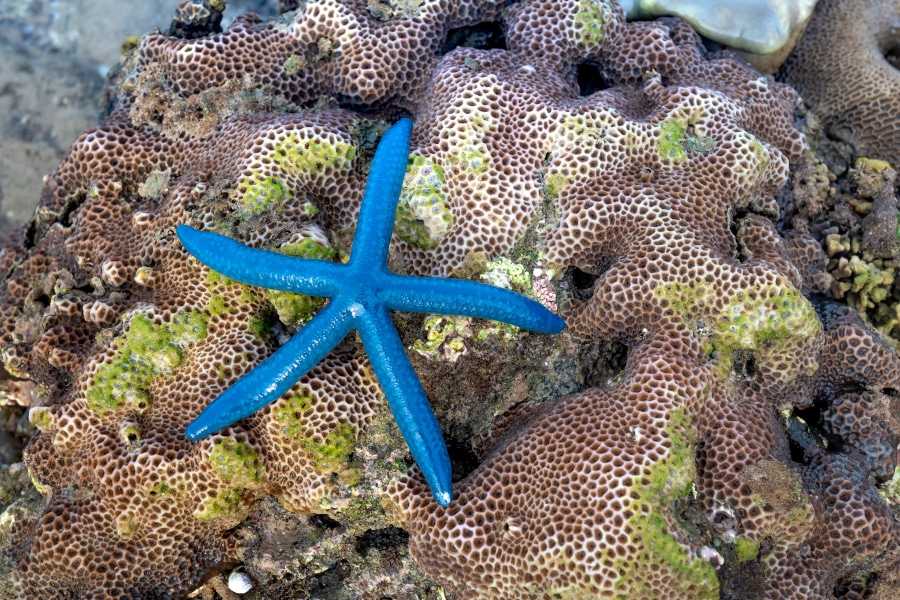
The Blue Linckia is easily the most photogenic sea star around the Gili Islands.
Its velvet-textured, bright cobalt arms stand out vividly against pale hard corals and golden sand.
-
The “Linckiacyanin” Secret: Their vibrant blue hue comes from a unique, stable carotenoid-protein complex called linckiacyanin. This chemical structure locks in their signature color, although rare genetic variations occasionally produce pink, purple, or orange morphs.
-
Gentle Grazers: They are entirely harmless to coral reefs, spending their days slowly creeping over rocks to feed on microalgae, organic detritus, and bacterial films.
-
Ultimate Survivalists: A Blue Linckia can regrow its entire body from a single severed arm. In the early stages of this regeneration, the lone arm growing tiny new arms looks like a shooting star and is affectionately known as a “comet.”
Crown-of-Thorns Starfish: The Coral Predator
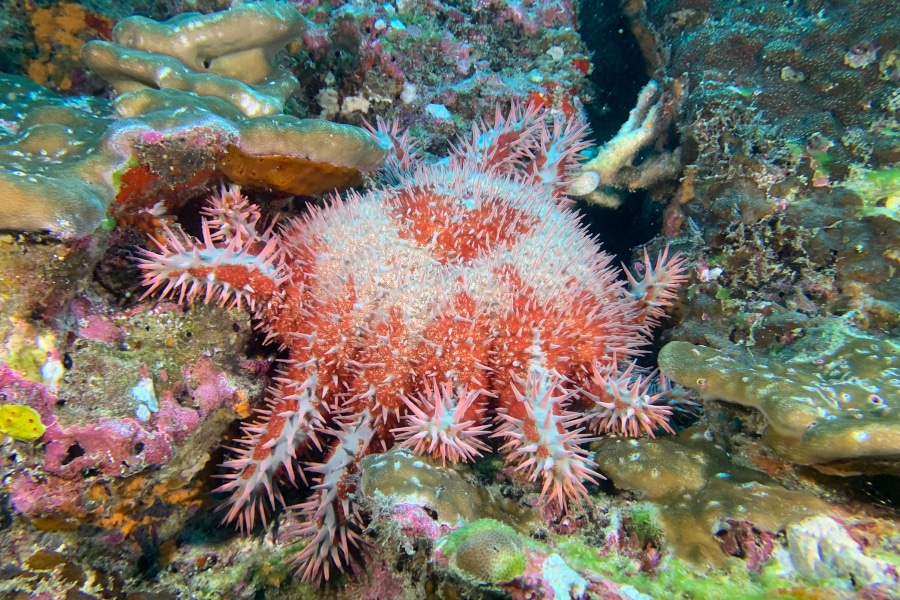
The Crown-of-Thorns Starfish (often called COTS) looks drastically different from its gentle cousins.
Equipped with a menacing appearance and an insatiable appetite, it plays a very different role on the reef.
-
Breaking the Five-Arm Rule: While most common starfish display classic five-fold symmetry, the Crown-of-Thorns completely shatters this rule. They can grow up to 21 or more arms and reach a massive diameter of nearly 1 meter (3.2 feet).
-
Venomous Armor: They are the only known venomous sea stars. Their bodies are covered in needle-sharp, 1-inch spikes loaded with toxic saponins and plancitoxins. A puncture wound can cause intense pain, swelling, nausea, and even localized paralysis in humans, making good buoyancy control vital when diving near them.
-
Voracious Coral Liquidation: They are strict carnivores that feed exclusively on living hard coral polyps. A single adult can liquidate and devour up to 10 square meters of coral reef per year. During population explosions (outbreaks), they leave behind ghostly white paths of dead coral skeletons.
-
Hyper-Fertile Spawners: They have one of the highest reproductive rates of any marine invertebrate. A single female can release up to 200 million eggs in a single breeding season, which fuels devastating population spikes when ocean conditions shift.
-
A Global Threat—Yet Rare in the Gilis: Crown-of-Thorns outbreaks have become a catastrophic ecological problem across many coral reef hotspots around the world, most notably in destinations like the Maldives and parts of the Great Barrier Reef. Thankfully, on the Gili Islands, COTS remain remarkably rare sightings. Our local dive communities and marine teams actively monitor the reefs, and encountering one here is an infrequent event rather than an ecosystem-threatening plague.
Side-by-Side Comparison
| Feature | Blue Linckia (Linckia laevigata) | Crown-of-Thorns (Acanthaster planci) |
| Diet | Microalgae, detritus & bacterial films | Live hard coral polyps |
| Max Arms | 5 (rarely 4 or 6) | 21+ arms |
| Top Speed | ~8.1 cm per minute | ~30 to 35 cm per minute |
| Defense | Mild distasteful toxins & camouflage | Venomous 1-inch spikes (plancitoxins) |
| Ecosystem Role | Helpful reef cleaner & harmless grazer | Destructive boom-and-bust coral predator |
| Gili Sighting Frequency | Very common (seen on nearly every dive) | Rare (carefully monitored) |
Other Common Sea Stars Around Gili Meno
-
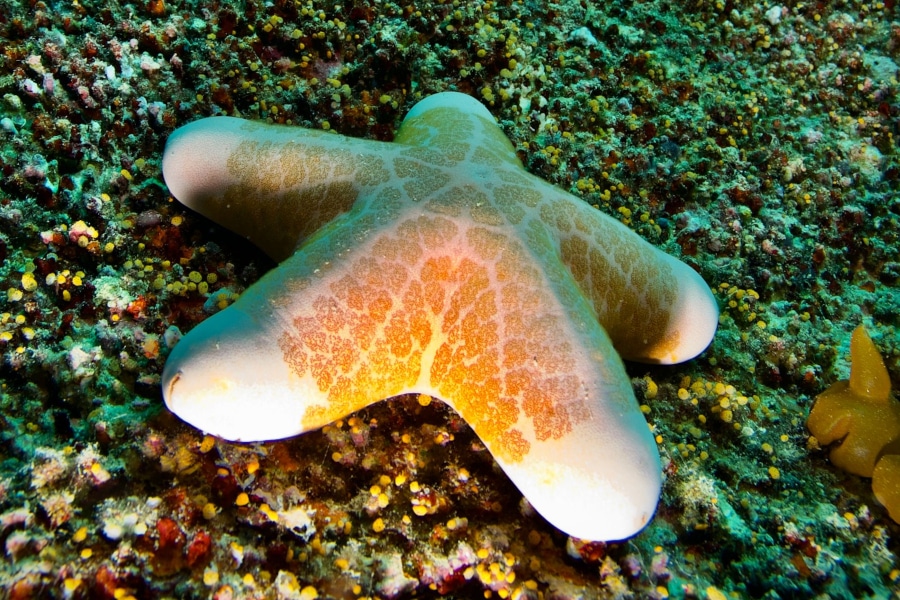
Granulated Sea Star (Choriaster granulatus): Often affectionately nicknamed the “doughnut” or “cushion” star. It features a thick, plump, pinkish-peach body with short, blunt arms.
-
Cushion Star (Culcita novaeguineae): Resembling a rounded pincushion or soccer ball, this star barely shows distinct arms. It is a slow omnivore found resting on sandy rubble beds.
-
Combing Sea Stars (Astropecten): These flattened stars bury themselves just below the sand surface. They hunt tiny bivalves and worms along gentle slopes.
Fascinating Facts About Sea Stars
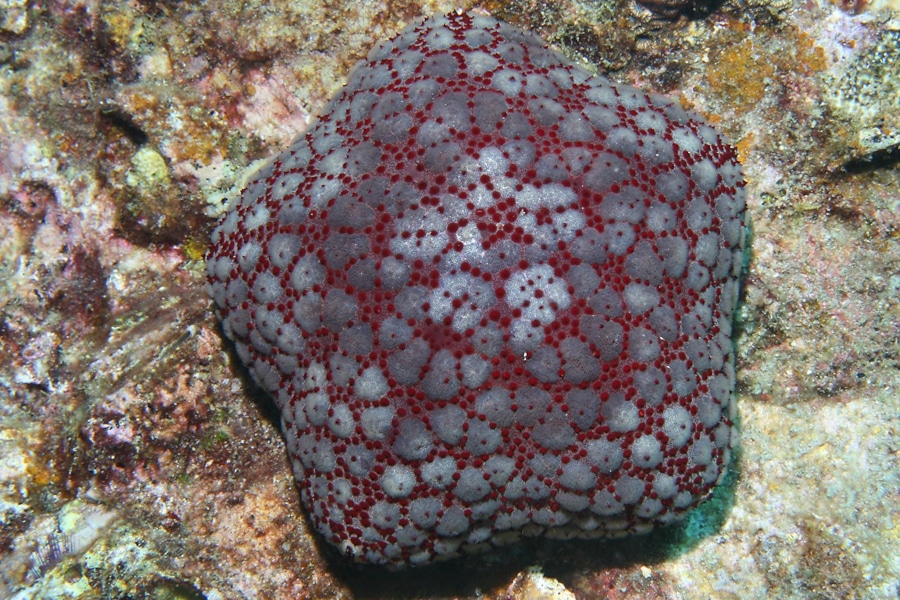
Starfish boast an extraordinary suite of biological adaptations:
-
Hydraulic Tube Feet: Sea stars move using a hydraulic water vascular system. Hundreds of tiny, fluid-filled tube feet line their undersides, creating powerful suction to crawl and grip rock.
-
External Stomachs: When eating, a starfish can eject its cardiac stomach outward through its mouth. It digests food externally on the reef before pulling the liquefied nutrients inside.
-
Bloodless Bodies: Starfish do not possess blood. Instead, they pump filtered seawater directly through their vascular systems to deliver essential oxygen and nutrients to their tissues.
Best Sites to Spot Sea Stars Around Gili Meno
-
Meno Slope: The sunny shallows right off our beach are full of vivid Blue Linckias resting peacefully on coral blocks and sand patches.
-
Bounty Wreck: Plump granulated sea stars and cushion stars cling to the algae-covered steel frame of the collapsed pontoon.
-
Halik: Deep coral bommies feature diverse invertebrates tucked into overhangs and sand gullies.
Dive into the Coral Reefs with Divine Divers
Ready to look closer and uncover the marvelous macro life living on our reefs?
Whether you want to discover serene coral slopes or iconic wrecks, our team is ready to guide your adventure.
We keep our dive groups small and personal to provide safe, relaxed, and unforgettable underwater experiences.
Book Your Dive with Divine Divers Gili Meno Today
and come explore the colorful world beneath our waves!