

Part of our Gili Marine Life Guide | Diving with Divine Divers Gili Meno
Peer closely into the folds of a swaying sea anemone or the tight branches of a staghorn coral. Here the reef suddenly reveals a miniature world bustling with activity.
While bigger pelagics like blacktip reef sharks and sea turtles capture headlines, coral reefs are kept in balance by an army of tiny, hard-shelled architects. Crabs are among the most diverse, adaptive, and ecologically vital invertebrates around the Gili Islands.
Far from simply scuttling sideways along the sand, local reef crabs have evolved astonishing partnerships. Some wear living gardens on their backs for camouflage. Others filter-feed safely inside stinging tentacles. And some others act as fierce security guards defending their coral homes.
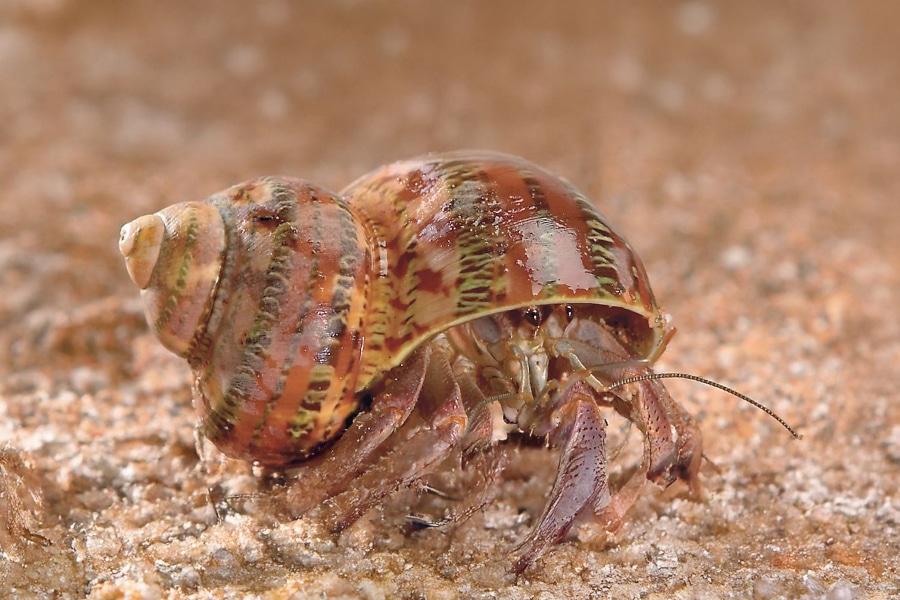
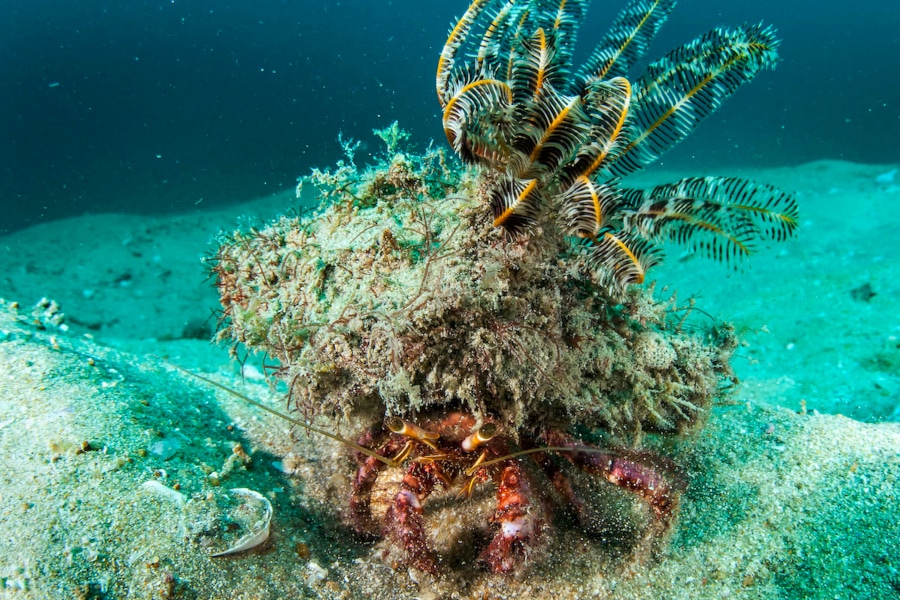
The Mobile Homeowners: Hermit Crabs
Look along the sand flats, rubble patches, or shallow tide pools. You will often see a sea snail shell suddenly stand up and run.
Inside lives a Hermit Crab.
Soft-Bellied Squatters: Unlike true crabs, hermit crabs have a soft, unarmored, spiral-shaped abdomen. They must find, occupy, and carry discarded gastropod shells to protect their vulnerable bodies from predators.
The Real Estate Problem: Hermit crabs never stop growing, but their adopted shells do not expand. To survive, a hermit crab must constantly search for a larger empty shell.
Vacancy Chains: Finding new shells is competitive. In many species, dozens of hermit crabs gather in “conga lines” ordered by size. When one crab claims a fresh shell, the others swap down the line in an orderly chain reaction.
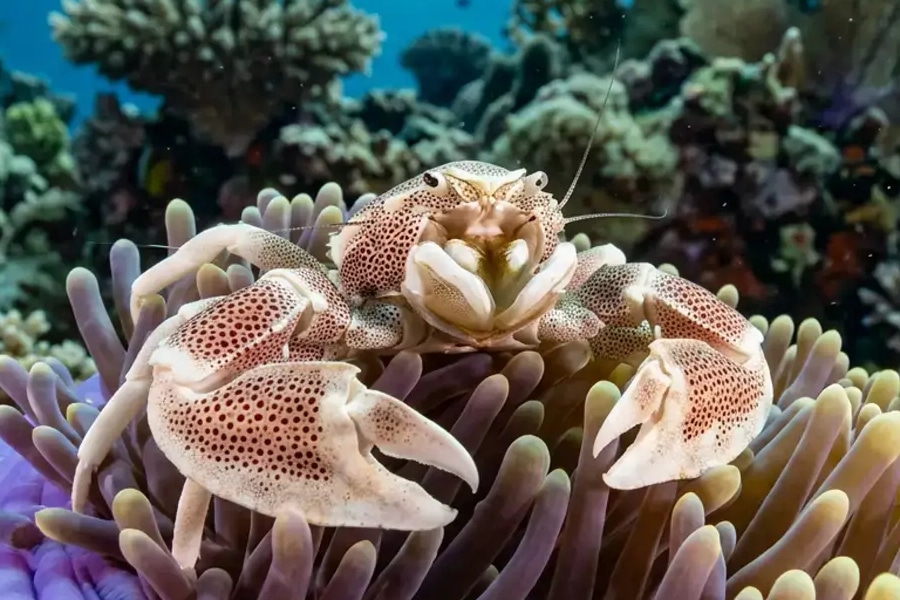
The Anemone Dwellers: Porcelain Crabs
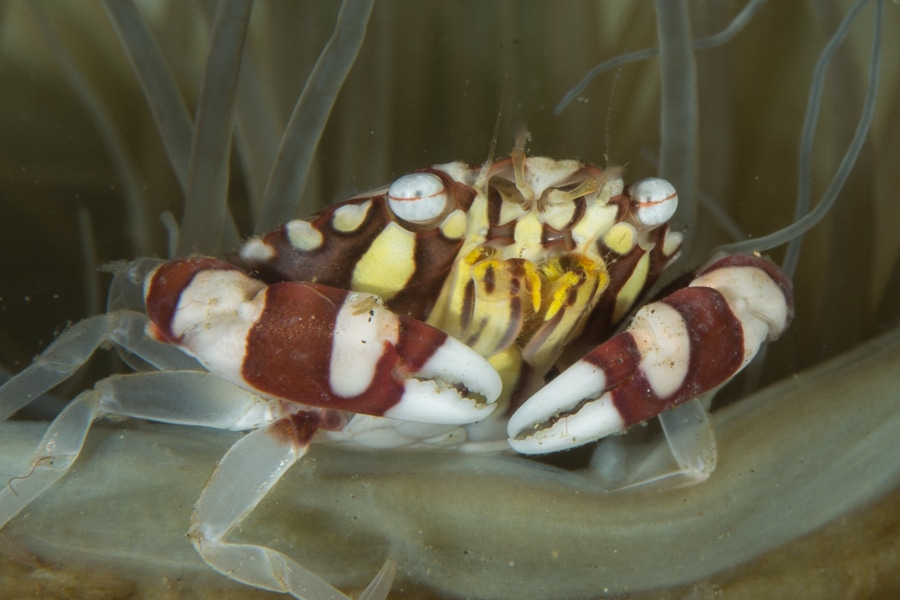
Glide over the coral bommies at Turtle City or Halik, and you will spot vibrant sea anemones hosting clownfish. Look a little closer beneath the skirt of the tentacles, and you are likely to spot a pair of Porcelain Crabs.
False Crabs: Despite their name and shape, porcelain crabs are anomurans. This means that they are evolutionary cousins to squat lobsters and hermit crabs rather than to true crabs. They possess only three visible pairs of walking legs instead of four.
Porcelain Defense: They get their name from their fragile defense mechanism. If grabbed by a predator, a porcelain crab easily snaps off a claw or leg to distract the attacker while it slips away. It regenerates the lost limb during subsequent molts.
Living Fan Feeders: Instead of hunting, they use specialized, feather-like mouthparts that cast out like miniature nets into the water column. Thus way they rhythmically sweep up passing plankton and suspended organic matter.
Sting-Proof Symbiosis: Wrapped in a thick protective mucus coat, porcelain crabs live completely unharmed in an anemone. They share the host with resident anemonefish.
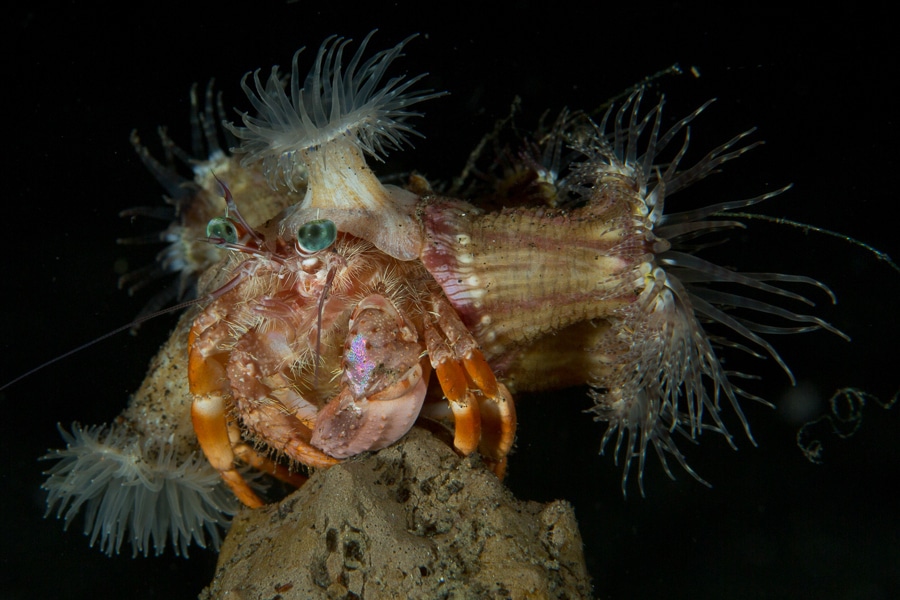
The Decorators: Masters of Disguise
Camouflage on the reef is an art form, and Decorator Crabs are the undisputed master artists.
DIY Camouflage: Decorator crabs possess hook-like, curved bristles across their carapaces. They deliberately snip bits of living sponges, soft corals, and toxic algae from their surroundings. They then chew the base slightly to make it tacky, and attach it to their backs.
Living Chemical Warfare: By wearing unpalatable and toxic organisms like sponges and tunicates, the crab not only disappears against the reef wall. They also throw off predators that rely on scent or taste.
Wardrobe Changes: When a decorator crab molts, it strips the living decorations off its discarded shell. Afterwards it reattaches them onto its brand-new exoskeleton.
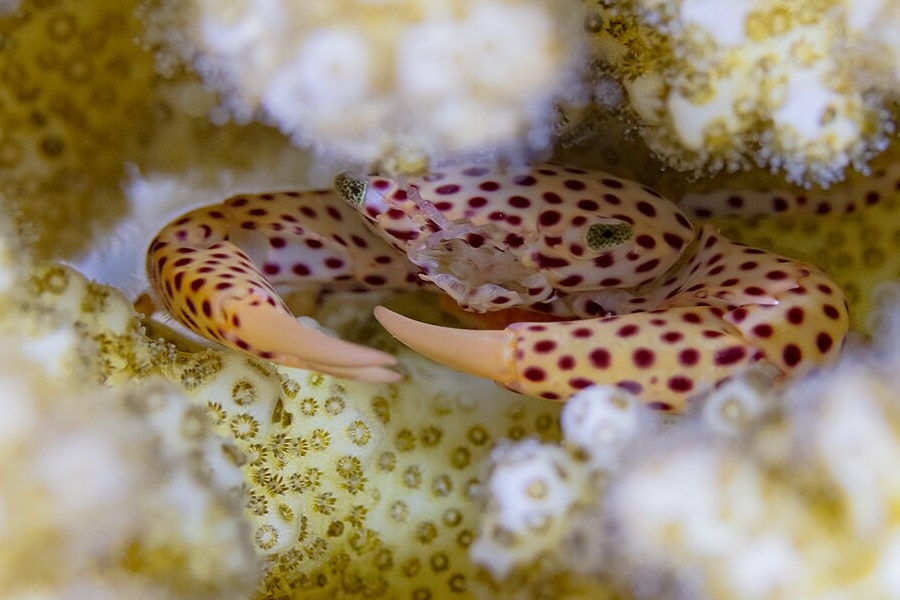
Coral Guards: The Trapezia Guard Crabs
Hidden inside the labyrinthine branches of branching stony corals live tiny, colorful Trapezia Crabs. They are commonly known as Coral Guard Crabs.
Fierce Security: Despite measuring barely a couple of centimeters across, these tiny crustaceans will fearlessly defend their host coral from massive predators. When a voracious Crown-of-Thorns Starfish or coral-eating snail attacks, guard crabs defend. They pinch, snip, and violently tug at the predator’s tube feet and spines until it retreats.
A Mutual Deal: In exchange for 24/7 security duty, the coral provides safe shelter within its limestone branches. The coral also secretes lipid-rich nutritional mucus droplets to feed its resident guard crabs. Studies show that corals hosting Trapezia crabs have drastically higher survival rates during predator outbreaks.
Fascinating Facts About Reef Crabs
Eyes with Super Wide Angles: Many crabs have eyes mounted on mobile stalks. This gives them a 360-degree panoramic vision while remaining wedged deep inside rock fissures.
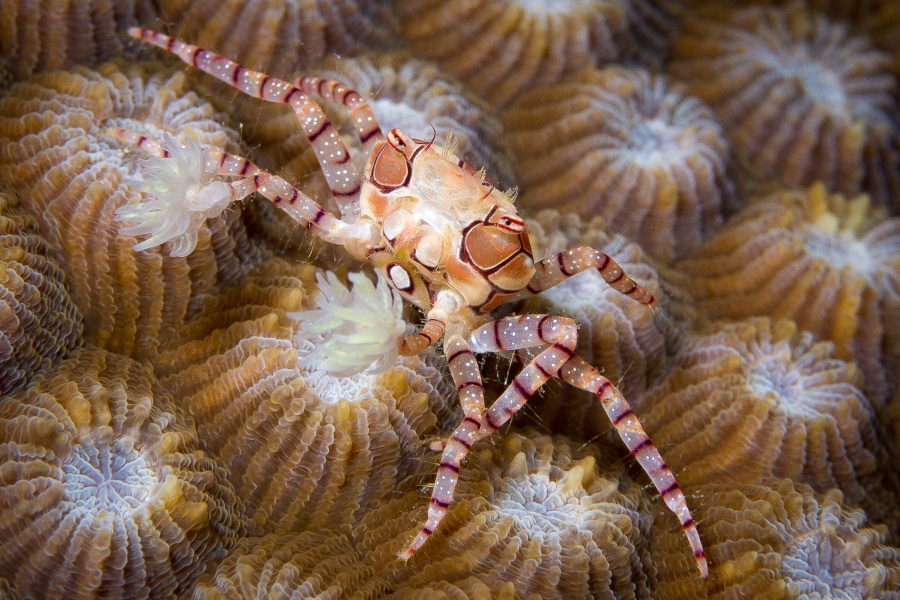
Heavyweight Boxers: The Boxer Crab carries a tiny, stinging sea anemone in each claw. They wave them around like boxing gloves to deter predators and mop up food from the substrate.
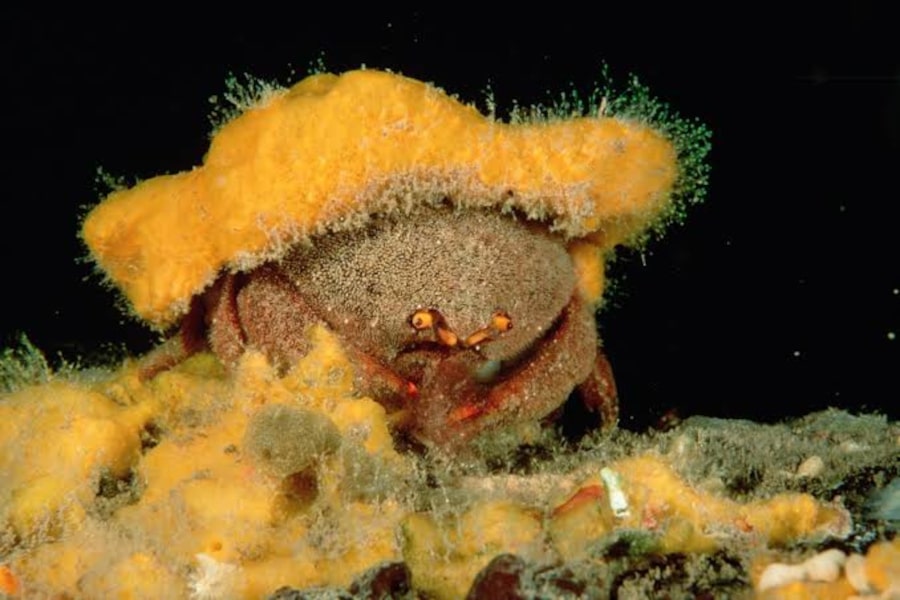
Giant Night Walkers: On night dives, the sandy flats reveal larger scavenging species, like the enormous Sponge Crab. This crab carries a custom-carved living sponge cap over its back using its modified hind legs.
Sensory Legs: Crabs don’t just walk with their legs—they taste with them. Chemosensory hairs lining their legs and claws allow them to identify food buried beneath the sand. Simply by walking over it.
Threats to Island Crab Populations
Because crabs rely intimately on healthy micro-habitats, environmental stress ripples through their communities rapidly:
Coral Bleaching and Habitat Loss: Coral guard crabs cannot survive without living branching corals. When marine heatwaves trigger widespread coral bleaching, resident guard crabs starve or become exposed to predators as the coral dies.
Plastic & Micro-Debris: Filter-feeding porcelain crabs ingest microplastics floating in the water column. Decorator crabs have been documented mistakenly fastening toxic plastic fibers to their carapaces.
Physical Reef Damage: Poor buoyancy control, anchor drops, and careless fin kicks can shatter fragile branching corals and anemone colonies. This destroys centuries-old micro-habitats in seconds.
Best Sites to Spot Crabs Around Gili Meno
Hans Reef: Shallow bommies and anemone gardens are ideal for spotting porcelain crabs waving their feeding fans under anemones.
Shark Point: Deep bommies crowded with staghorn corals host dozens of watchful Trapezia guard crabs tucked between branches.
Bounty Wreck, Meno Wall and Meno Slope: The metal pontoon frame, covered in hydroids, sponges, and soft corals, is the ultimate hunting ground for camouflaged decorator crabs and nocturnal hermit crabs.
Explore the Macro World
The magic of scuba diving isn’t just about the massive animals—it is about learning how the tiniest creatures keep the ocean alive.
From colorful porcelain crabs and camouflaged decorators to majestic green sea turtles. Our professional, small-group dive guides at Divine Divers Gili Meno love showing you the secret macro life hidden across our home reefs.