

Part of our Gili Marine Life Guide | Diving with Divine Divers Gili Meno
As you glide past the vibrant coral bommies of Gili Meno, take a moment to look downward at the rubble slopes. At first glance, this sandy seabed might seem like an empty underwater desert. However, once you hover closer, an extraordinary hidden world quickly emerges.
Marine worms and worm-like crawlers are among the most resilient and adaptive inhabitants of our local reefs. They range from delicate tube builders to paper-thin ribbon swimmers gliding through open water. Furthermore, some decorate the coral like festive holiday trees, while others scurry across rocks armed with glass-like needles. A few are even formidable ambush predators lurking beneath the sand.
Let us dive in and explore the fascinating worms and flatworms thriving around the Gili Islands.
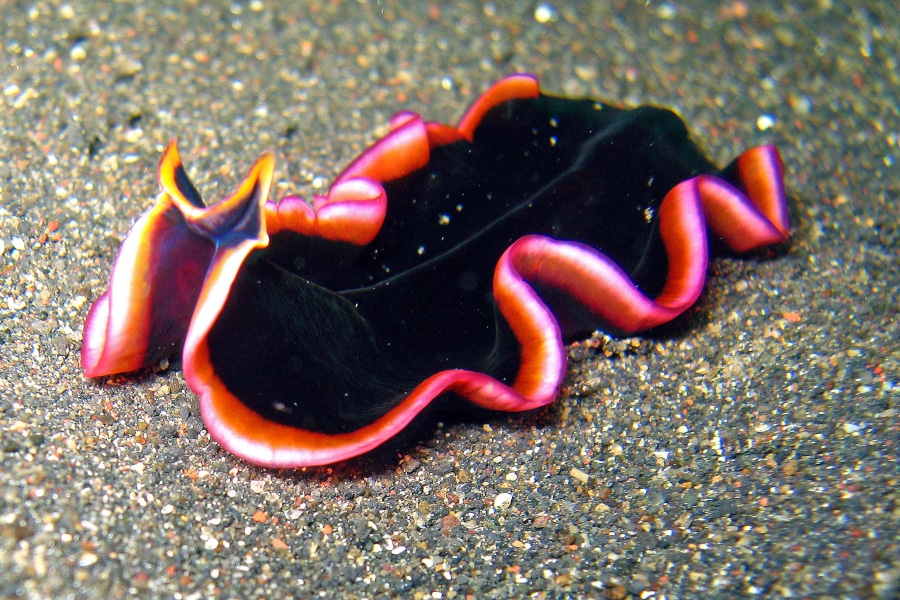
Marine Flatworms: The Paper-Thin Ocean Dancers
Divers frequently spot marine flatworms gliding over coral heads and mistake them for colorful nudibranchs. In reality, they are not, they belong to a completely different species. They are among the simplest bilateral animals on Earth.
Wafer-Thin Bodies: Because they lack gills, blood, and a respiratory system, flatworms absorb oxygen directly through their razor-thin skin.
Master Imposters: To deter hungry reef fish, flatworms cleverly mimic the toxic warning colors of sea slugs. However, you can tell them apart because flatworms lack external branchial plumes and horn-like rhinophores.
Mesmerizing Swimmers: When startled by a current, they effortlessly launch into open water. They undulate their ruffled skirts in rhythmic, hypnotic ripples, resembling tiny flying carpets floating above the coral.
Unique Mating Duels: Flatworms are hermaphrodites that engage in a rare ritual known as “penis fencing.” Each worm attempts to fertilize the other, and the loser must expend energy carrying the resulting eggs.
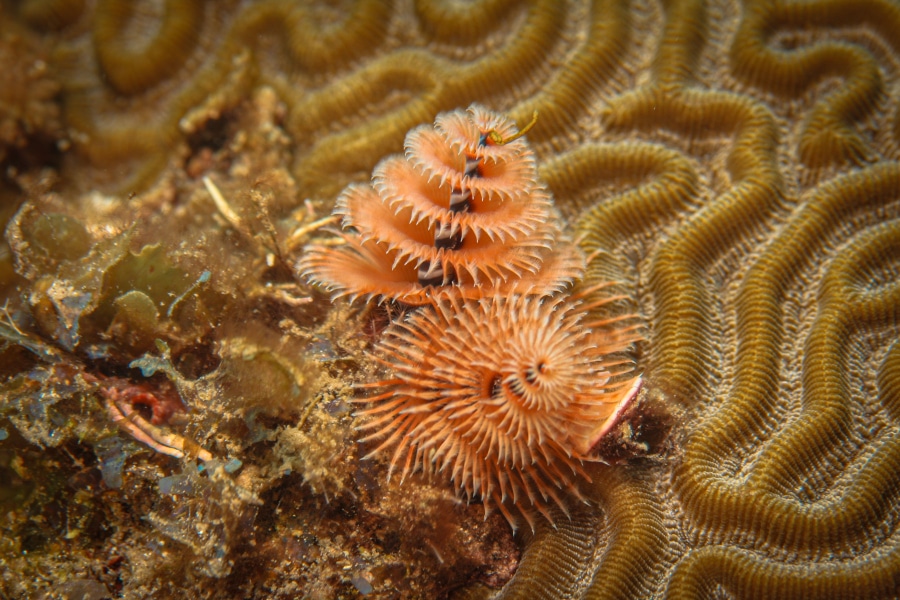
Christmas Tree Worms: Colorful Living Jewels
Hover near a massive coral head, and you will instantly spot twin spirals of brilliant neon color. These animals are sedentary tube worms that never leave their calcified homes.
Hidden Architects: The worm builds a solid calcium tube deep inside the living hard coral skeleton. Consequently, only its paired, colorful crown plumes extend into the open sea.
Multipurpose Plumes: These radioles do far more than look stunning. They actively catch drifting plankton while functioning as gills to extract vital oxygen from the current.
Lightning-Fast Reflexes: If a diver approaches too rapidly, the plumes vanish in the blink of an eye. Tiny eyespots detect incoming shadows, prompting the worm to snap shut behind an armored trapdoor cap.
A Brilliant Palette: These worms display almost every shade imaginable. You can spot bright orange, electric blue, sunny yellow, and deep crimson varieties clustered together on a single coral block.
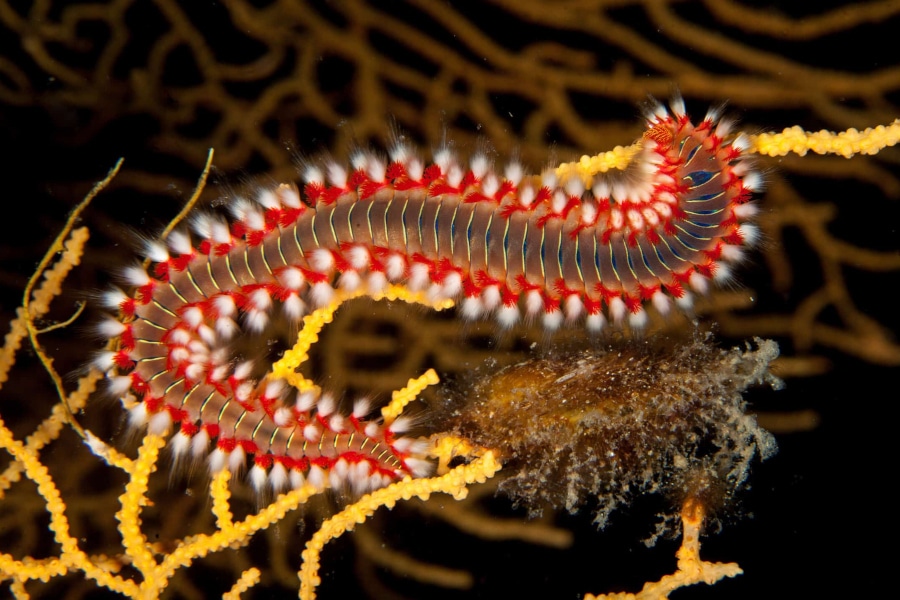
Bearded Fireworms: Armed and Toxic Scavengers
Crawl-hunting across shallow rubble beds, fireworms command instant respect from every experienced diver. They take their name from the intense, burning pain their chemical stings inflict on exposed skin.
Glass Harpoons: Their segmented bodies are lined with hundreds of hollow white bristles called setae. These brittle needles are composed of calcium carbonate and packed with potent neurotoxins.
Defensive Armor: Because the bristles snap off upon the slightest contact, you should never attempt to touch one. The fragments embed deep into your skin, causing painful throbbing, swelling, and redness that lasts for days.
Reef Cleanup Crew: Despite their fearsome reputation, fireworms play a useful ecological role. They spend their days grazing on decaying organic matter, anemone tips, and dead coral patches across the seabed.
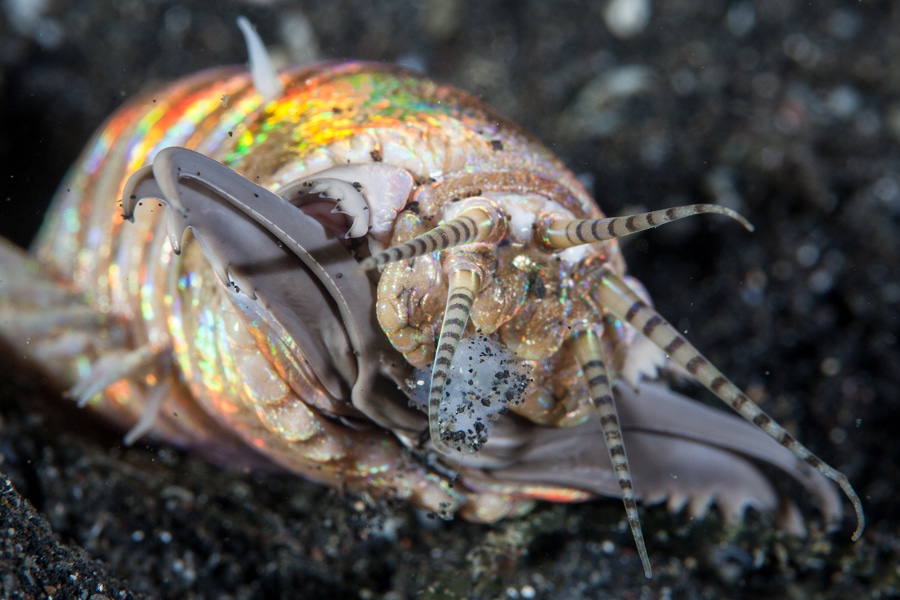
The Bobbit Worm: The Ultimate Sand Assassin
During a night dive around the Gili Islands, the true villain of the muck occasionally shows its face. The Bobbit worm is an ambush predator buried beneath the sand.
Concealed Giants: Although these terrifying worms can grow over two meters in length, only their predatory heads breach the surface.
Iridescent Lures: Their armored bodies shine with a metallic rainbow sheen under a dive torch beam. Five sensitive antennae project upward, patiently sampling water vibrations for approaching meals.
Devastating Strikes: Once an unsuspecting fish brushes an antenna, the worm attacks with explosive speed. Its spring-loaded, scissor-like jaws snap shut instantly, dragging its prey deep underground into its lair.
How to Observe Reef Crawlers Safely
Look with Your Eyes, Not Your Hands: Fireworms look soft and fuzzy, but their bristles cause severe irritation. Always keep your hands off rocks, dead corals, and sand patches.
Fine-Tune Your Buoyancy: Hover gently when photographing sensitive Christmas tree worms and delicate swimming flatworms. Sudden kicks create strong water pressure waves, which cause them to withdraw immediately.
Use Red Lights at Night: Bobbit worms are extremely sensitive to bright white illumination. Therefore, switch your primary torch to a red beam to observe their hunting behavior without frightening them back into the sediment.
Top Sites for Muck and Worm Spotting
If worms, unusual critters and tiny marine creatures are your thing, don’t miss our guide to the best muck diving sites around the Gili Islands and Lombok. Discover where to find fascinating macro life, from colourful nudibranchs and seahorses to rare crustaceans and other hidden treasures.
New to muck diving? Check out our guide to what muck diving is, why divers love searching the sandy seabeds and rubble slopes, and why some of the smallest underwater encounters can be the most exciting!
Uncover the Secrets of the Gilis
A truly memorable dive is not solely about encountering large pelagic animals. Instead, taking time to search the coral rubble reveals some of the ocean’s most astonishing survival strategies.
Our experienced, passionate dive guides at Divine Divers Gili Meno love showcasing these miniature reef wonders. We keep our guided groups small and relaxed, giving you ample time to discover every fascinating creature along the reef.