

Few terms create more concern amongst marine enthusiasts more than coral bleaching.
Photos of bright white reefs have become common in the media. Stories often describe coral bleaching as the death of coral reefs and a sign of environmental collapse.
While coral bleaching is a serious issue, the reality is more complex.
Not every bleached coral dies.
Also, not every reef responds in the same way.
And some reefs are proving surprisingly resilient.
The reefs of the Gili Islands provide an interesting example. While they have experienced bleaching events over the years, they have avoided some of the catastrophic damage seen elsewhere in Indonesia and around the world.
Understanding coral bleaching helps snorkelers and divers appreciate both the challenges facing coral reefs and the remarkable ability of some reefs to recover.
What Is Coral Bleaching?
Despite the name, coral bleaching is not a disease.
It is a stress response.
To understand bleaching, we first need to understand how corals survive.
Corals are animals. Inside their tissues live microscopic algae called zooxanthellae. These algae use sunlight to perform photosynthesis and provide much of the energy corals need to grow and build reefs.
In return, the coral provides shelter and access to sunlight.
It is one of the most successful partnerships in nature.
The beautiful colours we see on healthy coral reefs are largely produced by these algae.
When corals become stressed, they may expel their zooxanthellae.
Without the algae, the coral becomes transparent, revealing the white limestone skeleton underneath.
This is coral bleaching.
What Causes Coral Bleaching?
Many things can stress corals.
However, the most common cause is elevated sea temperature.
Corals live close to their thermal limits.
Even a sustained increase of one or two degrees Celsius above normal can trigger bleaching.
- Prolonged heat waves
- Extreme sunlight exposure
- Pollution
- Sedimentation
- Freshwater runoff
- Disease
- Sudden temperature changes
Today, climate change is considered the greatest global threat to coral reefs because it increases both ocean temperatures and the frequency of marine heatwaves.
Does Bleaching Mean the Coral Is Dead?
No.
This is one of the biggest misconceptions about coral bleaching.
A bleached coral is stressed.
But it is not necessarily dead.
If water temperatures return to normal quickly enough, corals can recover.
The zooxanthellae return.
The coral regains its colour.
Growth resumes.
Some reefs around the world have demonstrated remarkable recovery following bleaching events.
However, if stressful conditions persist for too long, the coral may eventually die.
The longer bleaching lasts, the greater the risk.
The Global Bleaching Events
Over the last few decades, several major global bleaching events have affected coral reefs around the world.
The most severe occurred between 2014 and 2017.
During this period, elevated ocean temperatures caused widespread bleaching across the Pacific, Indian Ocean, and many parts of Southeast Asia.
Some reefs suffered catastrophic losses.
Large sections of the Great Barrier Reef experienced extensive bleaching.
Many reefs throughout the Coral Triangle were also affected.
The event highlighted just how vulnerable coral reefs can be to prolonged heat stress.
Why Did the Gili Islands Escape the Worst of the 2016 Event?
One of the most interesting aspects of Gili Islands coral reefs is that they avoided much of the severe damage seen in other regions during the 2016 bleaching event.
The primary reason appears to be oceanography.
The Gili Islands sit within a dynamic area influenced by strong currents flowing through the Lombok Strait.
These currents often bring cooler water from deeper areas.
This natural flushing effect can help moderate water temperatures around the islands.
While many reefs elsewhere experienced prolonged heat stress, the Gili Islands benefited from these cooler water influences.
As a result, widespread catastrophic bleaching was largely avoided.
This does not mean the reefs were completely unaffected.
Some corals showed signs of bleaching.
However, the overall impact was significantly less severe than in many other tropical reef systems.
Many marine biologists consider areas influenced by cooler currents to be potential climate refuges for coral reefs in the future.
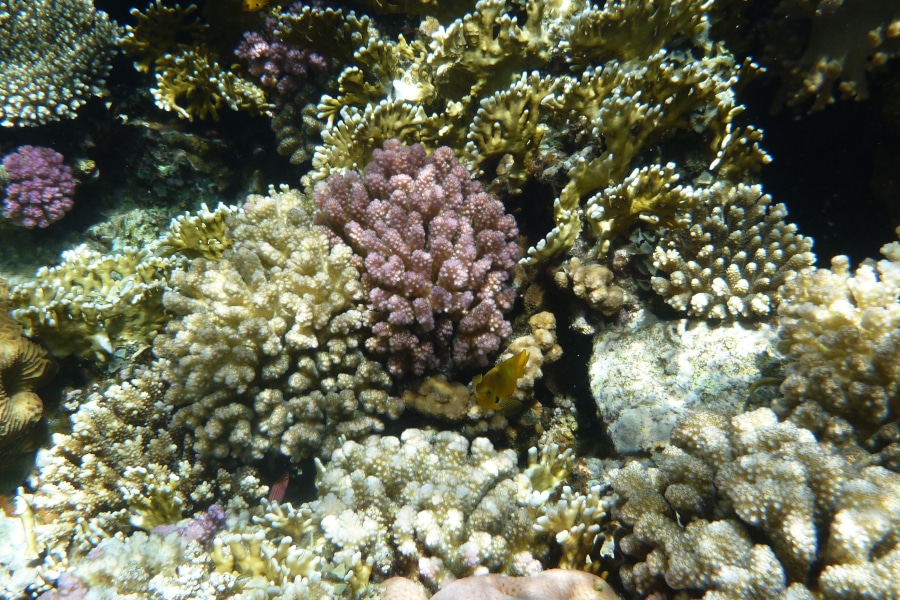
Do Corals Bleach in the Gili Islands?
Yes.
Corals in the Gili Islands do bleach from time to time.
Snorkelers and divers occasionally encounter individual coral colonies or small reef sections that have lost their colour.
This is completely normal.
Bleaching can occur for many reasons.
A particularly warm period.
Unusually calm conditions.
Localised stress.
Disease.
The important thing to remember is that occasional bleaching has always been part of reef ecology.
The concern arises when bleaching becomes widespread or prolonged.
Fortunately, many bleached corals in the Gili Islands recover successfully once conditions improve.
Why Some Corals Survive Better Than Others
Not all corals respond to heat stress in the same way.
Some species are surprisingly resilient.
Others are highly sensitive.
Even within the same reef, one coral colony may bleach while another remains healthy.
Scientists continue studying why certain corals tolerate warmer temperatures better than others.
Possible factors include:
- Coral species
- Local current patterns
- Water depth
- Previous exposure to heat stress
- Different strains of zooxanthellae
Understanding these differences may become increasingly important as ocean temperatures continue to rise.

What Does a Bleached Reef Look Like?
The first time divers encounter bleaching, it can be shocking.
Instead of vibrant colours, sections of the reef appear bright white.
At first glance, the reef can almost look covered in snow.
However, a bleached reef is not necessarily a dead reef.
Fish often remain present.
Marine life continues to use the habitat.
The reef may still recover.
This is why scientists distinguish carefully between bleaching and mortality.
The two are not the same thing.
Other Threats Facing Coral Reefs
While bleaching receives most of the attention, coral reefs face many other challenges.
These include:
Climate Change
The biggest long-term threat.
Pollution
Plastic waste and poor water quality can weaken reefs.
Overfishing
Disrupting natural food webs affects reef health.
Physical Damage
Anchors, careless divers, and destructive fishing methods can all damage coral.
Coastal Development
Sedimentation can smother coral reefs.
Healthy reefs are generally more resilient to all of these threats.

Why Healthy Reefs Recover Better
One of the best defenses against bleaching is overall reef health.
Healthy reefs typically contain:
- High coral diversity
- Strong fish populations
- Good water quality
- Low levels of pollution
- Stable ecosystems
These factors improve the reef’s ability to recover after disturbances.
This is one reason why conservation efforts matter.
Protecting reefs today improves their chances of surviving future challenges.
What Divers Can Do
Individual divers cannot stop climate change.
But they can help reduce local stress on reefs.
Simple actions make a difference:
- Maintain good buoyancy.
- Never touch coral.
- Avoid standing on the reef.
- Choose environmentally responsible operators.
- Support reef conservation initiatives.
- Reduce plastic waste.
- Use reef-safe sunscreen when possible.
Reasons for Optimism
Coral bleaching is a serious issue.
But the story is not entirely negative.
Scientists continue discovering reefs that are more resilient than expected.
Many coral species recover after bleaching.
Conservation efforts are improving.
Marine protected areas are expanding.
And awareness amongst divers is growing.
The reefs of the Gili Islands demonstrate that coral reefs are not passive victims.
They are dynamic ecosystems with an impressive capacity for recovery when given the opportunity.