

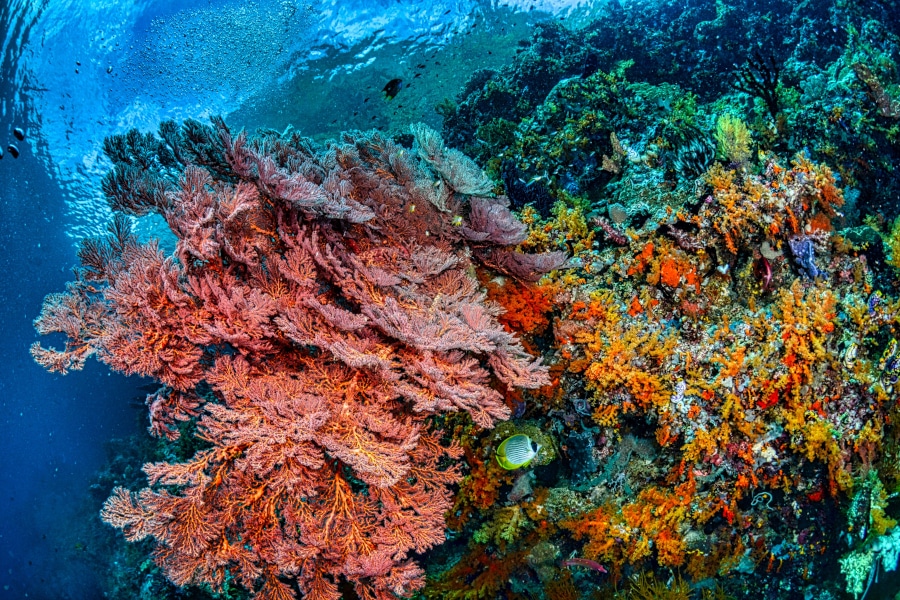
When most people think about coral reefs, they picture colourful fish.
For many divers, coral reefs simply provide beautiful scenery.
But coral reefs are far more than that.
They are living cities.
They feed millions of people.
Protect coastlines.
Support local economies.
Create tropical islands.
And provide a home for one of every four marine species on Earth.
Without healthy coral reefs, the oceans—and places like the Gili Islands—would look completely different.

More Than Just Beautiful Underwater Landscapes
It is easy to think of coral reefs as colourful underwater gardens.
In reality, they are among the most important ecosystems on our planet.
Although coral reefs cover less than one percent of the ocean floor, they support around 25% of all marine species.
Thousands of animals depend on coral reefs for:
- Food
- Shelter
- Protection
- Breeding grounds
- Nursery habitats
From tiny gobies hiding amongst branching corals to reef sharks patrolling the drop-offs, every animal plays a role in this complex ecosystem.
Healthy coral reefs create the biodiversity that makes scuba diving in the Gili Islands so unforgettable.
The Rainforests of the Sea
Coral reefs are often called the rainforests of the sea.
The comparison is remarkably accurate.
Like tropical rainforests, coral reefs support extraordinary biodiversity in a relatively small area.
Every square metre of reef can contain hundreds of different species.
Corals.
Fish.
Sponges.
Crustaceans.
Sea stars.
Sea cucumbers.
Octopus.
Molluscs.
And countless microscopic organisms that most divers or snorkelers never even notice.
The reefs surrounding Gili Meno, Gili Air, and Gili Trawangan are part of the Coral Triangle, the most biodiverse marine region on Earth.
This is one of the reasons why diving in Indonesia is considered among the best in the world.

Coral Reefs Protect Tropical Islands
Most people never think about what happens beneath the waves during a storm.
Coral reefs act as natural breakwaters.
They absorb enormous amounts of wave energy before it reaches the shoreline.
Without healthy reefs, tropical islands would experience far greater coastal erosion.
Beaches would disappear more quickly.
Storm damage would increase.
Many islands would become far more vulnerable to rising sea levels.
The reefs surrounding the Gili Islands quietly perform this protective role every single day.
Coral Reefs Support Millions of People
Healthy reefs are not only important for marine life.
They are also vital for people.
Around the world, hundreds of millions of people depend on coral reefs for:
- Food
- Fisheries
- Tourism
- Coastal protection
- Employment
In many island communities, coral reefs are directly linked to local livelihoods.
Healthy reefs attract visitors.
Visitors support local businesses.
Those businesses create jobs.
Protecting coral reefs therefore also means protecting local communities..

Coral Reefs Need Fish
Many people think fish need coral reefs.
That is certainly true.
But the relationship also works in reverse.
Parrotfish and surgeonfish remove algae that would otherwise smother corals.
Cleaner wrasse remove parasites from larger animals.
Predators such as reef sharks help maintain the balance of the food chain.
Without healthy fish populations, coral reefs gradually decline.
Every fish has a job.
Together they help keep the reef alive.
Coral Reefs Help Create White Sand Beaches
One of the greatest surprises for many visitors is learning that coral reefs help create tropical beaches.
Parrotfish spend much of the day scraping algae from coral surfaces.
In doing so, they also grind tiny amounts of limestone.
After passing through the fish, this material becomes the fine white sand that makes beaches in the Gili Islands so famous.
Even the beaches owe something to healthy coral reefs.

Coral Reefs Are Living History
Some coral colonies have been growing for hundreds of years.
Entire reef systems have developed over thousands of years.
Every coral head tells a story.
Storms survived.
Fish sheltered.
Generations of turtles fed nearby.
When a large coral colony is damaged, it cannot simply be replaced overnight.
Nature measures reef growth in decades and centuries.
Coral Reefs Face Growing Threats
Despite their importance, coral reefs are under pressure around the world.
Major threats include:
- Climate change
- Coral bleaching
- Plastic pollution
- Poor water quality
- Unsustainable fishing
- Coastal development
- Physical damage from anchors and careless divers
The good news is that healthy reefs are remarkably resilient.
Many reefs recover when local stress is reduced and conservation measures are in place.
The Gili Islands have demonstrated this resilience through coral restoration projects, mooring buoy systems, and responsible diving initiatives.