

Few underwater encounters are as exciting as spotting a seahorse. Unless you really love sharks…
They don’t rush past you like a school of fish or glide overhead like a turtle. Instead, they cling quietly to seagrass, coral or other structures, often blending so perfectly into their surroundings that you can swim right past them without noticing.
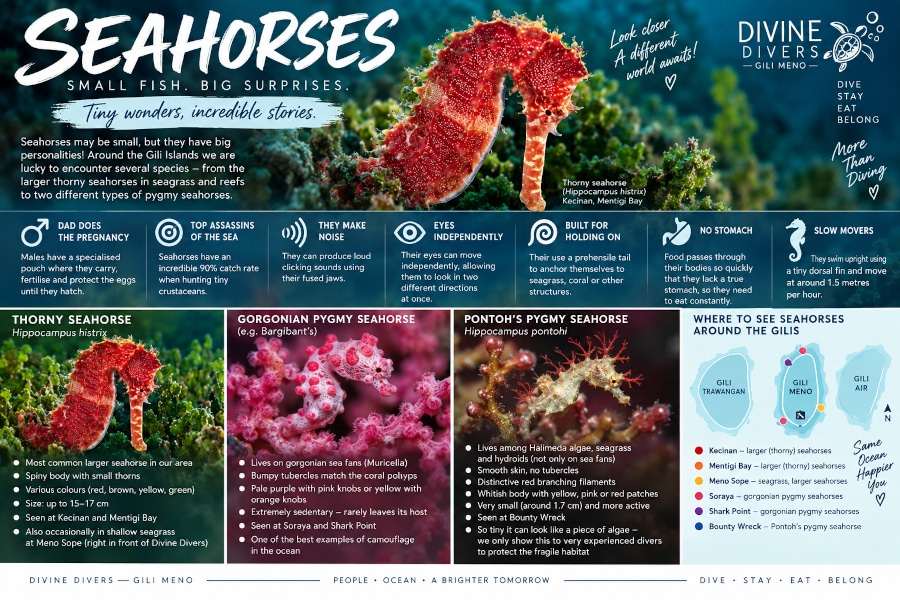
Around the Gili Islands, we are lucky enough to encounter several different types of seahorses — from the larger thorny seahorse (Hippocampus histrix) to two very different types of pygmy seahorses.
And each one has its own fascinating way of surviving.

The thorny seahorse
The larger seahorse we most commonly encounter around Kecinan and Mentigi Bay appears to be the thorny, or spiny, seahorse (Hippocampus histrix).
It is easy to understand where the name comes from. This species is covered in small spines and has a distinctive long, tapered snout. Its colour can vary considerably, including reddish, brown, yellowish and greenish individuals, allowing it to blend beautifully into its surroundings.
The red individual in our photograph is a particularly striking example, almost disappearing among the algae and vegetation.
These seahorses can grow to around 15–17 cm, making them giants compared with the tiny pygmy species we encounter elsewhere around the Gilis.
A seahorse right in front of Divine Divers
You don’t always have to go far to find something special.
We have even encountered a spiny seahorse in the shallow seagrass area at Meno Slope, directly in front of Divine Divers.
These shallow seagrass habitats are important homes and nursery areas for marine life and are well worth exploring slowly. Seahorses use their prehensile tails to hold onto seagrass and other structures, allowing them to stay anchored when currents move through.
So next time you are doing a shallow dive or snorkel, slow down and look carefully.
That piece of seagrass might be looking back at you.
The ocean’s tiny assassins
Seahorses may look gentle and almost fragile, but they are remarkably effective predators.
They are ambush hunters, waiting patiently for tiny prey such as small crustaceans to come within range.
Then comes the strike.
Using their long, tube-like snout, they create a powerful suction that pulls their prey into their mouth incredibly quickly.
According to our marine biologist, their hunting success can reach an astonishing 90%.
That’s an impressive catch rate for an animal that looks like it could barely move.
Their hunting strategy is based on patience, camouflage and precision rather than speed.
The dads do the pregnancy
One of the most famous things about seahorses is also one of the strangest.
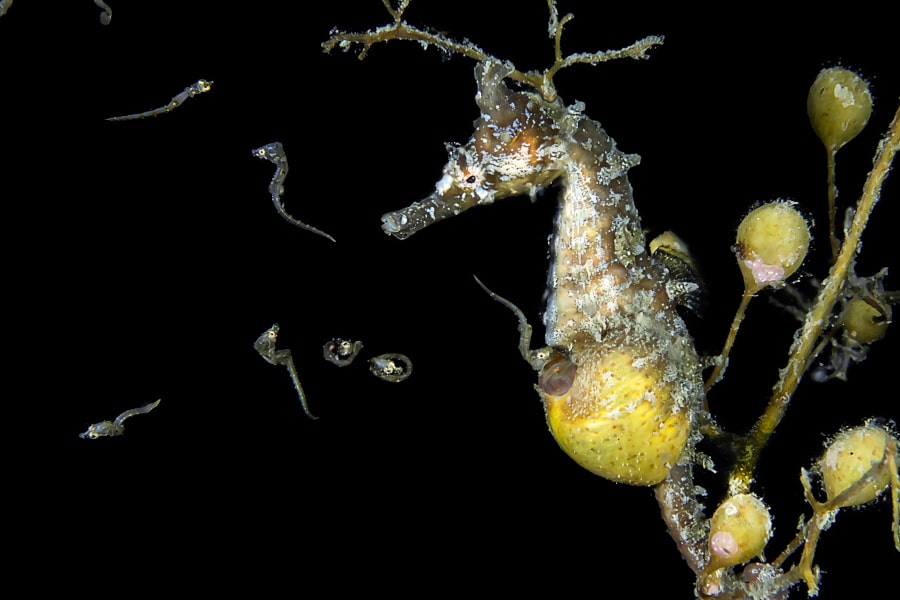
Male seahorses carry the developing eggs.
During mating, the female transfers her eggs into the male’s specialised brood pouch. The male fertilises them and carries them until they are ready to hatch.
Eventually, he gives birth to fully formed miniature seahorses.
And once the babies leave the pouch, they are on their own.
Seahorse parenting is therefore a little different from ours: Dad does the pregnancy, and then the newborns immediately have to fend for themselves.
A very unusual voice
Seahorses can also make sounds.
Their fused jaws can produce surprisingly loud clicking sounds, particularly during feeding and communication.
It is another reminder that there is far more going on beneath the surface than we can see.
An animal that appears to simply float quietly among the seagrass can actually be hunting, communicating and interacting with its surroundings all at once.
Pygmy seahorses: two very different tiny worlds
Around the Gilis, we are lucky enough to encounter two very different types of pygmy seahorse: gorgonian specialists and Pontohi’s pygmy seahorse (Hippocampus pontohi).
Although both are tiny, the way they live couldn’t be much more different.
Gorgonian specialists: masters of becoming coral
At Soraya and Shark Point, we sometimes find pygmy seahorses living on sea fans.
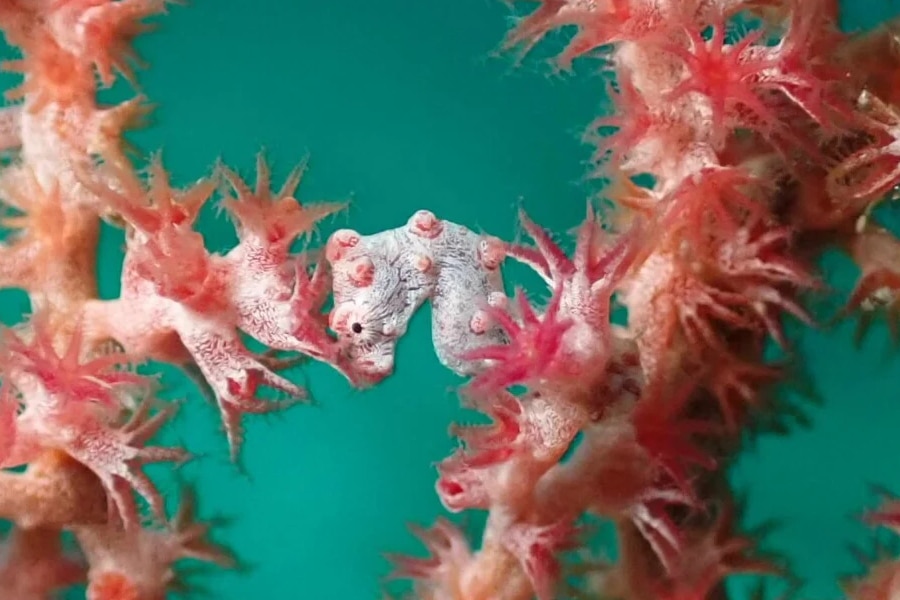
These are gorgonian specialists, meaning they are extremely closely associated with particular gorgonian sea fans. They spend much of their lives on the same host coral and are masters of camouflage.
Their bodies can develop tiny, wart-like tubercles that closely resemble the polyps of the sea fan they live on. Their colour and texture can also match their host, making them extraordinarily difficult to see.
This creates one of the great underwater challenges:
Find the seahorse without losing sight of the sea fan.
Once you know where one is, it can still be surprisingly difficult to see.
For divers interested in finding small and unusual marine life, these encounters are part of what makes the Gili Islands dive sites so interesting.
Pontohi’s pygmy seahorse: a different strategy
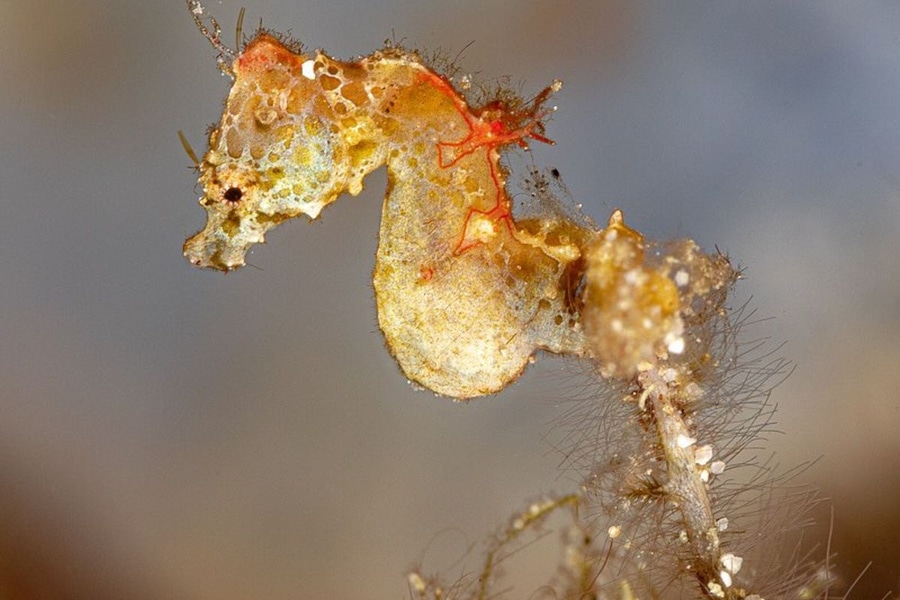
Then there is Pontohi’s pygmy seahorse (Hippocampus pontohi), which behaves quite differently.
Rather than being permanently tied to a particular gorgonian sea fan, Pontohi’s pygmy seahorses can be found among Halimeda algae, seagrass and hydroids. They are also more mobile, moving between different places to hitch onto.
They have relatively smooth skin rather than the pronounced tubercles of gorgonian specialists and can have distinctive red branching filaments along their back.
Their colouring can include a whitish body with yellow, pink or red markings.
So while a gorgonian specialist essentially says:
“This sea fan is my home.”
A Pontohi’s pygmy seahorse is a little more like:
“I’ll see where the current takes me.”
Meet Pontohi’s pygmy seahorse
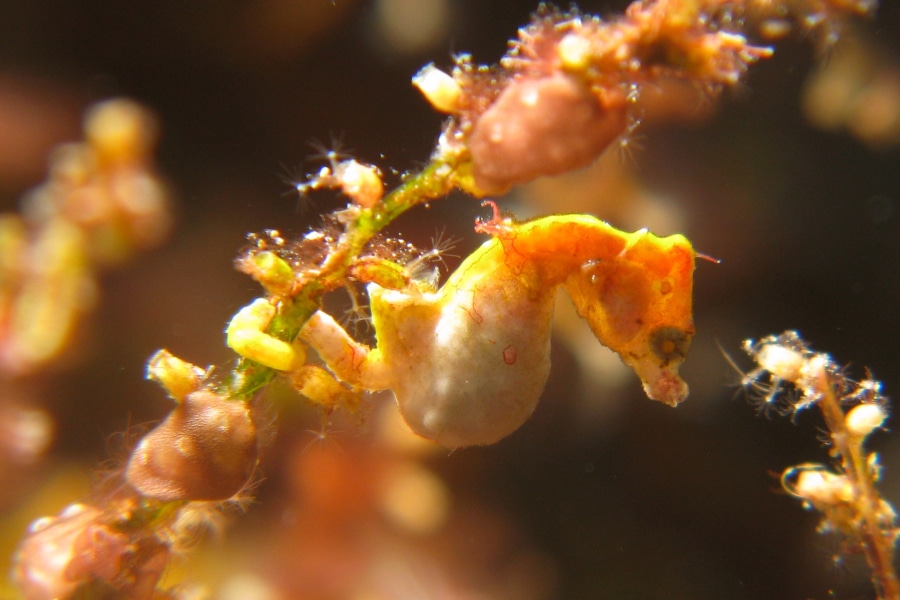
At Bounty Wreck, we have encountered Pontohi’s pygmy seahorse — and this one takes the word tiny to another level.
It can be so small that, when you first look at it, you may genuinely wonder whether you are looking at an animal or simply a tiny piece of algae.
Bounty Wreck is particularly interesting for macro lovers because the coral-covered wreck and surrounding reef provide habitat for a surprising variety of small marine life.
But it also creates a responsibility.
We only show this seahorse to very experienced divers.
The animal itself is tiny, and its habitat is fragile. Getting close enough for a photograph can easily become a problem if a diver touches the reef, sea fan or surrounding habitat.
For us, finding a rare animal is never more important than protecting the place where it lives.
Experienced divers with good buoyancy control can observe it without needing to touch or lean on the reef.
Seahorses: An Underwater Photographer’s Dream
Seahorses are also a dream subject for underwater photographers.
For one thing, they don’t move very much. Unlike a fast-moving reef fish or a passing turtle, a seahorse can spend a long time perched in exactly the same spot, holding onto seagrass, coral or another structure with its tail.
That gives photographers time to compose the shot, adjust their focus and wait for the right moment.
And then there is their appearance.
Their unusual shape, delicate fins, curled tail, textured bodies and beautiful colours make them incredibly photogenic. A well-positioned seahorse can produce a remarkably detailed macro photograph, especially when its background is clean and the animal is isolated from the reef.
But their slow movement can also make them very easy to disturb.
Getting the perfect photograph should never mean grabbing a seahorse, moving it, touching the reef or repeatedly repositioning yourself around the animal. Good buoyancy and patience are usually all you need.
Related articles:
Gili Islands Marine Life: Complete Guide to Underwater Wildlife
Gili Islands Macro Marine Life
Best Dive Sites for Underwater Photographers