


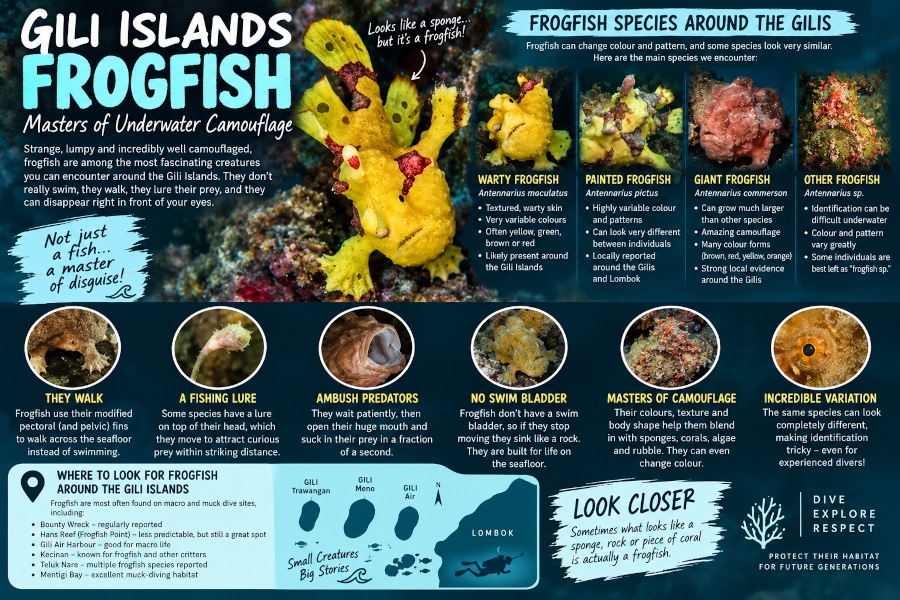
Frogfish are some of the strangest fish you can encounter around the Gili Islands.
They are lumpy, slow-moving and exceptionally good at disappearing. A frogfish can sit on a sponge, coral-covered rock or piece of rubble and look so much like its surroundings that you can swim straight past it.
They also don’t behave much like most fish.
Rather than spending their time swimming around the reef, frogfish spend much of their lives on the seafloor. Their modified fins allow them to walk across the bottom, while their camouflage keeps them hidden from both predators and prey.
Around the Gili Islands, we encounter several types of frogfish. However, identifying them isn’t always easy. Frogfish can vary enormously in colour and pattern, and several species look remarkably similar.
The species currently associated with the area include warty frogfish (Antennarius maculatus), painted frogfish (Antennarius pictus) and giant or Commerson’s frogfish (Antennarius commerson). We also regularly encounter frogfish that are best recorded simply as frogfish when there isn’t enough information to identify the species confidently.
What is a frogfish?
Frogfish belong to the family Antennariidae, a group of anglerfishes found mainly in tropical and subtropical seas.
They are specialised ambush predators. Instead of actively chasing their prey, they sit and wait for an opportunity.
Their entire body is adapted to this lifestyle.
Frogfish have:
- Large, expandable mouths
- Small eyes
- Modified pectoral fins used for walking
- Highly camouflaged skin
- A modified dorsal spine that can form a fishing rod
- A fleshy lure in species that possess an esca
- No swim bladder
Their strange appearance isn’t accidental. The unusual shape, texture and colour of a frogfish help it blend into the environment while allowing it to remain ready to strike.
Frogfish don’t really swim
Watch a frogfish for a few minutes and you’ll realise that it doesn’t really behave like a typical fish.
It walks.
Its pectoral fins are modified into limb-like structures that allow it to move across the seafloor. The pelvic fins also help support and move the body.
Watching one walk can look almost comical. Instead of gracefully swimming over the reef, it pushes itself along the bottom using its fins.
Frogfish can swim when they need to, but this isn’t their normal way of getting around. Their hunting strategy depends on staying close to the seafloor, where they can remain hidden and wait for prey.
They sink like a rock
There is another reason frogfish are so closely connected to the seafloor.
They don’t have a swim bladder.
Many bony fish use a swim bladder to control their buoyancy and remain suspended in the water without constantly swimming. Frogfish don’t have this option.
If a frogfish stops actively moving in open water, it will sink.
That isn’t really a problem for a fish that spends its life walking, sitting and waiting on the bottom.
Masters of camouflage
Camouflage is probably the most impressive thing about frogfish.
Their body shape, colour and skin texture can make them look like:
- Sponges
- Rocks
- Coral
- Algae
- Encrusted reef growth
- Pieces of rubble
Some frogfish can also change colour over time, allowing them to better match their surroundings.
But colour is only part of the story.
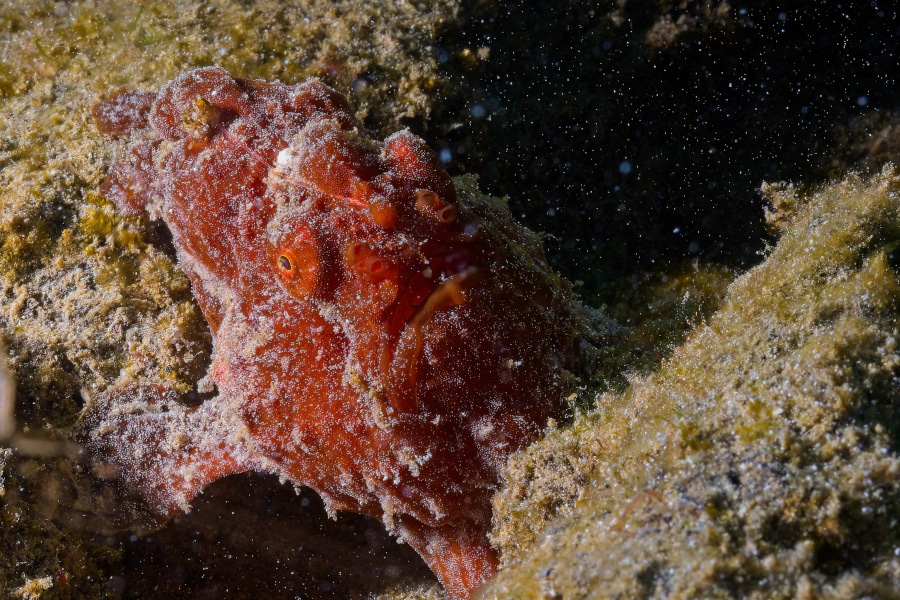
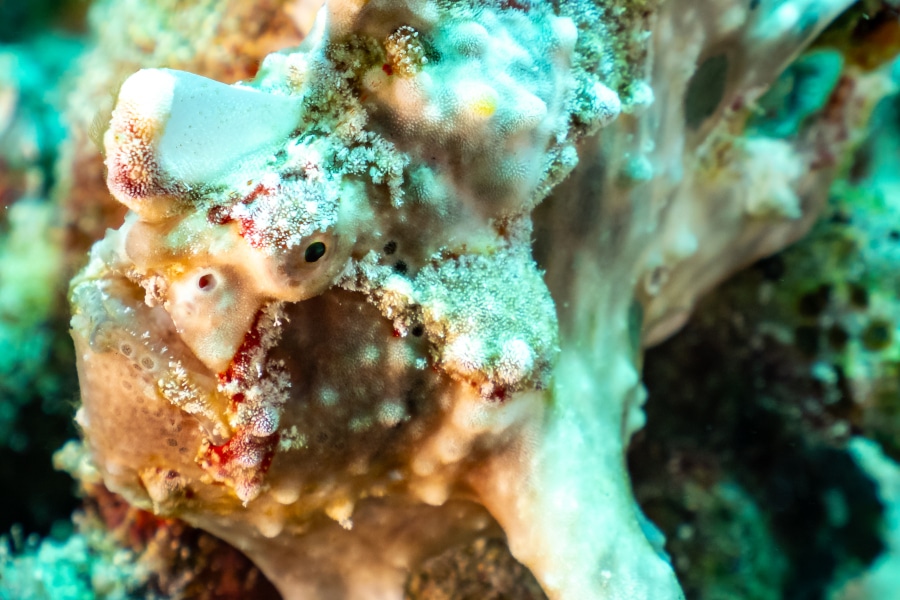
Their skin can be covered in bumps, folds and irregular textures that break up the outline of the animal. Small organisms can also grow on the skin, adding another layer to the disguise.
This is particularly obvious in some of the frogfish we’ve photographed around the Gili Islands.
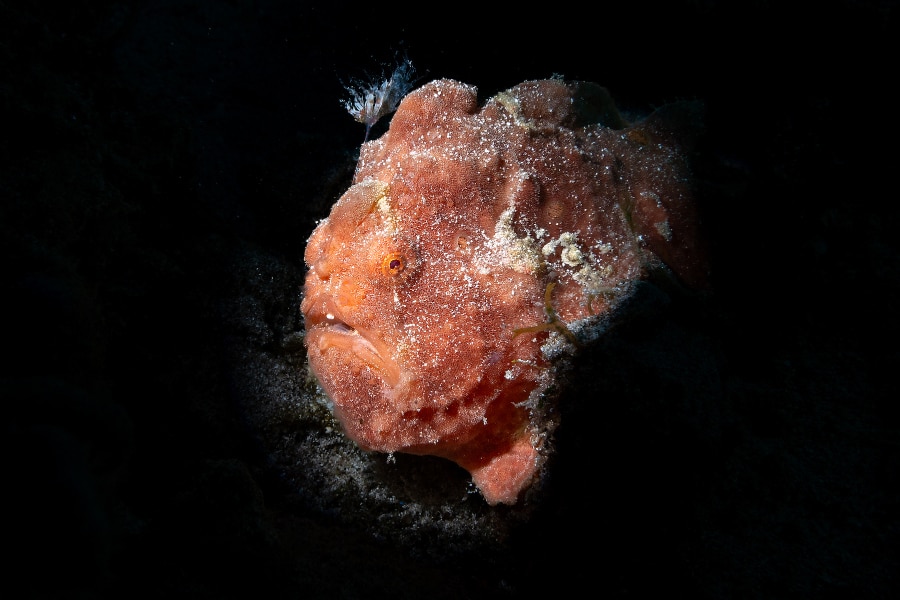
A red frogfish covered in algae can look like part of the reef. A pale frogfish covered in growth can resemble a sponge.
You can know that there is a frogfish somewhere on the reef and still have trouble finding it.
That is one reason local knowledge makes such a difference when looking for them.
The fishing rod on their head
Some frogfish have an extraordinary hunting tool built into their dorsal fin.
The first dorsal spine has evolved into a movable stalk called the illicium. At the end can be a fleshy structure called the esca, which acts as a lure.
The frogfish can move the lure above its head to attract potential prey.
Different frogfish species have different-looking lures, and they can resemble small animals such as worms or crustaceans.
The strategy is simple.
The frogfish stays hidden.
It moves the lure.
A curious fish comes closer.
Then the frogfish strikes.
The fastest mouth on the reef?
Frogfish don’t chase their prey. They wait until it comes within range and then swallow it with an incredibly rapid movement.
The frogfish opens its huge mouth and rapidly expands its mouth cavity. This creates suction, drawing water and the unfortunate prey into the mouth.
The whole process happens extremely quickly.
Their expandable stomachs also allow them to swallow surprisingly large prey relative to their own body size.
The frogfish we see around the Gili Islands
Frogfish identification can be difficult, even for experienced divers.
Colour isn’t enough to identify a species. The same species can occur in very different colours, while two different species can look remarkably similar.
For that reason, we prefer to be conservative when identifying the frogfish we encounter.
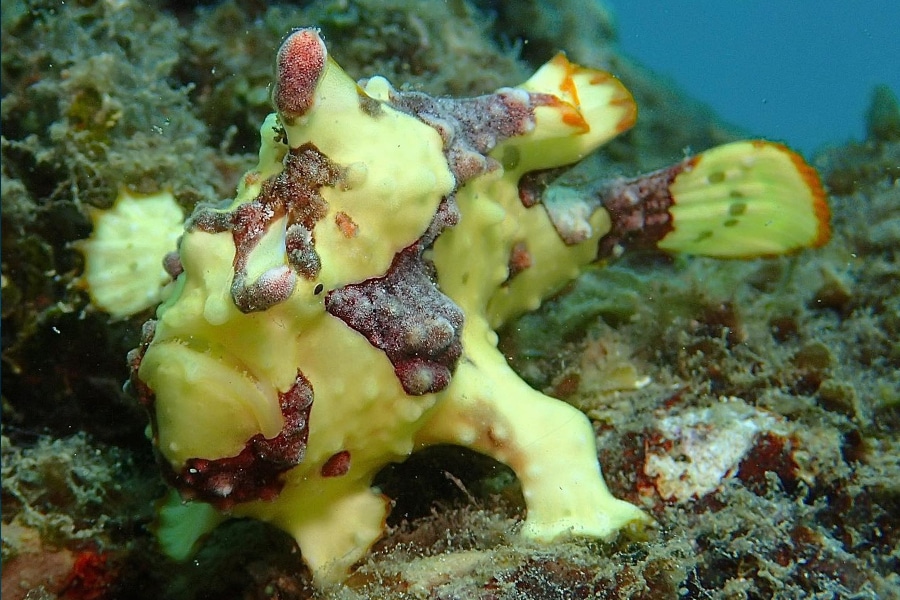
Warty frogfish — Antennarius maculatus
The warty frogfish has a heavily textured body covered with wart-like structures.
It can occur in a range of colours, including yellow, greenish, brown and reddish forms, often with contrasting markings.
Some of the colourful frogfish photographed around the Gili Islands appear consistent with Antennarius maculatus, but we would not automatically assign every similarly coloured frogfish to this species.
Painted frogfish — Antennarius pictus
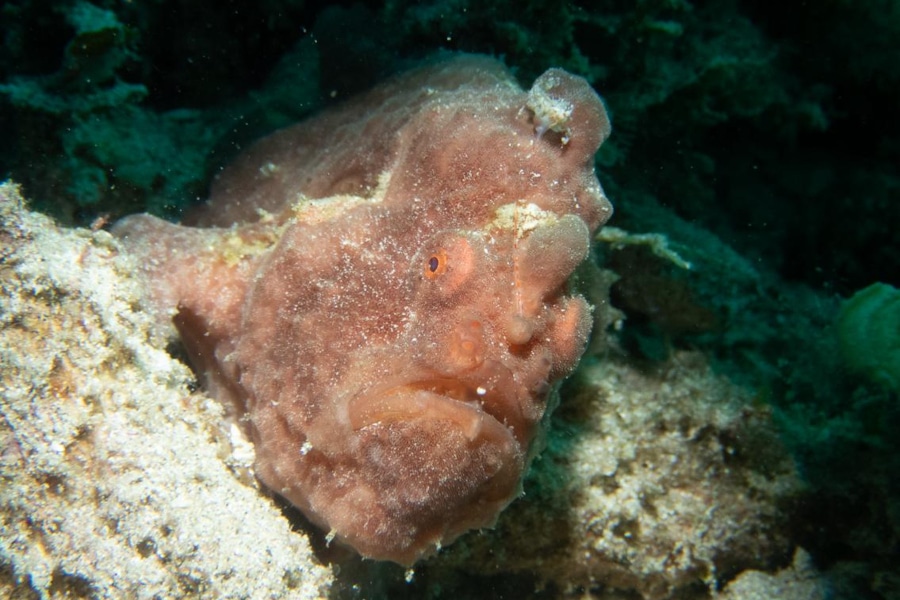
The painted frogfish is another highly variable species found throughout the tropical Indo-Pacific.
Its colour and markings can differ considerably between individuals, which makes identification from a single photograph difficult.
It is locally reported around the Gili Islands and nearby Lombok.
Giant or Commerson’s frogfish — Antennarius commerson
Then there is the big one.
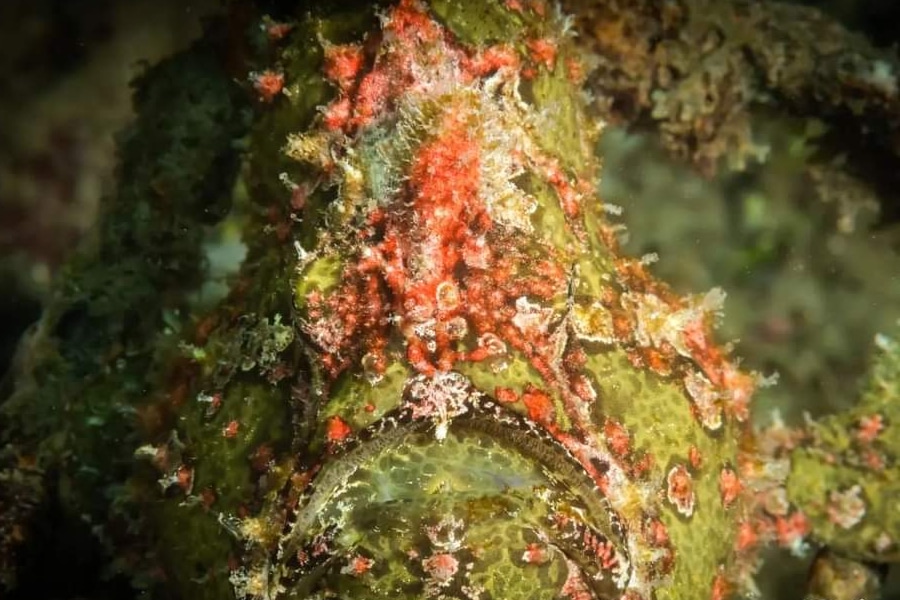
The giant frogfish, also known as Commerson’s frogfish, can become considerably larger than the smaller frogfish species.
Despite its size, it can be remarkably difficult to spot.
Large individuals can be brown, orange, red, yellow or mottled, and their colouring can blend almost perfectly with coral-covered rocks and sponges.
Other frogfish
And then there are the frogfish that we simply can’t identify with confidence.
This is completely normal.
When a photograph doesn’t show enough diagnostic features, it is better to say frogfish, species undetermined than to make a confident-sounding guess.
Where can you find frogfish around the Gili Islands?
Frogfish are particularly associated with the macro and muck-diving habitats around the islands and northwest Lombok.
Bounty Wreck is one of our better-known places to look, with its heavily encrusted structures providing plenty of hiding places.
Hans Reef, also known as Frogfish Point, has historically been famous for frogfish, although sightings are less predictable than they once were.
Around Lombok, Kecinan, Mentigi Bay and Teluk Nare are also good places to search. Their mixture of sand, rubble, artificial structures, algae and other growth provides exactly the sort of habitat that cryptic animals need.
Our guide to muck diving in the Gili Islands and Lombok also explains why places such as Kecinan, Mentigi Bay and Teluk Nare are so productive for unusual macro life.
Frogfish are built for patience
Most fish need to keep moving to find food.
Frogfish have found another solution.
They sit.
Their camouflage keeps them hidden, their lure can bring prey closer and their huge mouths allow them to swallow prey in an instant.
That means a frogfish can spend a remarkable amount of time doing almost nothing.
But “doing nothing” isn’t quite right.
It is watching.
The eyes are positioned to help the frogfish judge its surroundings and potential prey. The fish remains ready to strike while using as little energy as possible.
For an ambush predator, patience is an advantage.
Why do frogfish look so strange?
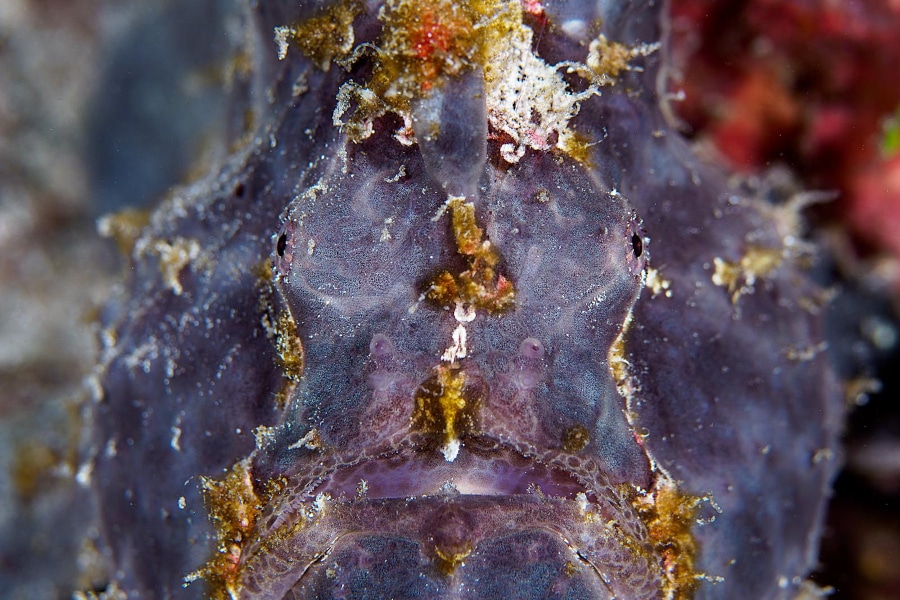
The strange appearance of a frogfish makes much more sense when you understand how it lives.
A fast-swimming fish needs a streamlined body.
A frogfish doesn’t.
It needs a body that can disappear into a sponge.
Its irregular outline makes it harder to recognise. Its modified fins allow it to move along the bottom. Its skin helps it blend into its surroundings.
Even its lack of a swim bladder fits the lifestyle.
Everything about a frogfish points towards one thing:
Stay on the seafloor. Stay hidden. Wait.
Frogfish and underwater photography
Frogfish are fantastic subjects for underwater photographers.
They don’t normally swim away when approached slowly, giving you time to compose an image.
The most interesting photographs often show the frogfish together with its surroundings. Instead of simply photographing the animal, you can show the camouflage that makes it so unusual.
As with all macro subjects, good buoyancy is essential.
Don’t touch, move or reposition a frogfish to get a better photograph. If you need to move coral or other reef growth to reveal the animal, the photograph isn’t worth it.
The best frogfish photographs are the ones that show the animal behaving naturally.
For more tips, see our complete underwater photography guide.