


Every coral reef starts with something almost impossible to imagine.
Not a giant coral colony.
Not a colourful reef.
Not even a tiny branching coral.
It starts with a larva.
Smaller than a grain of rice.
Every coral head you see while scuba diving in the Gili Islands began life drifting through the ocean, searching for the perfect place to settle.
Some coral colonies you dive over today may be hundreds of years old.
Entire reefs have taken thousands of years to grow.
Yet every single one began in exactly the same way.
Understanding how corals reproduce helps us appreciate not only how reefs are created, but also why they are so fragile—and so remarkably resilient.
Corals Are Animals
Before talking about reproduction, it helps to remember one important fact.
Although they may look like colourful rocks or underwater plants, corals belong to the same group of animals as jellyfish and sea anemones.
Each coral colony is made up of thousands of tiny animals called polyps.
These polyps work together as a single colony, sharing food, nutrients, and energy.
Like all animals, corals must reproduce to ensure the survival of their species.
They do this in two very different ways.
Two Ways Corals Reproduce
Corals reproduce through:
- Sexual reproduction, creating entirely new coral colonies.
- Asexual reproduction, allowing existing colonies to grow or spread.
Both methods are essential for healthy coral reefs.
One creates genetic diversity.
The other helps reefs recover after storms and other natural disturbances.
Sexual Reproduction: A New Beginning
The most spectacular way corals reproduce is through broadcast spawning.
Once a year, under the right environmental conditions, many coral colonies release millions of tiny eggs and sperm into the water at almost exactly the same time.
For a few magical hours, the ocean fills with tiny floating bundles that drift towards the surface.
To divers lucky enough to witness it, it can look like an underwater snowstorm.
Why do corals release everything at once?
Because timing increases their chances of success.
When thousands of coral colonies spawn together, the likelihood of eggs and sperm meeting is dramatically increased.
From Egg to Coral Larva
After fertilisation, the tiny embryos begin developing into free-swimming larvae called planulae.
These microscopic larvae drift with ocean currents for days or sometimes even weeks.
During this journey they may travel surprisingly long distances.
Some larvae settle only a few metres from their parent colony.
Others may help establish reefs many kilometres away.
This natural dispersal allows coral reefs to spread and recover over time.
Finding the Perfect Home
Eventually, the tiny larva must make one of the most important decisions of its life.
Where to settle.
Finding the wrong location usually means death.
The perfect location needs:
- A hard surface
- Clean water
- Plenty of sunlight
- Good water movement
- Little competition from algae
Healthy reefs provide exactly these conditions.
Once the larva settles, it permanently attaches itself to the surface.
It will never swim again.
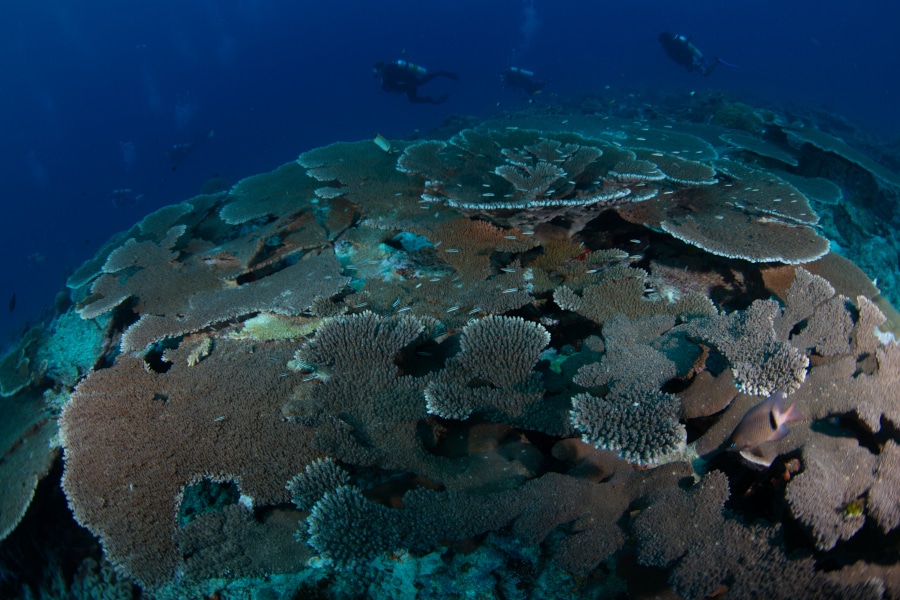
Building a Coral Colony
After settling, the tiny coral polyp begins producing a limestone skeleton.
It divides again and again.
New polyps remain connected.
Slowly, a colony begins to grow.
Year after year, the colony expands.
Branches develop.
Plates form.
Massive coral heads slowly increase in size.
Eventually, thousands of individual polyps work together as one living colony.
Over hundreds and thousands of years, countless colonies build the reefs that divers enjoy today.
Asexual Reproduction: Nature’s Shortcut
Corals have another remarkable way of reproducing.
They can clone themselves.
This process is known as asexual reproduction.
Instead of producing eggs and sperm, coral colonies simply grow larger by producing new genetically identical polyps.
Each new polyp remains connected to the colony.
This allows coral colonies to become enormous over time.
Fragmentation: Turning Damage into Opportunity
One of the most fascinating forms of asexual reproduction is fragmentation.
Anchors may break pieces off branching corals.
At first glance, this appears disastrous.
But if the broken fragment lands on a suitable surface, it can attach itself and continue growing into an entirely new colony.
What looks like destruction can actually become a new beginning.
This natural process is also the reason many coral restoration projects are so successful.
Rather than collecting healthy corals from the reef, conservationists often use naturally broken fragments.
These fragments are attached to restoration structures where they continue growing.
Why Genetic Diversity Matters
If corals only reproduced by cloning themselves, every colony would be genetically identical.
That would make reefs far more vulnerable to disease and environmental change.
Sexual reproduction creates genetic diversity.
Some young corals may tolerate warmer water better.
Others may grow faster.
Some may be more resistant to disease.
This diversity gives coral reefs their remarkable ability to adapt over time.

Coral Reproduction and Reef Recovery
Coral reproduction is one of nature’s greatest recovery mechanisms.
After storms, bleaching events, or other disturbances, new coral larvae gradually settle onto suitable surfaces.
Over time, damaged reefs begin rebuilding themselves.
This process is slow.
Very slow.
A reef damaged in a single day may require decades to recover fully.
That is why protecting healthy reefs is always more effective than trying to restore damaged ones later.
Why Healthy Fish Matter
Coral larvae cannot settle successfully if algae completely cover the reef.
Fortunately, herbivorous fish such as parrotfish and surgeonfish constantly graze algae, creating space for new corals to establish themselves.
This is one of the many reasons healthy fish populations are essential for healthy coral reefs.
Without fish, successful coral reproduction becomes much more difficult.
What Divers Can Do
Most coral reproduction happens unnoticed beneath the waves.
Yet divers can still help.
Maintain good buoyancy.
Never touch or break coral.
Support responsible dive operators.
Choose reef-safe sunscreen.
Protect the fish that keep reefs healthy.
Every healthy coral colony you avoid touching may one day produce millions of larvae that help build the reefs of the future.