


Just next to Kecinan on the north western coast of Lombok, Mentigi Bay offers a completely different kind of diving from the coral reefs around the Gili Islands.
Also known as Seahorse Bay, it is a sheltered muck dive where the sandy bottom is home to an impressive collection of unusual and well-camouflaged marine life.
Located about 25-30 minutes by boat from Gili Meno, Mentigi Bay is often protected from the stronger currents that influence many of the Gili Islands’ dive sites.
The result is a calm, relaxed environment where divers can slow down and search the bottom without constantly being carried along by the current.
And when it comes to macro diving, slowing down is exactly what you want to do.
A Sheltered Bay Full of Critters
Mentigi Bay consists mainly of sand, silt and scattered rubble, with patches of seagrass in the shallower areas. It may not look particularly spectacular when you first descend, but this seemingly simple environment provides ideal habitat for creatures that are rarely found on the coral reefs around the Gili Islands.
There are no dramatic coral gardens or walls to follow and no reason to cover large distances.
Instead, the dive is about looking carefully at what is directly in front of you.
A movement in the sand could reveal a buried stargazer. A piece of rubble might be hiding a frogfish. A seagrass frond could be home to a seahorse or ghost pipefish.
And if you’re lucky, you may encounter something considerably more unusual.
Why Mentigi Bay Is So Calm
One of the biggest advantages of Mentigi Bay is its sheltered location.
The bay is naturally protected from the currents of the Lombok Strait that influence many of the Gili Islands’ dive sites. While conditions can vary, Mentigi is often remarkably calm and current-free.
This changes the entire character of the dive.
Instead of drifting with the current and looking for subjects as you pass them, you can stay in one area and observe. Creatures are not being swept across the bottom, and photographers have time to position themselves carefully and wait for the right moment.
For macro photographers, this can be a huge advantage.
You can spend several minutes photographing a stationary subject without having to constantly adjust your position because the current is moving you away.
Seahorses in the Seagrass
The shallow seagrass areas are one of the highlights of Mentigi Bay.
At around 5–8 metres, the seagrass provides habitat for seahorses, which can often be found gripping individual fronds with their tails.
These tiny animals can be remarkably difficult to spot. Take your time and scan the seagrass carefully rather than swimming quickly across it.
Ghost pipefish can also be found in the shallows, making this one of the most productive areas of the site for macro photographers.
The shallow depth also makes it possible to spend a long time searching without worrying about depth becoming a limiting factor.
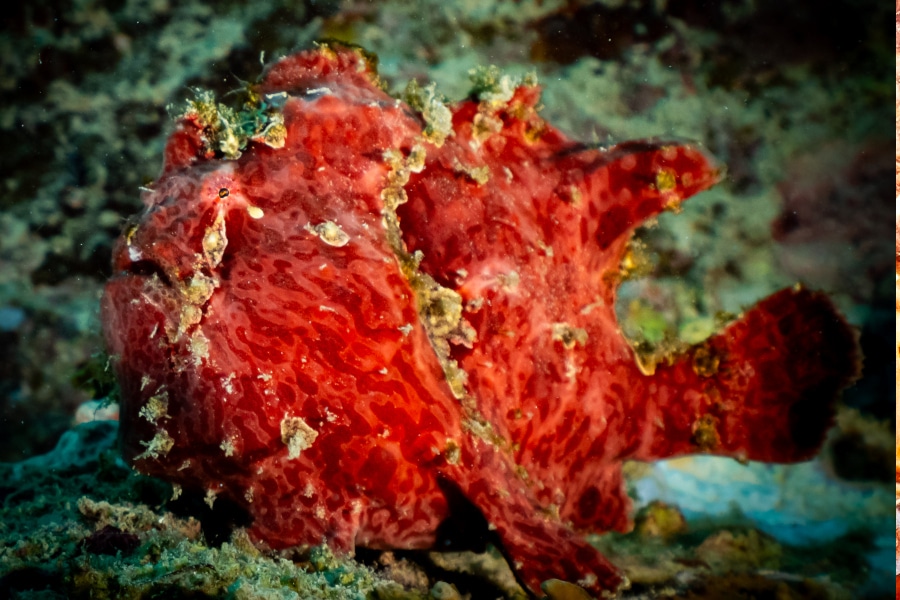
Frogfish and Ribbon Eels
Mentigi Bay is particularly good for divers who enjoy unusual and cryptic marine life.
Frogfish, ribbon eels and different species of pipefish are among the site’s regular residents.
Ribbon eels are especially fascinating because they can appear in different colour forms during their life cycle. They live in burrows in the sandy substrate, so once you find one, patience is usually rewarded with a fascinating observation of the animal emerging from its hiding place.
Frogfish can be much harder to spot. Their camouflage allows them to blend into their surroundings, and they may remain completely motionless while waiting for prey.
This is classic muck diving: the animal is often right in front of you—you just have to see it.
Flamboyant Cuttlefish
One of the most exciting encounters at Mentigi Bay is the flamboyant cuttlefish.
Unlike most cuttlefish, which primarily swim, flamboyant cuttlefish are famous for moving across the seabed using their arms and fins. They can often be seen slowly hunting across the sand.
Experienced guides may know specific areas where these cuttlefish tend to forage, making local knowledge particularly valuable.
If you encounter one, slow down and watch rather than immediately trying to follow it. Their hunting behaviour can be fascinating to observe, and the relatively calm conditions at Mentigi provide excellent opportunities for photography.
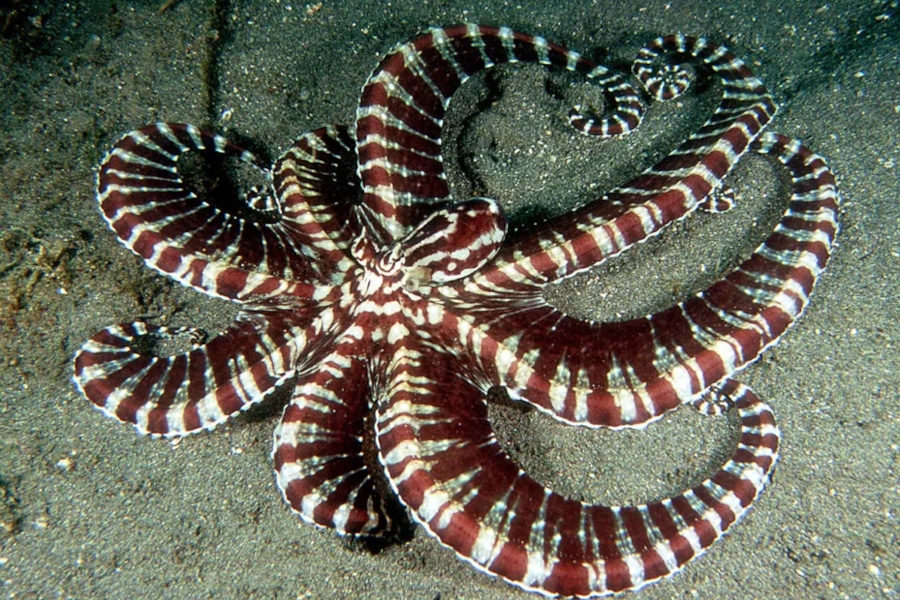
Mimic Octopus
For many divers, finding a mimic octopus would be enough to make the entire dive.
These remarkable octopuses are famous for their ability to imitate the appearance and behaviour of other animals. They can move across the open sand, changing their behaviour and appearance as they go.
They are not guaranteed on every dive, but Mentigi Bay provides the sandy habitat in which they can be encountered.
This is one of those moments when muck diving really delivers. You’re looking at what appears to be an ordinary sandy bottom—and suddenly something extraordinary appears.
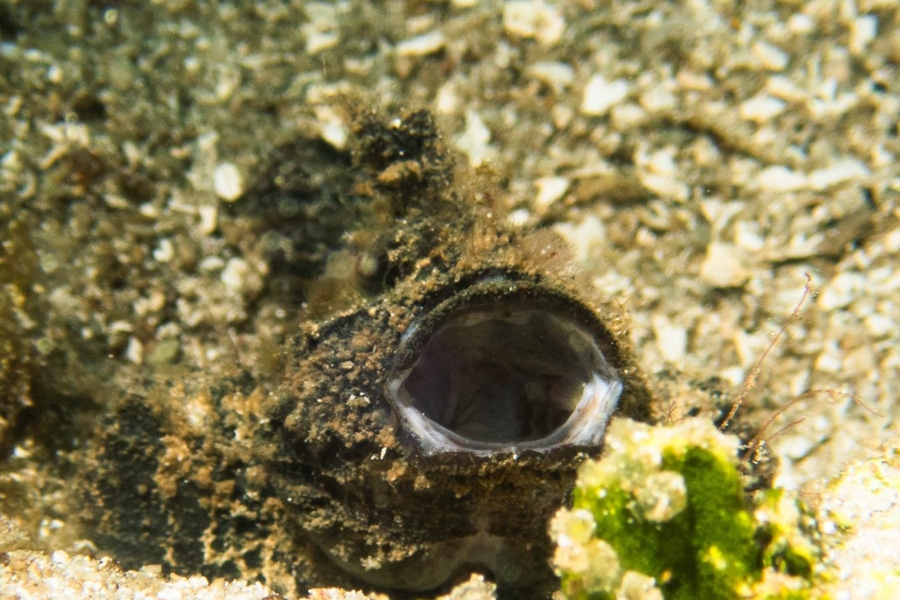
Look Closely at the Sand
The sand is one of the most important features of Mentigi Bay.
It provides habitat for animals that spend much of their lives partially or completely buried.
Stargazers, for example, can lie hidden beneath the sand with only their eyes visible, waiting for prey to pass overhead.
Devil scorpionfish can also be remarkably difficult to see, resting motionless against the substrate.
Various species of sand-burying crabs emerge from their hiding places during active feeding periods, adding yet another group of creatures to the list of potential encounters.
This is why Mentigi is best approached as a treasure hunt rather than a traditional reef dive.
A Nursery for Young Fish
The site isn’t only interesting because of its unusual adult animals.
Mentigi Bay also acts as a nursery for many reef fish, with numerous juveniles using the sheltered environment for protection.
For divers who enjoy looking at small details, this adds another layer to the dive. Tiny juvenile fish can be found among the seagrass, rubble and other structures, often behaving very differently from their adult counterparts.
It is easy to swim past them without noticing, which is another reason why a slow pace works so well here.
Perfect for Macro Photography
Mentigi Bay is particularly well suited to underwater macro photography.
A macro lens is ideal for small subjects such as seahorses, pipefish, nudibranchs and shrimp, while slightly wider compositions can work well when photographing larger animals such as frogfish, cuttlefish or octopus within their surroundings.
But the most important piece of equipment is still good buoyancy.
How to Dive Mentigi Bay
Mentigi is not a site where you want to rush.
A good approach is to move no faster than walking pace and spend most of the dive hovering just above the substrate, scanning methodically.
Look at the sand.
Then look again.
Check the edges of seagrass, small rubble patches and anything that looks slightly out of place. Watch for movement rather than simply searching for obvious shapes.
And don’t be afraid to spend several minutes in one small area. In muck diving, covering less ground can actually mean seeing more.
Mentigi Bay and Kecinan
One of the advantages of diving Mentigi Bay is its location right next to Kecinan.
Both sites offer excellent macro and muck diving, but they have quite different characters.
Kecinan is a large bay with anchor lines, artificial reef structures, seagrass, rubble and coral blocks, offering enough variety for multiple dives.
Mentigi is more sheltered and sandy, with fewer structures and a particular focus on cryptic, burrowing and sand-dwelling species.
Together, the two sites make an excellent combination for divers interested in macro photography and unusual marine life.
Is Mentigi Bay Suitable for Beginners?
Yes. Mentigi Bay is suitable for all certified divers, and the generally calm conditions make it a particularly relaxed environment for exploring macro life.
The main skill to focus on is buoyancy.
You don’t need to be an expert photographer or an experienced critter hunter. With a good guide, patience and controlled buoyancy, even newer divers can enjoy the site and learn how to search for small marine life.