

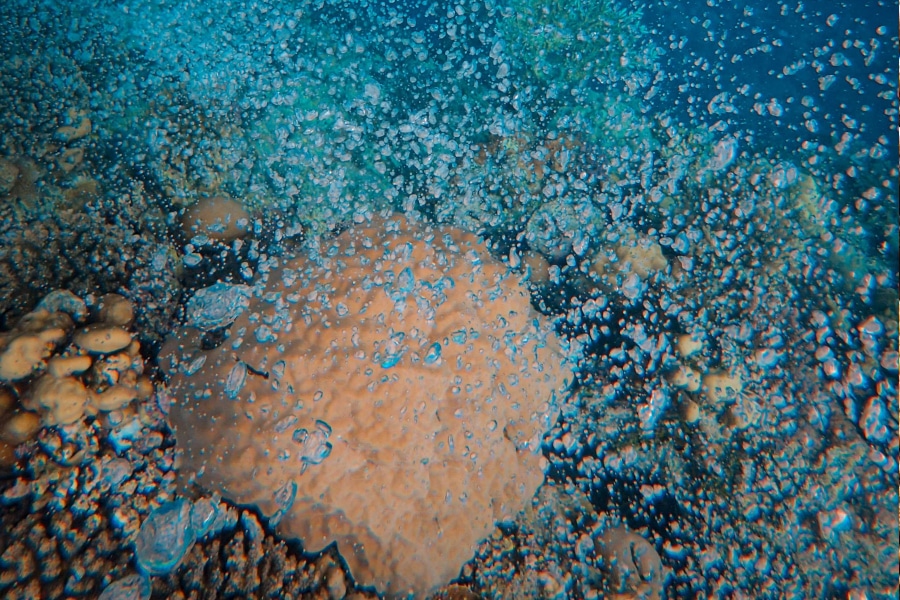
Every year, something extraordinary happens beneath the waters surrounding the Gili Islands.
Without warning to most divers, thousands of coral colonies release millions of eggs and sperm into the sea at almost exactly the same moment.
For a few magical hours, the reef comes alive.
Tiny pink, orange and white bundles drift towards the surface like an underwater snowstorm.
Fish gather to feed.
The water fills with life.
And the next generation of coral reefs begins.
Coral spawning is one of the greatest natural events in the ocean.
Yet very few people ever witness it.
What Is Coral Spawning?
Coral spawning is the annual reproductive event during which many hard coral species release eggs and sperm into the water.
Unlike fish or turtles, corals cannot move to find a mate.
Instead, thousands of coral colonies reproduce together.
This phenomenon is known as broadcast spawning.
By releasing enormous numbers of eggs and sperm simultaneously, corals dramatically increase the chances of successful fertilisation.
It is one of nature’s most remarkable examples of perfect timing.
Why Do Corals Spawn Together?
Scientists believe coral spawning is triggered by several environmental factors working together.
These include:
- Water temperature
- Moon phase
- Day length
- Tides
- Sunset
Rather than relying on a single trigger, corals appear to use several natural cues.
This allows thousands of colonies to synchronise their spawning within a remarkably short period.
Even today, researchers continue studying exactly how this incredible timing works.
Coral Spawning in the Gili Islands
The reefs surrounding Gili Meno, Gili Air and Gili Trawangan are part of the Coral Triangle, home to the greatest diversity of reef-building corals on Earth.
As expected, many of these coral species also participate in annual spawning events.
During our observations around the Gili Islands, one of the major coral spawning events took place on 12 October 2025.
While spawning dates can vary slightly from year to year depending on environmental conditions, October is an exciting period for divers interested in reef ecology.
Every spawning event is slightly different.
Different coral species may spawn on different nights or even at different times during the evening.
That unpredictability makes witnessing the event even more special.

What Does Coral Spawning Look Like?
Most divers expect something dramatic.
The reality is surprisingly gentle.
Small bundles containing eggs and sperm slowly emerge from the coral colonies.
They rise towards the surface with the current.
Within minutes, the water begins filling with thousands—sometimes millions—of tiny floating bundles.
Under a dive torch they shimmer like snowflakes drifting through the water.
Some divers describe it as an underwater blizzard.
Others compare it to watching a galaxy form around them.
It is one of those underwater experiences that is difficult to describe until you have seen it yourself.
What Happens After Spawning?
The spawning itself is only the beginning.
Once the eggs and sperm meet, fertilisation occurs.
Tiny embryos develop into free-swimming larvae called planulae.
These microscopic larvae drift with the currents for several days or even weeks.
Eventually, they search for the perfect place to settle.
If they find:
- Clean water
- Healthy reef
- Hard substrate
- Plenty of sunlight
they attach themselves permanently.
From that single tiny larva, an entirely new coral colony begins to grow.
The reefs divers explore decades from now may begin during a single spawning night.
Why Coral Spawning Is So Important
Coral spawning does far more than create new coral colonies.
It maintains genetic diversity.
It allows reefs to recover after storms and bleaching events.
It connects reefs across enormous distances as larvae drift with ocean currents.
Without successful spawning, coral reefs could not replace aging colonies or recover from natural disturbances.
Every healthy reef depends on successful reproduction.
A Feast for Marine Life
Coral spawning is not only important for corals.
Many reef animals eagerly await it.
Fish quickly gather to feed on the nutrient-rich eggs and sperm.
Plankton populations increase.
Other marine animals take advantage of this temporary abundance of food.
For the reef ecosystem, spawning is one of the largest seasonal events of the year.
Nothing goes to waste.
Why Healthy Reefs Matter
Successful coral spawning depends on healthy coral colonies.
Damaged reefs produce fewer larvae.
Corals weakened by pollution, disease or bleaching often reproduce less successfully.
This is why protecting healthy reefs is so important.
Good water quality.
All contribute to successful coral reproduction.
Every healthy reef improves the chances that future generations of corals will continue building the incredible underwater landscapes found throughout the Gili Islands.
Can Divers Witness Coral Spawning?
Yes.
Although timing is never guaranteed.
Many spawning events take place after sunset or during the evening.
Some years are more spectacular than others.
Because spawning depends on several environmental factors, predicting the exact timing remains difficult.
For night divers lucky enough to witness it, however, it is often described as one of the most unforgettable experiences of their lives.