


The Gili Islands are home to a surprising variety of rays. From small blue-spotted rays hiding on the reef to large manta rays cruising through open water, you never quite know what you might encounter on a dive.
The most common rays we see include bluespotted ribbontail rays, Kuhl’s stingrays, marble rays, eagle rays, mobulas and manta rays.
Some spend most of their time on the seabed. Others are constantly moving through the water column. Knowing the difference makes each encounter even more interesting.
Bluespotted Ribbontail Rays
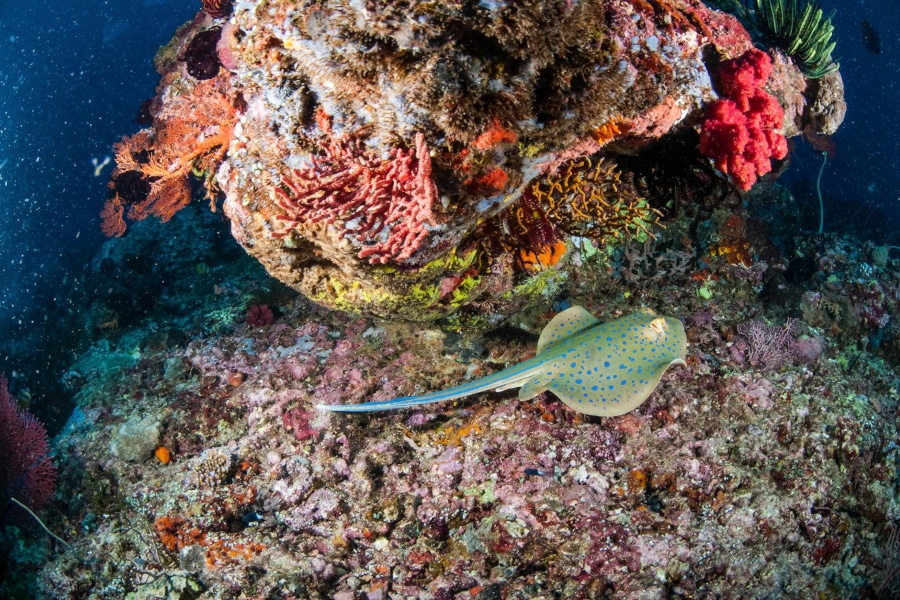
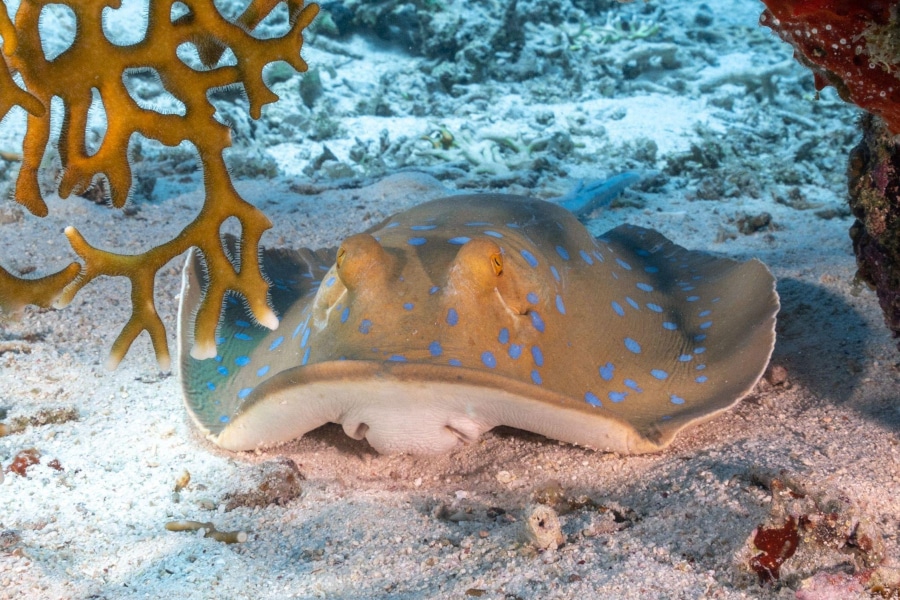
Bluespotted ribbontail rays are among the smaller rays you can see around the Gili Islands.
They are easy to recognise by their bright blue spots against a brownish or grey body. Usually, they stay close to the seabed, often resting on sand or around the edge of the reef.
Those bluespotted rays are most commonly seen around Halik, Shark Point and Hans Reef, particularly on deeper sections of these sites.
They are generally quite shy. If you approach too quickly, they will often disappear across the sand before you get a good look.
Kuhl’s Stingrays
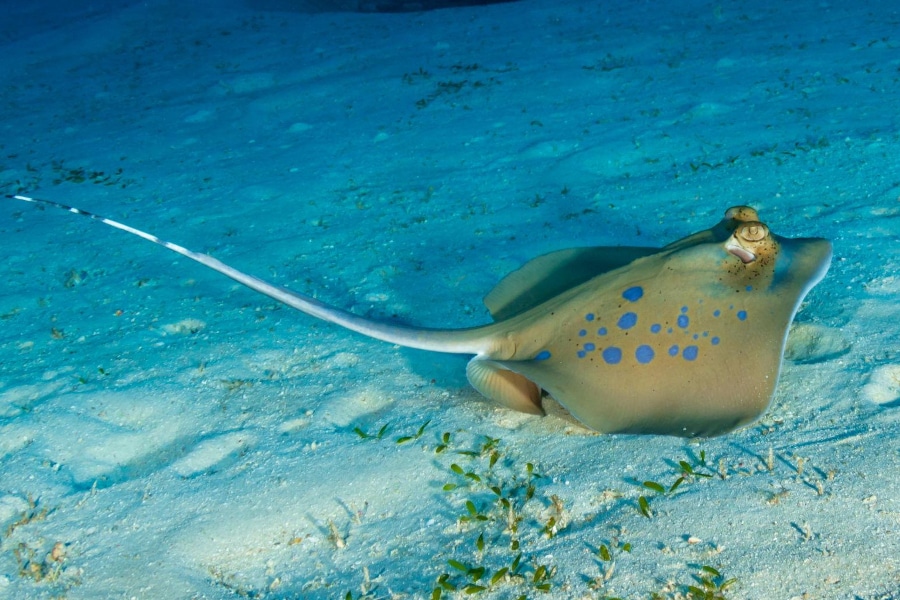
Kuhl’s stingrays are also regularly seen around the Gili Islands, especially at Halik, Shark Point and Hans Reef.
They have a more rounded body than the bluespotted ribbontail ray and are usually less brightly marked. Their colouring helps them blend into the sandy seabed.
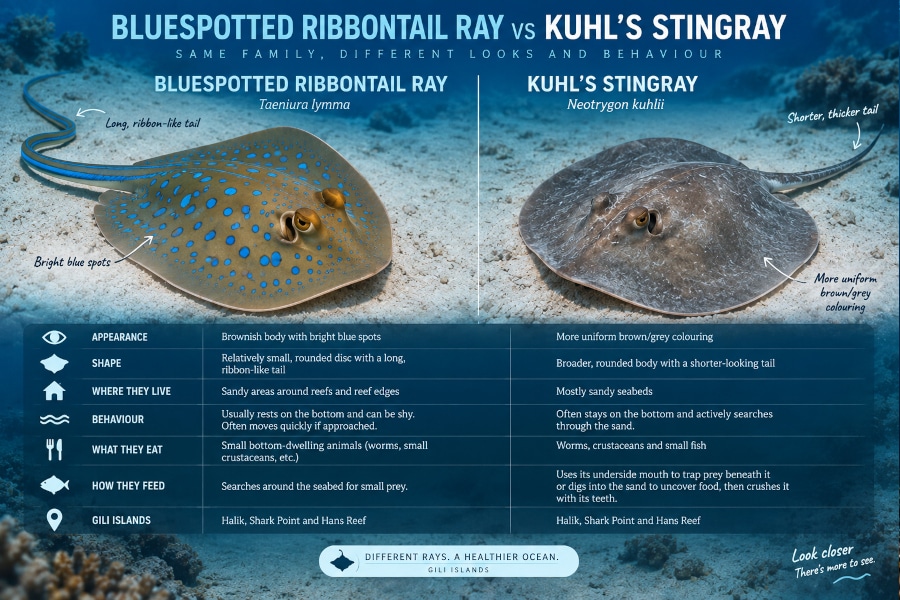
Bluespotted Ribbontail Ray vs Kuhl’s Stingray
Although both are bottom-dwelling rays commonly seen around the Gili Islands, they look and behave quite differently.
| Bluespotted Ribbontail Ray | Kuhl’s Stingray | |
|---|---|---|
| Appearance | Brownish body covered with bright blue spots | More uniform brown/grey colouring with a few blue spots |
| Shape | Relatively small, rounded disc with a long, ribbon-like tail | Broader, rounded body with a shorter-looking tail |
| Where they live | Sandy areas around reefs and reef edges | Mostly sandy seabeds |
| Behaviour | Usually rests on the bottom and can be quite shy | Often stays on the bottom and actively searches through the sand |
| What they eat | Small bottom-dwelling animals | Worms, crustaceans and small fish |
| How they feed | Searches around the seabed for small prey | Uses its underside mouth to trap or uncover prey in the sand, then crushes it with its teeth |
| Gili Islands | Halik, Shark Point and Hans Reef | Halik, Shark Point and Hans Reef |
The easiest difference to spot is the colour: the bright blue spots of a bluespotted ribbontail ray are hard to miss. Kuhl’s stingrays are much more subtly coloured and often blend into the sand.
Both have a venomous spine on their tail, so even though they are peaceful animals, they should always be given plenty of space.
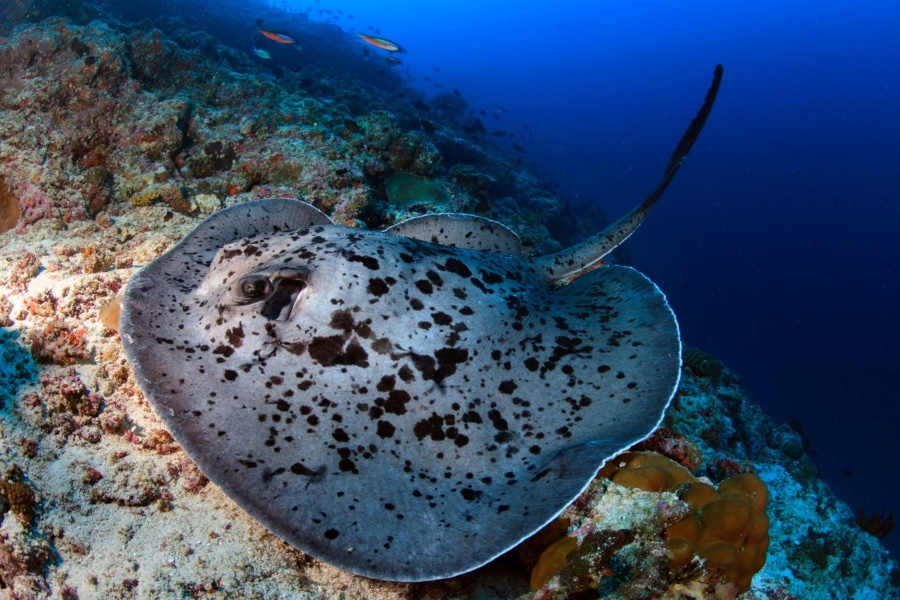
Marble Rays
Marble rays are usually found over sandy areas, rather than at one particular dive site. Seeing a marble ray is often a matter of being in the right place at the right time.
They spend much of their time close to the bottom, where their colouring helps them blend into their surroundings.
What Do Stingrays Eat?
Stingrays are hunters of the seabed.
They feed on worms, crustaceans and small fish hidden in the sand. Because their mouth is located underneath their body, they can trap prey beneath themselves or dig into the sand to uncover it.
Once they have found their food, their teeth help them crush hard-shelled prey such as crustaceans.
Watching a stingray feeding can be fascinating. You may see one pushing its body into the sand or stirring up the seabed as it searches for something underneath.
Mobulas
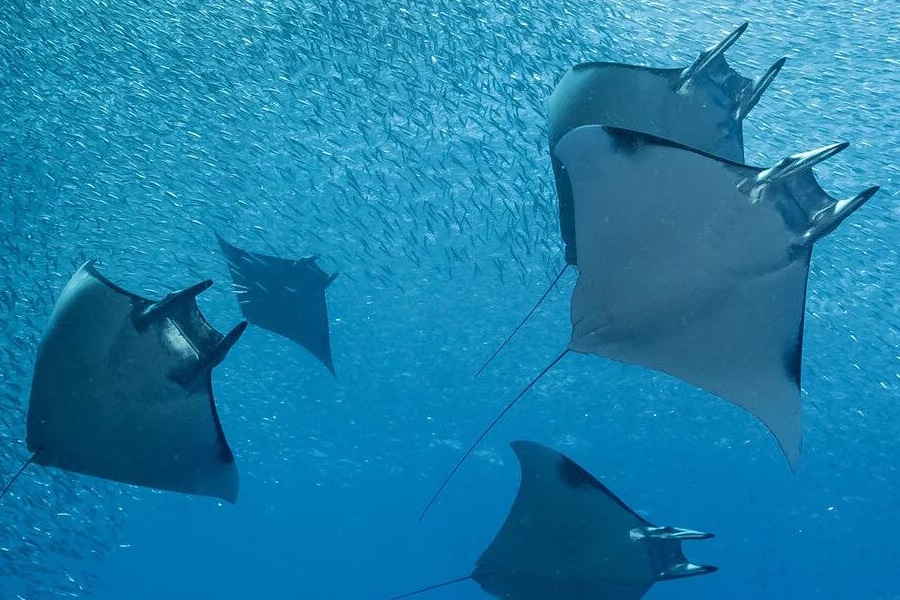
Mobulas are a very different kind of ray.
Instead of resting on the bottom, they spend their time swimming through the open water. They are often seen in groups of one to six animals, although the size of a group can vary.
Around the Gili Islands, Shark Point, Halik and Sunset are some of the places where we regularly look for them.
The best period for mobula sightings is generally July to October.
Seeing several mobulas swimming together is an impressive sight. They move through the water with powerful but graceful wingbeats, sometimes changing direction together as they search for food.
Manta Rays
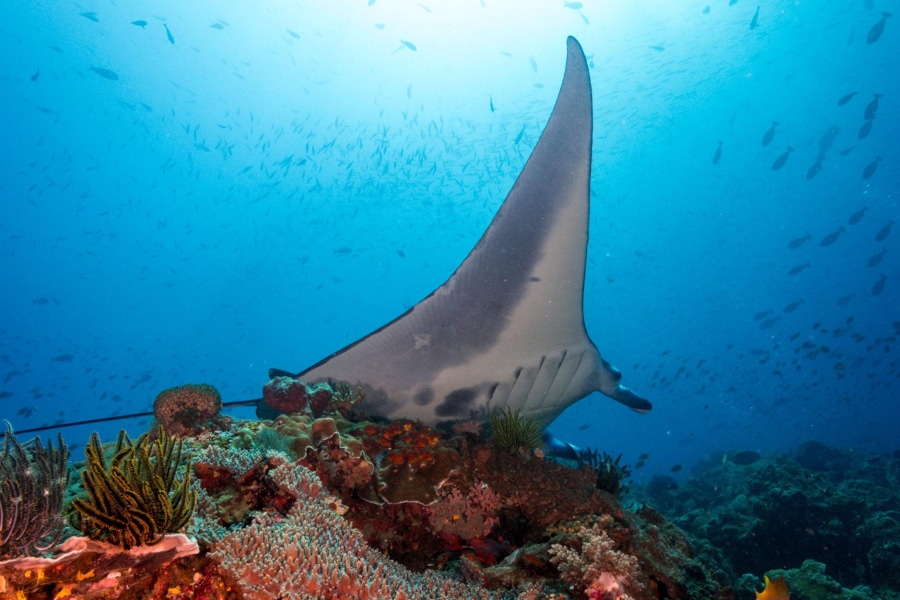
Manta rays are the largest rays you can encounter around the Gili Islands. Sightings are rare but possible.
The can be seen throughout the year, although during the dry season they are more frequently encountered around Gili Trawangan.
Mantas can also be seen during their wider movements through Indonesian waters. During migration between areas such as Nusa Penida and Komodo, they may sometimes be spotted travelling near the surface.
Like mobulas, manta rays are filter feeders. They use their large mouths and specialised cephalic fins to help channel plankton-rich water into their mouths as they swim.
They are not interested in hunting fish or animals on the seabed.
Manta Rays vs Mobulas: What’s the Difference?
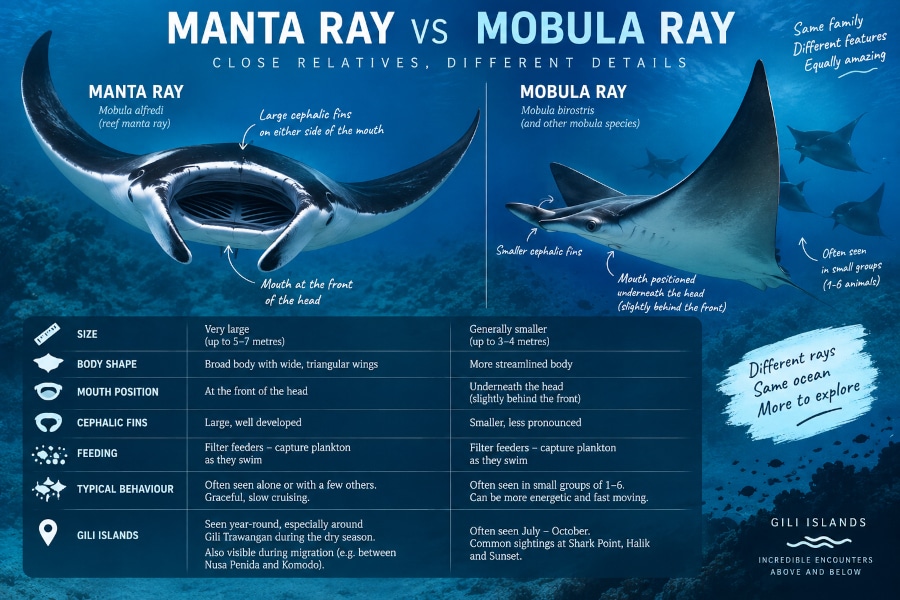
Manta rays and mobulas are closely related and can look very similar underwater. Both have wing-like pectoral fins and feed on plankton.
The easiest way to tell them apart is size, shape and the position of the mouth.
Manta rays are much larger and have a very broad body with large cephalic fins on either side of the mouth. Their mouth is positioned at the very front of the head, giving them a distinctive open-mouthed appearance when feeding.
Mobulas are generally smaller and more streamlined. Their mouth is positioned slightly underneath the head rather than directly at the very front.
Their behaviour can also give you a clue.
Mantas are often seen cruising slowly and gracefully through the water, sometimes alone or with other mantas. Mobulas can be more energetic and are often encountered travelling in small groups.
| Manta Ray | Mobula | |
|---|---|---|
| Size | Very large | Generally smaller |
| Body | Broad, wide wings | More streamlined |
| Mouth | At the front of the head | Positioned underneath/slightly behind the front |
| Feeding | Filters plankton while swimming | Filters plankton while swimming |
| Gili sightings | Rare | Often July–October |
| Typical behaviour | Graceful cruising | Often seen in groups of 1–6 |
At a distance, however, it can still be difficult to tell them apart. Once you see both species a few times, their different shapes and swimming styles become much easier to recognise
Why Are Manta and Mobula Rays Endangered?
Manta and mobula rays are especially vulnerable because they grow slowly, mature late and produce very few young. Even relatively small amounts of fishing pressure can therefore have a major impact on their populations.
In Indonesia, these rays are still being caught, both intentionally and as bycatch. Recent research in East Java found five mobulid species being caught mainly in drift gillnets, with juveniles making up a large proportion of the catch.
There is also an international trade in their gill plates. These delicate structures are removed from the gills, dried and sold primarily for use in traditional Asian medicine, despite there being no scientific evidence for the medicinal claims associated with them.
Indonesia has been documented as a source of gill plates exported to international markets, including Hong Kong. Recent research has also found evidence of gill plates entering the export trade from East Java.
Historically, Indonesia had some very large targeted manta and mobula fisheries, including in Lamakera in eastern Indonesia.
Although protections and conservation efforts have changed the situation in many areas, fishing and illegal landings continue.
Eagle Rays
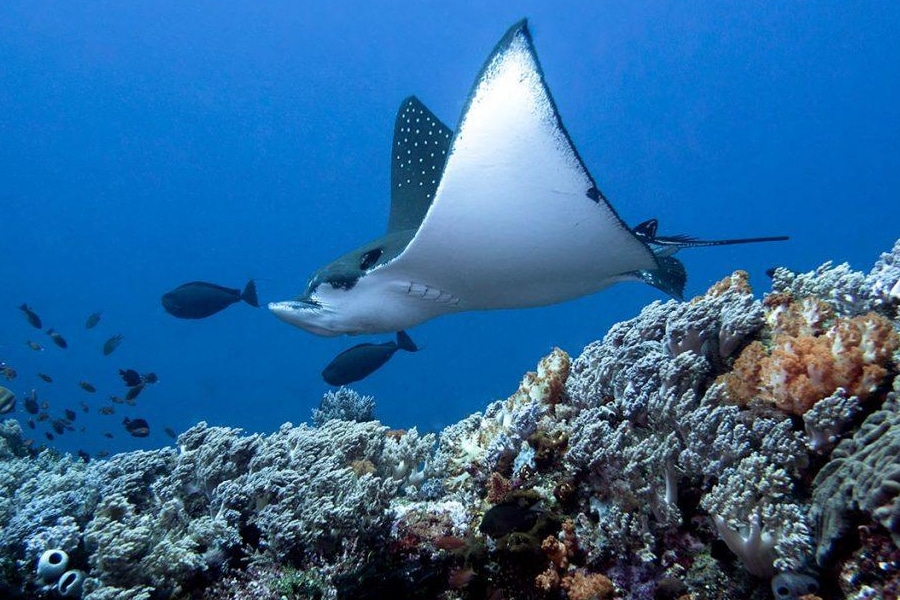
Eagle rays are another year-round possibility around the Gili Islands.
Unlike stingrays that spend much of their time sitting on the seabed, eagle rays are active swimmers and often move through open water above the reef or sandy areas.
They don’t have one particular dive site where they are guaranteed. Instead, eagle rays can appear at different sites throughout the year.
They can be surprisingly fast when they want to be, so a brief sighting can turn into a very memorable encounter as they disappear into the blue.
Eagle rays are not filter feeders. They mainly hunt on or near the seabed, eating crustaceans, molluscs, worms and small fish. Their specialised crushing teeth and plates allow them to break open hard-shelled prey.
Rays of the Gili Islands: From Sand to Open Water
One of the things that makes ray encounters around the Gilis so interesting is how differently they live.
A bluespotted ribbontail ray may be sitting quietly on the bottom.
A Kuhl’s stingray might be digging through the sand looking for a crustacean.
A marble ray may be resting on a sandy patch away from the main reef.
Then, somewhere above you, a group of mobulas can suddenly appear in the blue.
And if you’re particularly lucky, a huge manta ray may glide past.
The next time you see a ray on a Gili Islands dive, take a moment to watch how it moves. Its behaviour often tells you just as much about the animal as its appearance.