

Many divers remember their first drift dive for one reason: they expected it to be difficult, but it turned out to be one of the most enjoyable dives they’d ever done.
For newly certified divers, the thought of diving in a current can be intimidating. Will the current be too strong? What if I get separated from the group? How does the boat find me again? These are perfectly normal questions, and almost every diver asks them before their first drift dive.
The good news is that drift diving isn’t about fighting the current—it’s about learning to work with it. Once you understand a few simple techniques, you’ll discover why so many of the world’s most famous dive destinations are known for their drift dives.
In fact, some of the healthiest coral reefs on Earth owe their incredible biodiversity to moving water.
It’s no coincidence that destinations like the Maldives, Komodo, Cozumel and the Gili Islands are all famous for drift diving.
In this guide, you’ll learn how drift diving works, why currents create such spectacular dive sites, how to dive safely and confidently in moving water, and the techniques experienced divers use to make every drift dive enjoyable.
What Is Drift Diving?
A drift dive is a dive where you allow the natural movement of the water to carry you along the reef instead of swimming from one point to another. Rather than following a fixed route, your path is determined by the current, allowing you to explore the underwater world with minimal effort.
Drift diving can take many forms. Some dives involve only a gentle current that is barely noticeable, while others may carry divers swiftly along walls, coral ridges or channels. The speed and direction of the current depend on factors such as tides, wind and the underwater landscape, which means no two drift dives are ever exactly the same.
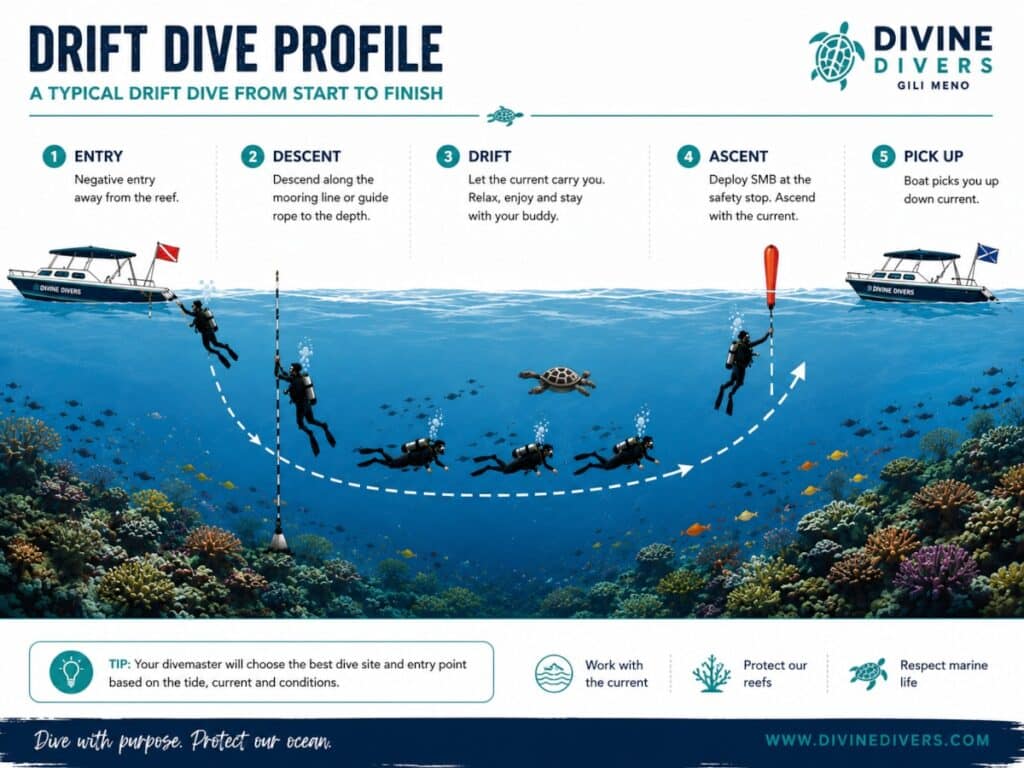
Unlike shore dives or dives where the boat remains anchored, drift dives are carefully coordinated between the dive guide and the boat captain. Before entering the water, the guide plans the route based on the conditions, while the captain follows the group’s progress from the surface. At the end of the dive, a Surface Marker Buoy (SMB) is deployed so the boat can safely pick up the divers.
Although the current determines the direction of the dive, divers are never simply passive passengers. Good buoyancy, proper trim and an understanding of how currents behave allow you to control your position, slow down when needed and comfortably stop to observe marine life. Once these skills become second nature, drifting with the current feels remarkably effortless.
Why Dive in a Current?
If currents make diving more challenging, why do experienced divers actively seek them out?
The answer lies in the reef itself. Currents are one of the driving forces behind healthy marine ecosystems. As water moves across a reef, it continuously brings fresh oxygen, nutrients and plankton.
This provides food for countless reef inhabitants and creates ideal conditions for corals, sponges and other filter-feeding animals to thrive.
Many marine animals have adapted their behaviour to take advantage of moving water.
Reef sharks often patrol channels where currents concentrate food, while large schools of fusiliers, jacks and barracuda position themselves directly in the flow to feed.
Even sea turtles frequently rest behind coral bommies or rock formations, using these natural shelters to avoid expending unnecessary energy.
Currents also help keep reefs clean. They carry away sediment that could otherwise settle on corals and block the sunlight needed by the algae living inside their tissues.
For this reason, some of the world’s most spectacular reefs are found in areas with regular water movement.
Of course, stronger currents don’t automatically mean a better dive. The best conditions depend on the dive site, the direction and strength of the current, and the experience level of the divers.
Different Types of Drift Dives
Not all drift dives are the same. The speed of the current, the underwater landscape and the dive plan all influence how a drift dive feels. Some are so gentle that you barely notice you’re moving, while others require more advanced skills and careful planning.
Understanding the different types of drift dives will help you know what to expect and why dive guides choose different techniques depending on the conditions.
Gentle Drift Dives
A gentle drift dive is perfect for divers who are new to diving in current. The movement of the water is slow enough that you can easily stop to observe marine life, communicate with your buddy and enjoy the reef without feeling rushed.
Many drift dives around the Gili Islands fall into this category. The current helps you move effortlessly along the reef while still giving you plenty of time to watch turtles feeding, admire colourful corals or photograph smaller marine life.
For most Open Water divers, a gentle drift dive is an enjoyable introduction to diving in current.
Moderate Drift Dives
Moderate currents create the type of drift diving that many experienced divers enjoy the most. The current carries you steadily along the reef, allowing you to cover a large distance while still giving you enough control to stop behind coral bommies or rock formations whenever something interesting catches your eye.
These conditions often attract larger schools of fish and increase the chances of encounters with reef sharks, eagle rays and other pelagic species.
Depending on the dive site and the strength of the current, moderate drift dives may be suitable for confident Open Water divers or may require an Advanced Open Water certification.
Fast Drift Dives
During a fast drift dive, the current becomes a much more noticeable part of the experience.
Divers spend very little time swimming and instead focus on maintaining good buoyancy, staying streamlined and remaining close to the dive guide.
Stopping to observe marine life becomes more challenging, so guides carefully choose sheltered areas behind coral formations where the group can briefly pause before continuing.
Fast drift dives are exciting and can be incredibly rewarding, but they require confidence, good buoyancy control and careful planning. They are generally recommended for experienced divers.
Wall Drift Dives
Some drift dives follow a steep reef wall, allowing divers to glide effortlessly alongside colourful corals, sea fans and sponges while maintaining a constant depth.
Walls often provide natural shelter from the strongest current, making it easier to slow down by staying close to the reef. They also create excellent opportunities to encounter turtles, reef sharks and schools of fish moving between the reef and the open ocean.
Channel Drift Dives
Channels are narrow passages where water is forced between islands or reefs. Because the same volume of water must pass through a smaller space, currents often become stronger and more predictable.
These areas are frequently home to larger marine life, as the current brings a constant supply of food. Depending on the conditions, channel dives can range from relaxed drifts to challenging dives suitable only for experienced divers.
Many famous drift diving destinations around the world (such as the Maldives and Komodo) are known for their spectacular channel dives.
Blue Water Drift Dives
Not every drift dive follows a reef. During a blue water drift dive, divers spend much of the dive away from the reef, drifting through open water while searching for larger pelagic animals such as manta rays, whale sharks or oceanic sharks. South Africa is known for blue water drift dives.
Because there are few visual references underwater, maintaining good buoyancy and staying close to the group becomes especially important. These dives are usually reserved for experienced divers and are less common than reef drift dives.
Understanding the Current
One of the first things to understand about drift diving is that currents are constantly changing. A dive site that offers a gentle, relaxing drift in the morning may have almost no current a few hours later, or the current may even be flowing in the opposite direction.
Several factors influence how the water moves, including the tides, wind, underwater topography and even the phase of the moon.
These constantly changing conditions mean that no two drift dives are ever exactly the same.
Fortunately, you don’t need to become an oceanographer to enjoy drift diving.
Your dive guide will assess the conditions before every dive and choose an appropriate entry point, route and exit based on the current that day. Part of being a good drift diver is learning to trust the dive plan and adapt to the conditions rather than expecting every dive site to behave the same way.
If you’re interested in learning more about why currents occur, why they change direction throughout the day and how local conditions influence diving around the Gili Islands, we’ve written a dedicated guide that explores the topic in much greater detail.
→ Read our complete guide: Understanding Currents in the Gili Islands
Preparing for the dive
Reading the Water
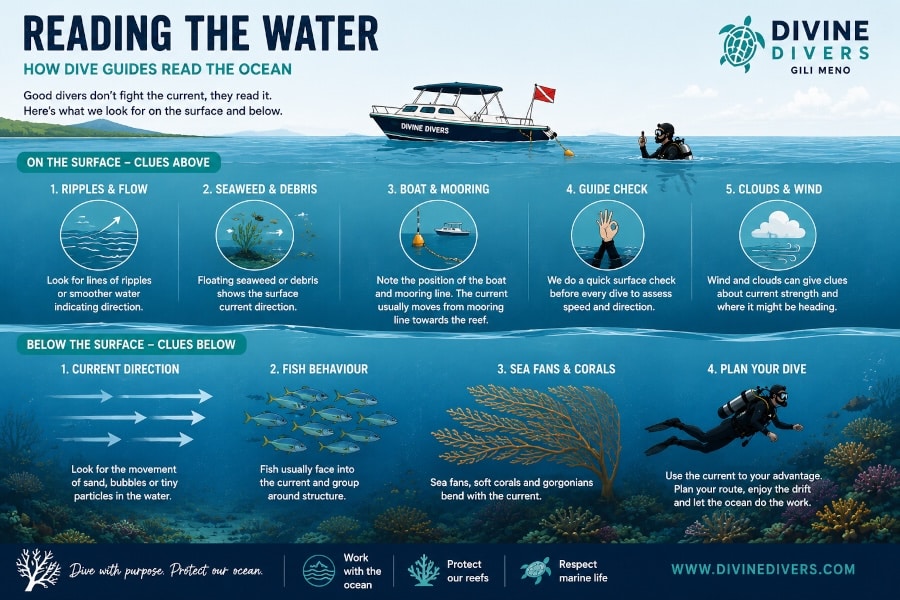
Successful drift dives begin long before divers enter the water. Before every dive, your guide assesses the conditions to decide whether a site is suitable and how the dive should be planned.
While tide tables and weather forecasts provide a good starting point, they don’t always tell the whole story. Wind, waves and local topography can all influence the current, which is why experienced guides combine this information with real-time observations.
The first clues are often visible from the boat. Small waves, ripples on the surface and even floating seaweed can reveal the direction and strength of the current. However, conditions at the surface don’t always match those underwater.
To confirm what the current is doing, the guide may make a quick current check before the group enters the water. By observing suspended particles, the movement of soft corals and sea fans, or the way fish position themselves in the water, it’s usually possible to judge both the direction and strength of the current within a few moments.
Equipment for drift diving
Drift diving doesn’t require much additional equipment beyond your standard scuba gear, but a few items can make your dive safer and more enjoyable.
Surface Marker Buoy (SMB)
An SMB is the most important piece of safety equipment for drift diving. Before surfacing, the dive guide deploys the buoy so the boat crew can easily locate the group for pickup. Many experienced divers also carry their own SMB and reel, especially when diving independently.
Dive Computer
A dive computer helps you monitor your depth, bottom time and ascent rate. During a drift dive, it’s easy to become distracted by the scenery, making regular checks even more important.
Streamlined Equipment
Keeping hoses, gauges and accessories neatly secured reduces drag and prevents equipment from catching on the reef. Combined with good trim, a streamlined setup allows you to drift more comfortably with the current.
Safety Accessories
Many divers carry a whistle or other signalling device to attract the boat’s attention after surfacing. While rarely needed, these simple items provide an extra layer of safety.
Reef Hooks
Reef hooks are sometimes used in destinations with very strong currents to allow divers to remain stationary. However, they should never be attached to living coral.
Around the Gili Islands, reef hooks are generally unnecessary. Most drift dives can be comfortably managed with good buoyancy and by using natural shelter behind coral bommies and reef formations.

Standard Entry vs Negative Entry
The type of entry used during a drift dive depends on the current conditions.
Standard Entry
In calm conditions, divers usually perform a standard entry. After stepping or backrolling into the water with an inflated BCD, they remain on the surface and wait for the rest of the group before descending together.
This is the entry technique most divers learn during their Open Water course and is suitable whenever there is little or no surface current.
Negative Entry
When the surface current is stronger, waiting on the surface can quickly separate the group before the dive has even begun.
Instead, divers perform a negative entry.
The jump into the water with a nearly empty BCD. After entering the water, they immediately vent the remaining air from their BCD and begin descending without stopping at the surface. By getting below the stronger surface current quickly, the group stays together and reaches the reef before starting the dive.
Negative entries may sound intimidating at first, but they’re simply another diving technique.
If you’ve never performed a negative entry before, don’t worry. Your dive guide will explain the procedure during the briefing, and you’ll have the opportunity to practise the technique during the PADI Drift Diver Specialty.
