
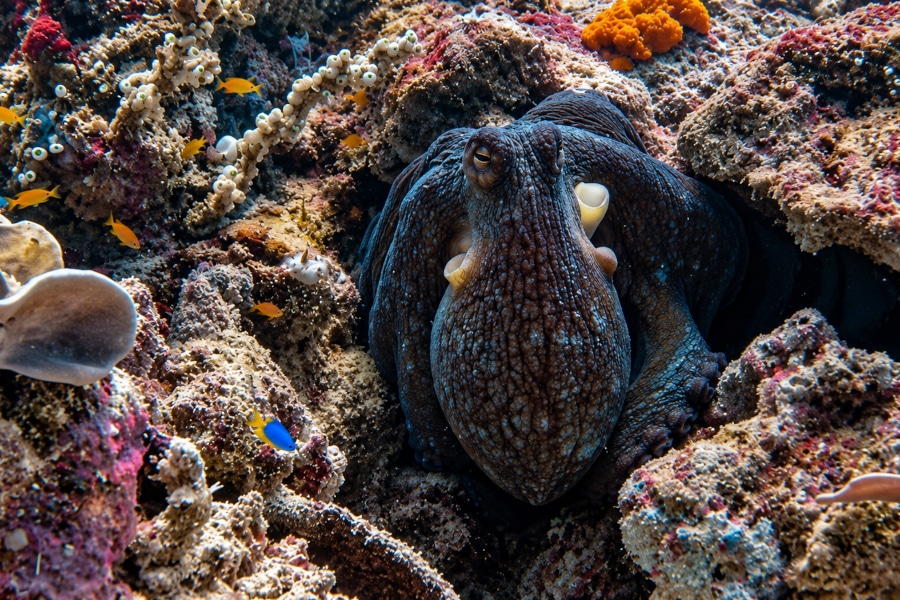
Octopus are some of the most fascinating animals you can encounter while diving in the Gili Islands. They are masters of camouflage, incredibly intelligent and capable of changing their appearance in an instant.
The tricky part is finding one.
Most octopus spend much of their time hidden in holes, beneath rocks or among coral rubble. Sometimes all you see is an eye watching you. Other times, a sudden change in colour gives one away.
The Gili Islands are home to several species, from the common reef octopus to much rarer encounters such as mimic, coconut and blue-ringed octopus.
What Species of Octopus Can You See in the Gili Islands?
Common Reef Octopus
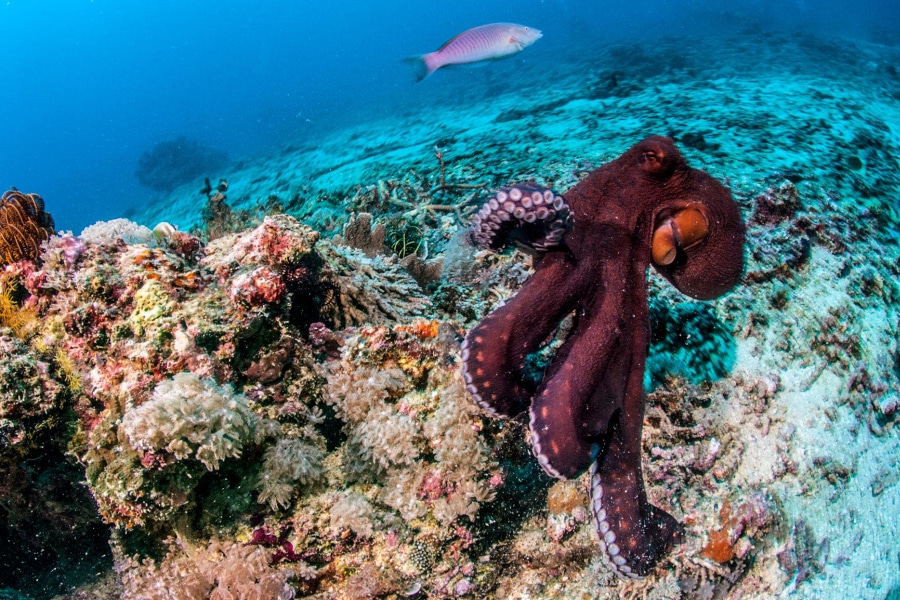
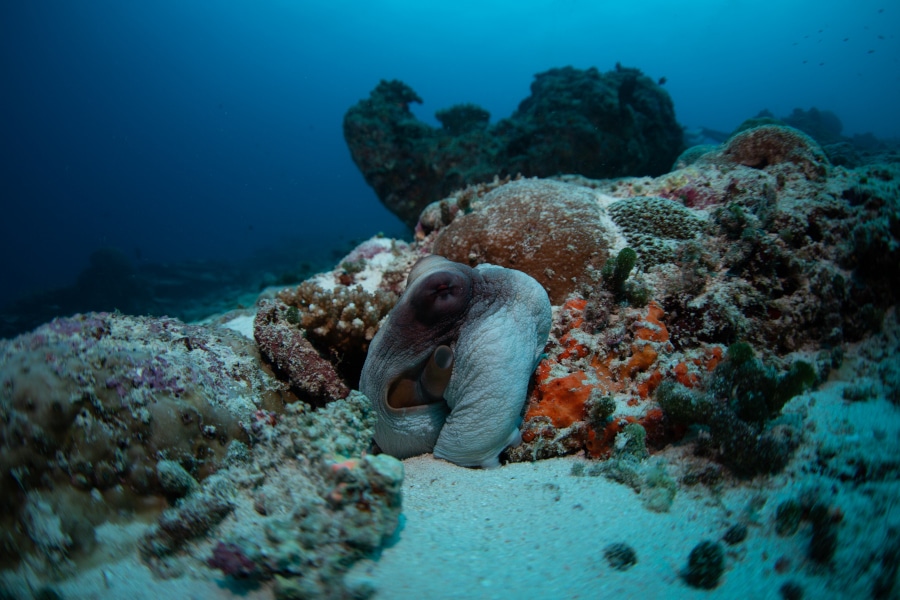
The common reef octopus (Octopus cyanea) is probably the octopus divers are most likely to encounter around the Gili Islands.
They live around coral reefs, rubble and rocky areas and are usually found tucked into a small hole or crevice. Their ability to change colour and pattern makes them surprisingly difficult to spot.
When disturbed or hunting, their appearance can change dramatically within seconds.
Mimic Octopus
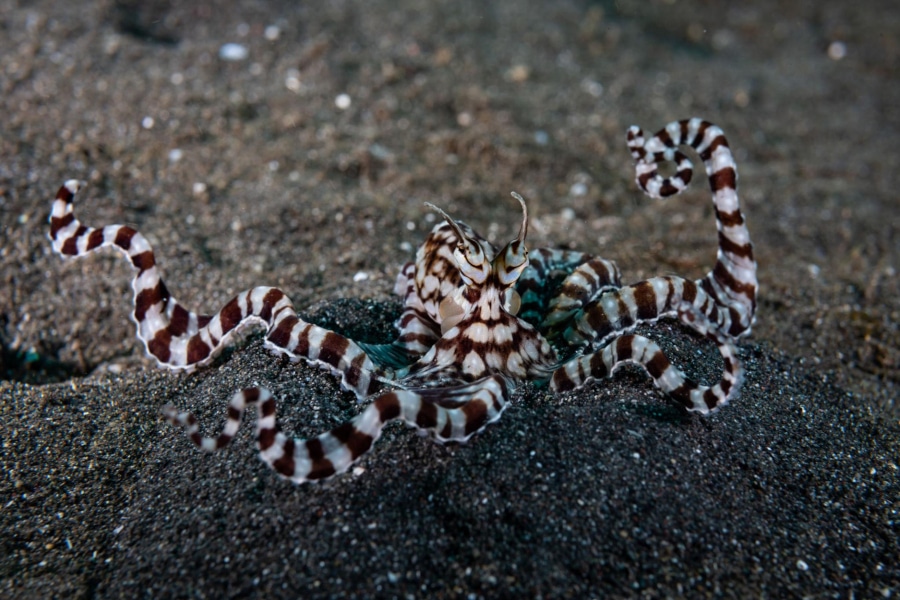
The mimic octopus is one of the most unusual octopus you can encounter in Indonesia.
Unlike a reef octopus that often relies on staying hidden, mimic octopuses can move across open sand while changing their body shape, colour and swimming style. They are famous for imitating other animals, including flounders and venomous species.
Research in Indonesia has documented this remarkable behaviour, including the ability to change its mimicry depending on the perceived threat.
Around the Gili Islands, mimic octopus are particularly associated with muck environments such as Teluk Nare, Kecinan or Mentigi Bay, where they can occasionally be found on sandy and silty bottoms.
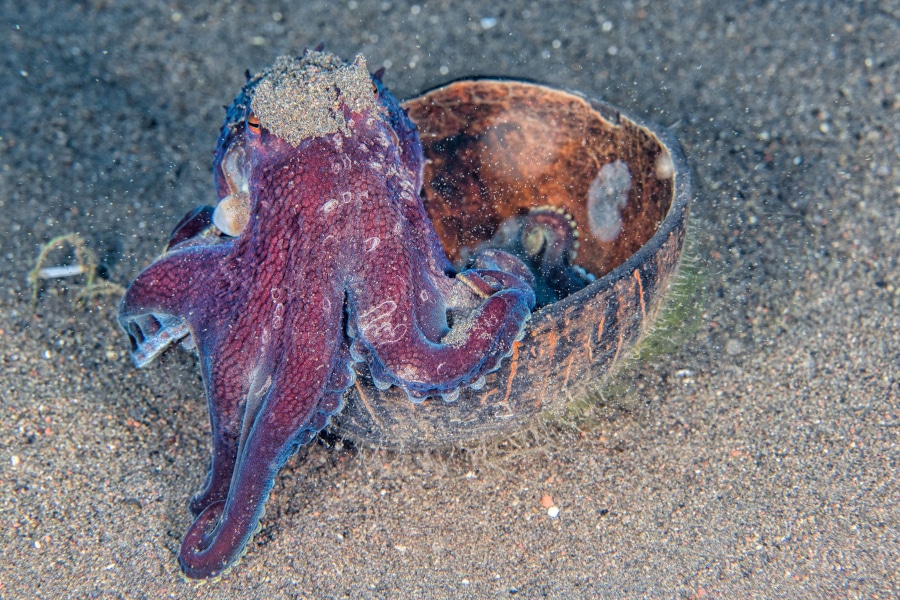
Coconut Octopus
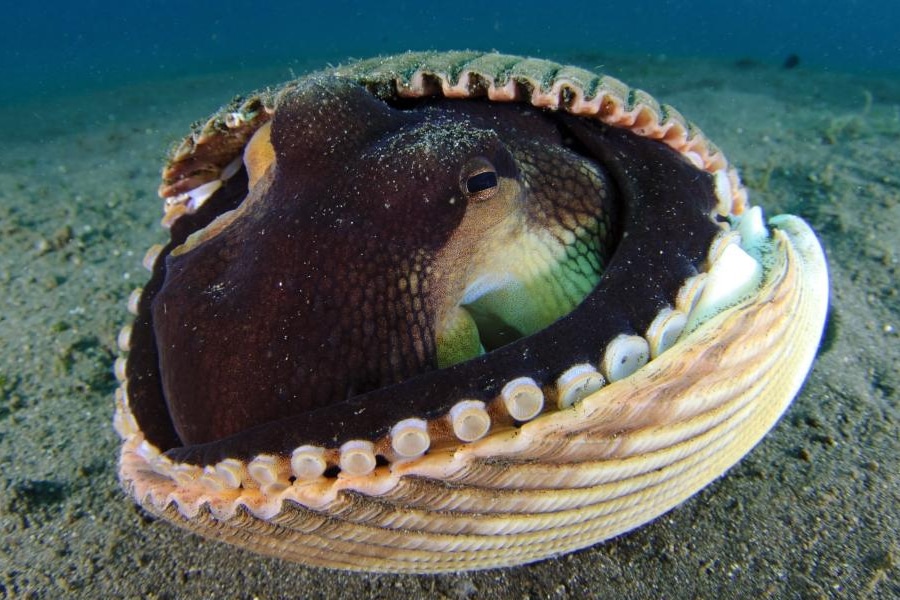
The coconut octopus is another fantastic muck-dive find.
It gets its name from its habit of using discarded coconut shells and other objects as shelter. Instead of simply hiding beneath a rock, it can carry a shell with its arms and later use it as a portable hiding place.
They are not restricted to coconuts, either. Empty shells and other suitable objects can become useful protection.
Coconut octopus are reported from the muck-diving sites around Lombok and the Gili Islands.
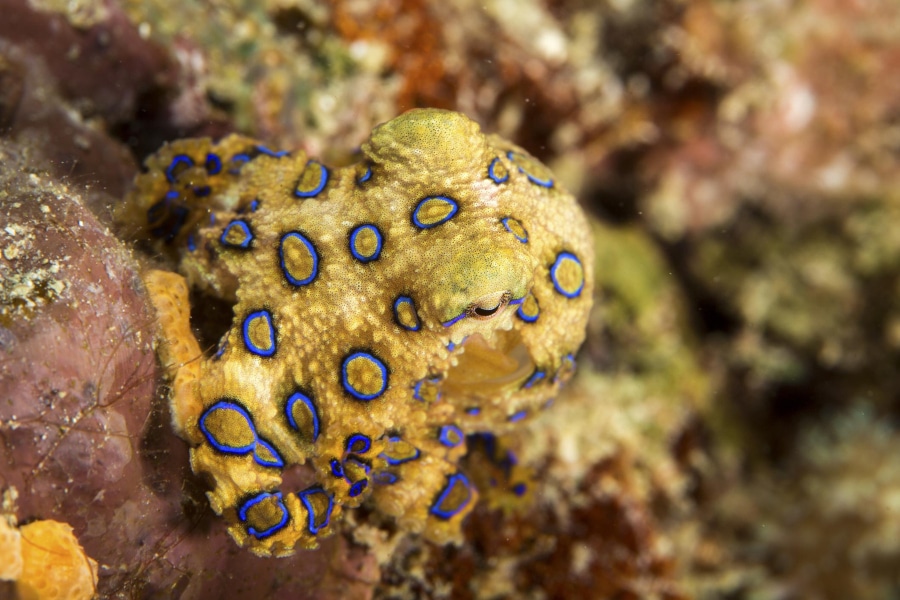
Blue-Ringed Octopus
Blue-ringed octopus are among the smallest and most exciting octopus sightings in the region.
They are usually well camouflaged and can be difficult to notice until they become disturbed, when their brilliant blue rings become visible.
They should never be touched or handled. Blue-ringed octopus are highly venomous and should always be observed from a safe distance.
Blue-ringed octopus have been documented in Indonesian waters, and local Gili-area dive operators report them as occasional sightings.
Why Are Octopus So Good at Camouflage?
Octopus can change the colour, pattern and appearance of their skin incredibly quickly. They can blend into coral, rocks, sand and rubble, making them almost disappear.
They can also change the texture of their skin, helping them look less like a soft animal and more like part of the reef.
This is one reason octopus can be surprisingly difficult to photograph. You may swim past one without realising it is there.
Then it moves.
And suddenly you wonder how you missed it.
Octopus Have Three Hearts and Blue Blood
Octopus have some wonderfully strange biology.
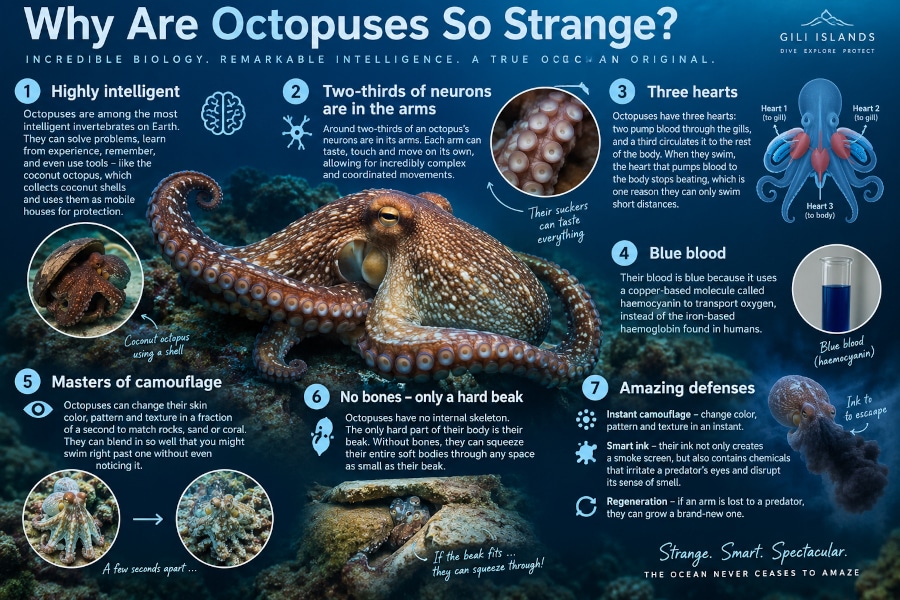
They have three hearts. Two pump blood through the gills, while the third pumps oxygenated blood around the rest of the body.
Their blood is blue because it uses a copper-based molecule called haemocyanin to transport oxygen rather than the iron-based haemoglobin found in humans.
There is another unusual detail. When an octopus swims using jet propulsion, the heart that supplies the body stops beating temporarily. Swimming is therefore tiring for an octopus, which is one reason they generally prefer crawling along the seabed or using their arms rather than swimming long distances.
Their Arms Can Taste
An octopus doesn’t experience the world only through its eyes.
Its suckers contain sensory receptors that help it touch and chemically sense its surroundings. In other words, an octopus can effectively taste and feel what it touches with its arms.
Around two-thirds of an octopus’s neurons are located outside its brain, with much of its nervous system distributed through its arms.
Each arm can perform remarkably complex movements, while the animal’s central nervous system coordinates the overall behaviour.
This partly explains why octopus seem so different from almost every other animal you encounter underwater.
How Intelligent Are Octopus?
Octopus are considered among the most intelligent invertebrates.
They can learn, solve problems, remember experiences and adapt their behaviour. Some species use objects as tools, with the coconut octopus being the famous example.
Their intelligence is particularly impressive when combined with their ability to change colour, shape and behaviour depending on their surroundings.
For divers, this can make watching an octopus far more interesting than simply spotting one.
They Don’t Have Bones
An octopus has no internal skeleton.
The only hard part of its body is its beak.
This means that if its beak can fit through an opening, the rest of its body can potentially squeeze through it as well.
That is why an octopus can disappear into a hole that looks far too small to contain the animal you just saw.
Octopus and Their Incredible Defences
Camouflage is their first line of defence, but it isn’t their only one.
When threatened, an octopus can release ink, creating a cloud that confuses predators and gives it an opportunity to escape. The ink can do more than simply block visibility; chemical components can interfere with a predator’s sensory systems.
Some species also use dramatic colour and body-pattern changes to startle or confuse predators.
And if an octopus loses an arm, it can regenerate a replacement over time.
What Do Octopus Eat?
Octopus are predators. Their diet can include crabs, shrimp, small fish and other marine animals.
They use their arms and suckers to locate and hold prey before using their hard beak to bite through it.
When Is the Best Time to See Octopus in the Gili Islands?
Octopus can be encountered throughout the year, but local observations suggest that August to October can be particularly interesting, when mating activity becomes more noticeable.
During this period, divers may see more octopus activity, including colour changes and interactions between individuals.
That doesn’t mean you won’t see them at other times. They are resident reef animals, and a good guide can often find them on any dive.
Why Octopus Are So Fascinating to Divers
Turtles and sharks are easy to appreciate because you can see them from across the reef.
Octopus are different.
You can be looking directly at one without knowing it is there.
Then it changes colour, extends an arm, opens an eye or suddenly crawls across the reef—and you realise that what looked like a piece of rock was actually one of the ocean’s strangest animals.
That combination of intelligence, camouflage, unusual biology and behaviour makes octopus one of the most rewarding marine-life encounters in the Gili Islands.