

Ghost pipefish are among the strangest fish you can encounter around the Gili Islands.
They don’t look much like fish at first glance. Their bodies can be covered with elaborate shapes, spines and filaments, while some species look remarkably like floating pieces of seaweed or leaves.
They are also unusual when it comes to reproduction. Unlike seahorses and true pipefish, where the male carries the developing eggs, female ghost pipefish carry the eggs in a specialised brood pouch formed from their pelvic fins.
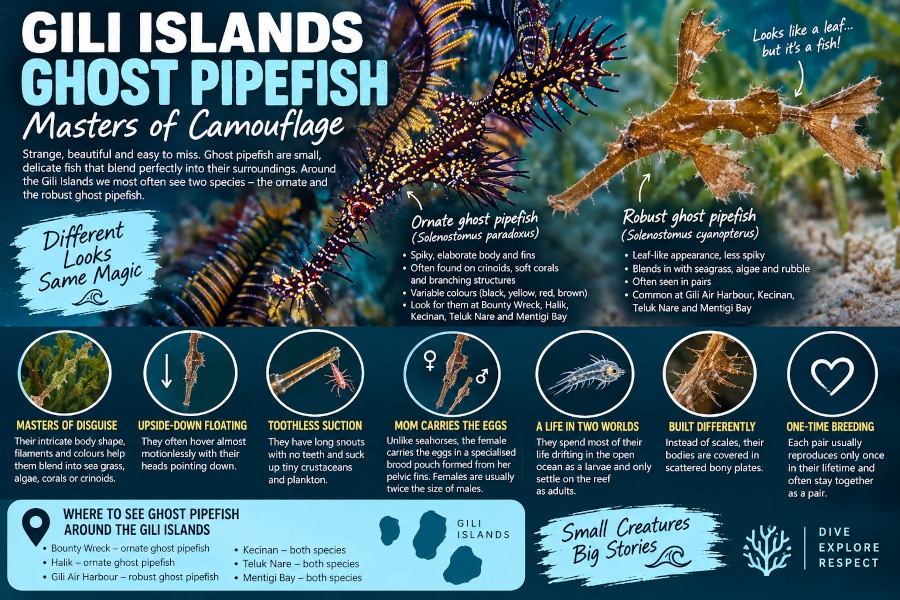
Around the Gili Islands, we mostly encounter two species: the ornate ghost pipefish (Solenostomus paradoxus) and the robust ghost pipefish (Solenostomus cyanopterus).
What are ghost pipefish?
Ghost pipefish are small marine fish belonging to the family Solenostomidae.
They are relatives of seahorses and true pipefish, but they are a separate group. Their unusual body shape is one of their most remarkable features.
Depending on the species, ghost pipefish can have:
- Long, narrow snouts
- Elaborate fins
- Spines and skin filaments
- Leaf-like extensions
- Bony plates instead of normal scales
- Intricate patterns and markings
All of this helps them disappear into their surroundings.
A ghost pipefish that looks like a piece of algae, seagrass or coral is much harder for a predator to recognise as a fish.
If you enjoy searching for unusual small marine life, our guide to Gili Islands Macro Marine Life covers many of the other strange creatures you can find around the islands.
The two ghost pipefish we see around the Gilis
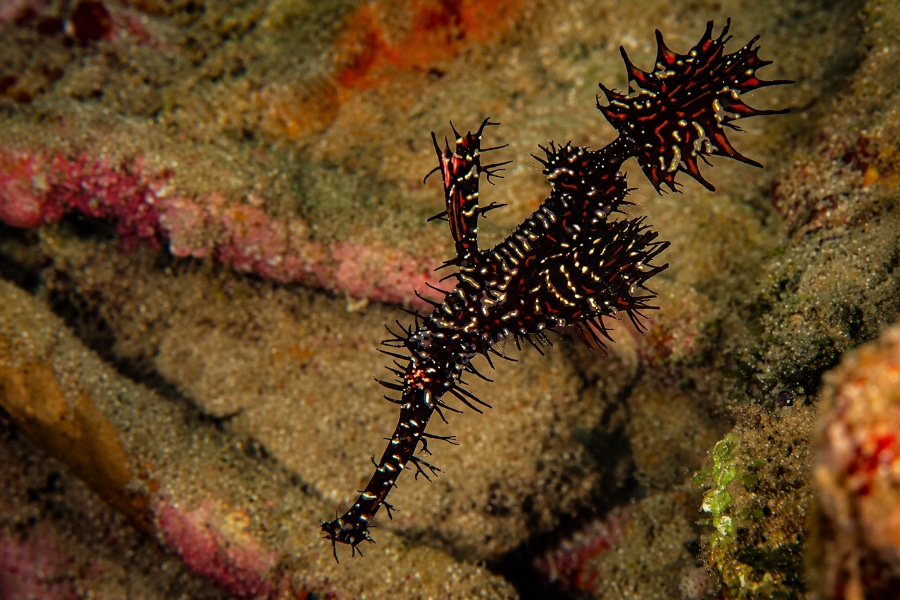
Ornate ghost pipefish
Solenostomus paradoxus
This is the spectacular, highly decorated ghost pipefish.
It can have an extremely spiky body, elaborate fins and long filaments that make it resemble the organism it is hiding among.
We regularly look for ornate ghost pipefish around Bounty Wreck, Gili Air Harbour and Halik, as well as at several macro sites around Lombok.
The species can vary considerably in colour. Brown, reddish, yellow, black and combinations of these colours are all possible.
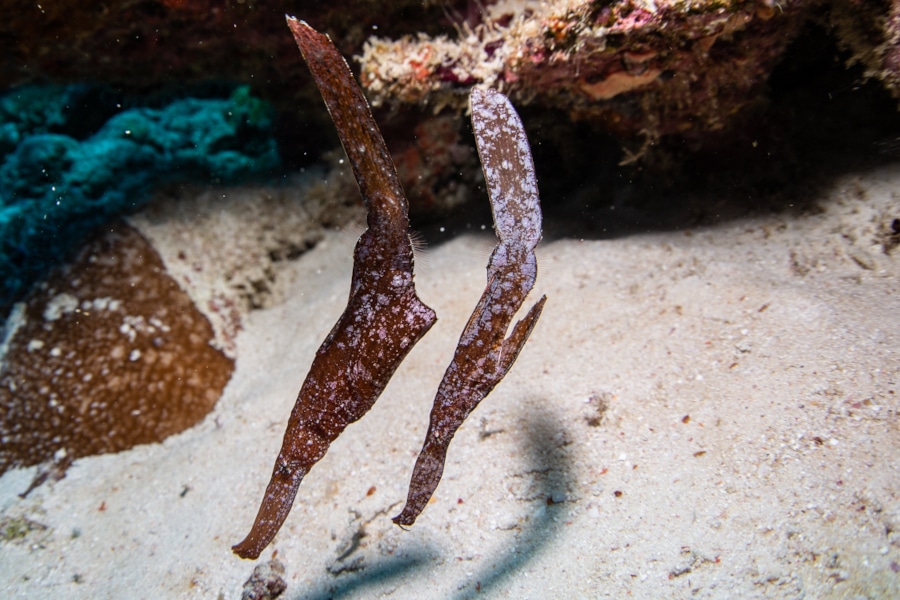
Robust (leaf) ghost pipefish
Solenostomus cyanopterus
The robust ghost pipefish looks completely different.
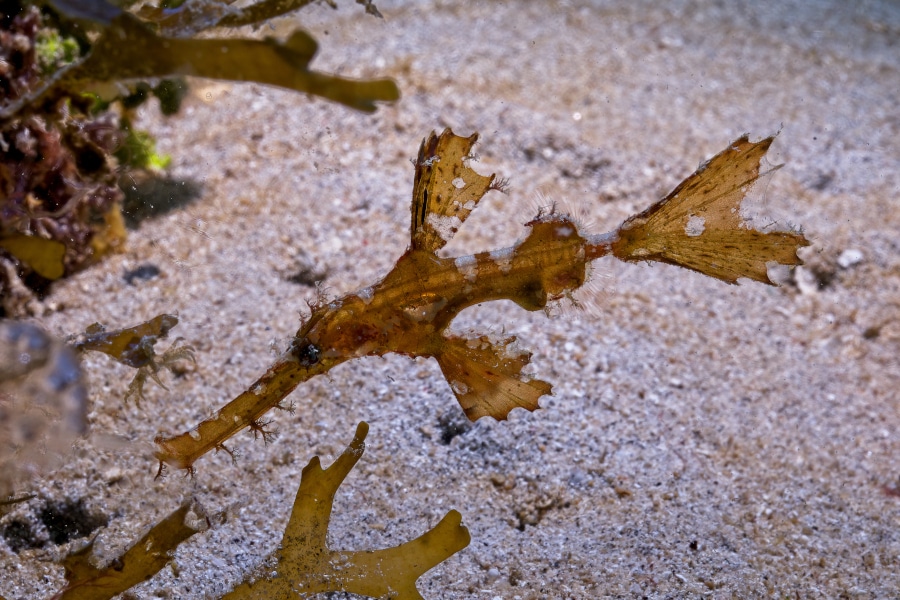
Rather than the heavily spined appearance of S. paradoxus, it can look remarkably like a dead leaf, piece of seagrass or floating algae.
This is the ghost pipefish you often need to search for rather than simply spot.
It is particularly interesting around shallow macro habitats such as Gili Air Harbour, Kecinan, Teluk Nare and Mentigi Bay, where seagrass, algae, rubble and other structures provide plenty of places to disappear.
Where can you see ghost pipefish around the Gili Islands?
Ghost pipefish aren’t found on every dive. They are closely associated with habitats that provide good camouflage.
Around the Gili Islands and nearby Lombok, our regular places to look include:
- Bounty Wreck – particularly good for ornate ghost pipefish and leaf ghost pipefish.
- Hans Reef – very good for both host pipefish and leaf ghost pipefish
- Halik – another place where ornate ghost pipefish can turn up.
- Gili Air Harbour – excellent shallow macro habitat for robust ghost pipefish.
- Kecinan – one of Lombok’s best critter-diving areas, with ghost and robust pipefish among the seagrass, rubble and artificial structures.
- Teluk Nare – a shallow muck-dive environment with a wide range of small marine life.
- Mentigi Bay – another sheltered macro site where ghost pipefish can be found.
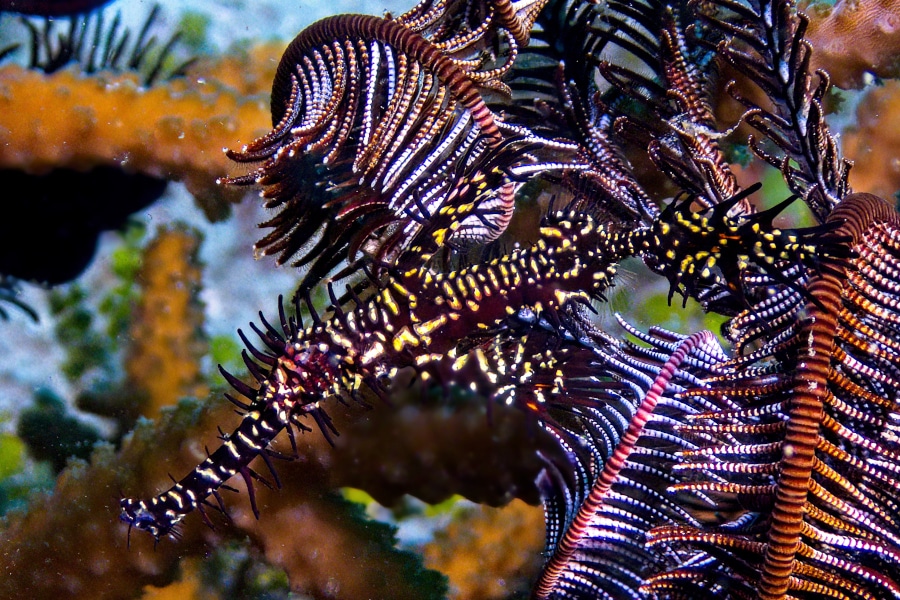
Masters of disguise
Ghost pipefish don’t simply hide behind something.
Their bodies are part of the disguise.
Their unusual fins, filaments and body extensions break up their outline, making it difficult for predators to recognise them as a fish.
The robust ghost pipefish is particularly impressive. Seen from a distance, it can look almost exactly like a piece of drifting seagrass.
The ornate ghost pipefish takes a different approach. Its elaborate fins and spines can make it resemble feather stars, algae, soft corals or other branching organisms.
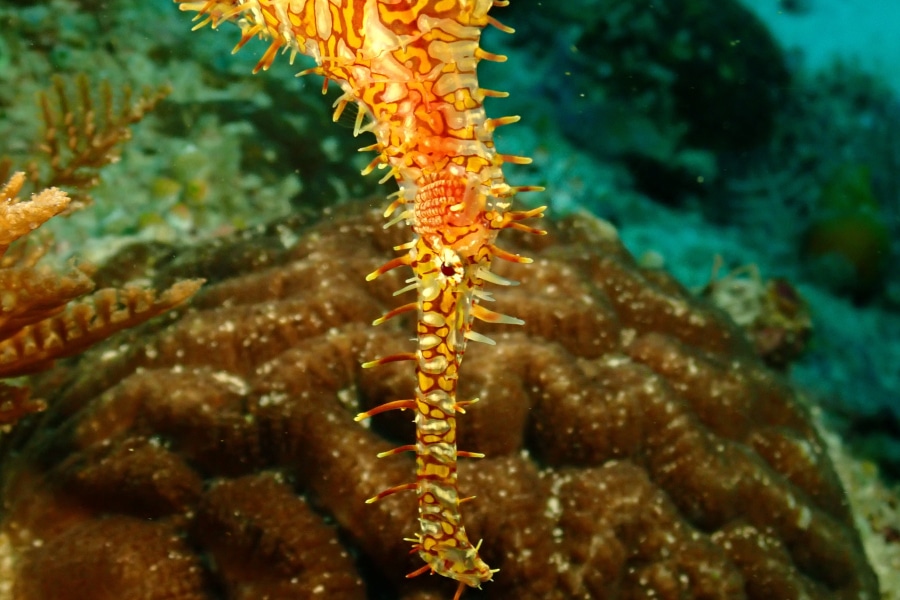
They often float upside down
Another strange ghost pipefish behaviour is the way they move through the water.
They can hover almost motionlessly with their head pointing downwards, sometimes appearing to be nothing more than a small piece of debris or vegetation.
Rather than constantly swimming around like a typical reef fish, they use slow movements and their unusual body shape to remain part of the background.
For a diver, this makes finding them half the fun.
A life that begins in the open ocean
One of the more remarkable parts of their life cycle happens before we ever see them on a reef.
Ghost pipefish spend much of their early life drifting in the open ocean as larvae.
Eventually, they settle onto reef and coastal habitats and develop into the specialised adults we encounter as divers.
This means the tiny ghost pipefish hiding among algae or coral today may have spent an earlier part of its life far away from the reef, carried by ocean currents.
Tiny suction feeders
Ghost pipefish have long, narrow snouts with no teeth.
Instead of biting their food, they use suction to draw tiny prey into their mouths.
Their diet includes tiny crustaceans and other small planktonic animals.
The long snout is well suited to picking prey from among the algae, seagrass and other structures where they live.
Bony plates instead of scales
Another unusual feature is their skin.
Ghost pipefish don’t have the familiar scales that cover many reef fish. Instead, their bodies are protected by bony plates.
Combined with their elaborate fins and filaments, this gives them their unusual, almost prehistoric appearance.
Look closely at a ghost pipefish photograph and you’ll see just how intricate the body really is.
Why ghost pipefish are such a great macro subject
For underwater photographers, ghost pipefish are a fantastic subject.
They are small enough to require a close-up or macro approach, but their unusual shape makes them visually interesting even before you start thinking about composition.
Once you’ve spotted one, the next challenge is working out where the fish ends and the surrounding algae, feather star or seagrass begins.
The best photographs often show the animal together with the habitat it is copying. That tells the story of its camouflage rather than simply showing the fish against a plain background.
And, as always with delicate macro subjects, good buoyancy matters.
There is no reason to touch, move or reposition a ghost pipefish for a photograph.
Let it stay exactly where it is.
If you want to improve your macro photography, our Underwater Photography Guide covers composition, lighting, buoyancy and getting close to marine life without disturbing it.
Ghost pipefish vs true pipefish
Ghost pipefish, seahorses and true pipefish are related, but they are not the same animals.
| Ghost pipefish | True pipefish | Seahorses | |
|---|---|---|---|
| Family | Solenostomidae | Syngnathidae | Syngnathidae |
| Body shape | Elaborate, often leaf-like | Long and slender | Upright, curled tail |
| Camouflage | Often extreme | Often relies on body shape and colour | Often excellent |
| Snout | Long and tubular | Long and tubular | Long and tubular |
| Teeth | No | No | No |
| Egg carrier | Female | Male | Male |
| Brood pouch | Female pelvic fins | Male body/tail region, depending on species | Male brood pouch |