

Part of our Gili Marine Life Guide | Diving with Divine Divers Gili Meno
While drifting along the sunny rubble slopes of the Gili Islands, you might suddenly hear a sharp, metallic crack echo through the water—like someone snapping two heavy rocks together.
Follow the sound down to an unassuming hole in the coral fragments, and you will likely lock eyes with an animal that seems built out of science fiction.
Dressed like an explosion of neon paint and armed with spring-loaded clubs capable of shattering aquarium glass, the mantis shrimp is the pound-for-pound undisputed heavyweight champion of the reef.
Despite their common name, mantis shrimps are neither mantises nor true shrimp. They belong to an ancient lineage of crustaceans called stomatopods, which have been roaming marine environments for nearly 400 million years—predating dinosaurs by over 150 million years.
The Fastest Punch in the Animal Kingdom
The claim to fame of the mantis shrimp is its jaw-dropping strike mechanism.
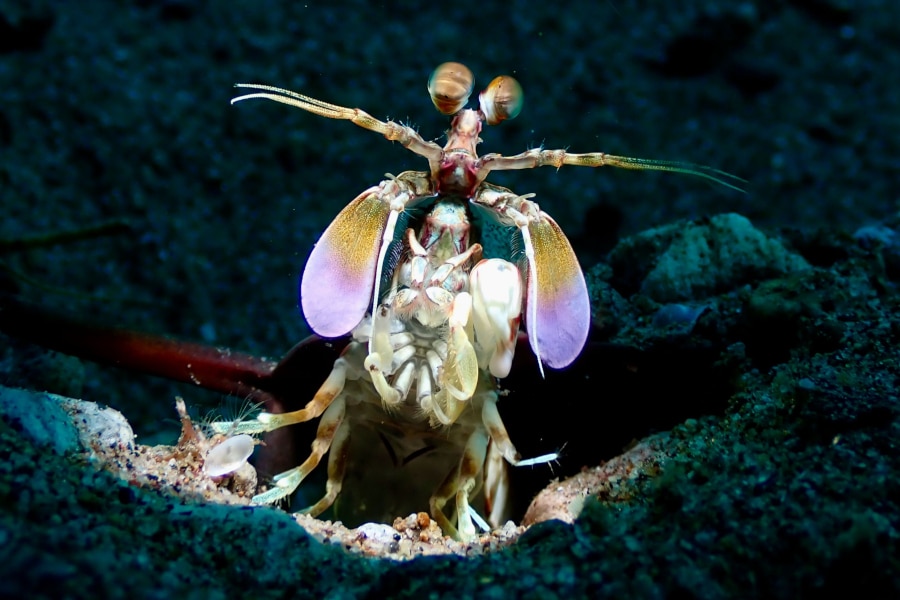
Stomatopods fall into two main hunting groups: spearers, which use barbed, harpoon-like appendages to snatch soft fish out of the water, and smashers, which use heavily calcified, hammer-like dactyl clubs to pulverize hard-shelled prey.
The Peacock Mantis Shrimp, the most famous species seen around the Gili Islands, is a smasher. Its strike is nothing short of physics-defying:
-
Bullet-Speed Acceleration: A mantis shrimp releases its spring-loaded clubs with the acceleration of a .22-caliber bullet (over 50 mph / 80 km/h in less than three milliseconds).
-
Cavitation Bubbles: The strike moves so rapidly underwater that it vaporizes the surrounding liquid, creating an ultra-low-pressure “cavitation bubble.” When this vacuum bubble collapses a microsecond later, it unleashes a secondary acoustic shockwave, producing thousands of pounds of force.
-
Sun-Hot Temperatures: Inside that collapsing cavitation bubble, temperatures momentarily spike to several thousand degrees Kelvin—nearly as hot as the surface of the sun—accompanied by a microscopic burst of light known as sonoluminescence.
Even if the shrimp narrowly misses a crab or snail with its physical punch, the collapsing shockwave alone is powerful enough to stun, crack, or dismember its target on impact.
Eyes from Another Dimension
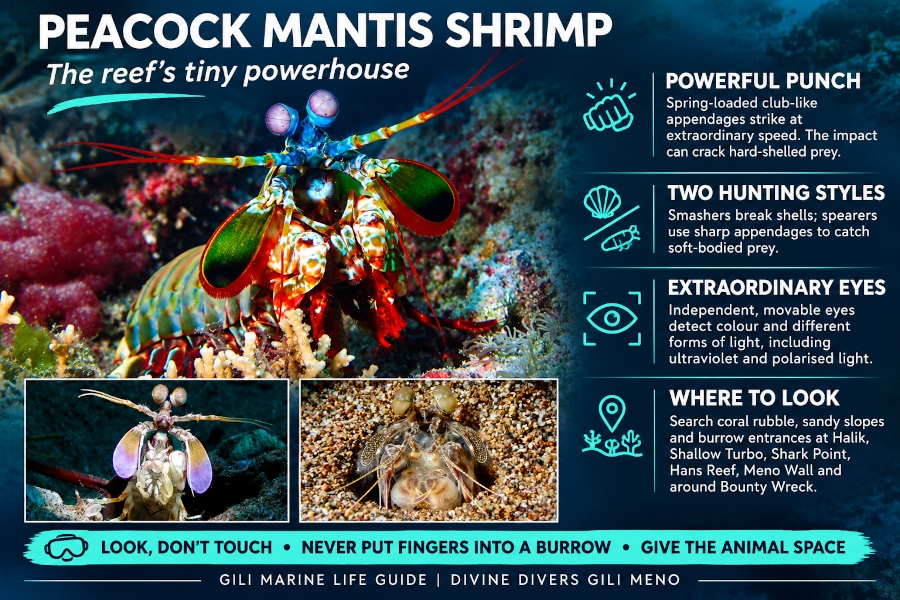
If its supersonic punch isn’t enough, the mantis shrimp also possesses the most complex visual system in the known animal kingdom.
While humans rely on three photoreceptor types (red, green, and blue) to see the visible spectrum, a mantis shrimp boasts 12 to 16 specialized photoreceptors.
-
Seeing the Invisible: They can perceive deep ultraviolet light, visible light, and polarized light waves invisible to the naked human eye.
-
Circular Polarization: Mantis shrimps are among the only animals known to detect and emit circularly polarized light, which researchers believe functions as a secret, private communication channel for mating and territorial warnings that predators cannot decode.
-
Hexnocular Vision: Each eye is mounted on an independent stalk that rotates 360 degrees. Furthermore, each individual eye is split into three separate optical sections, meaning a mantis shrimp possesses trinocular depth perception in each single eye.
Peacock Mantis Shrimp: The Gili Islands Showstopper
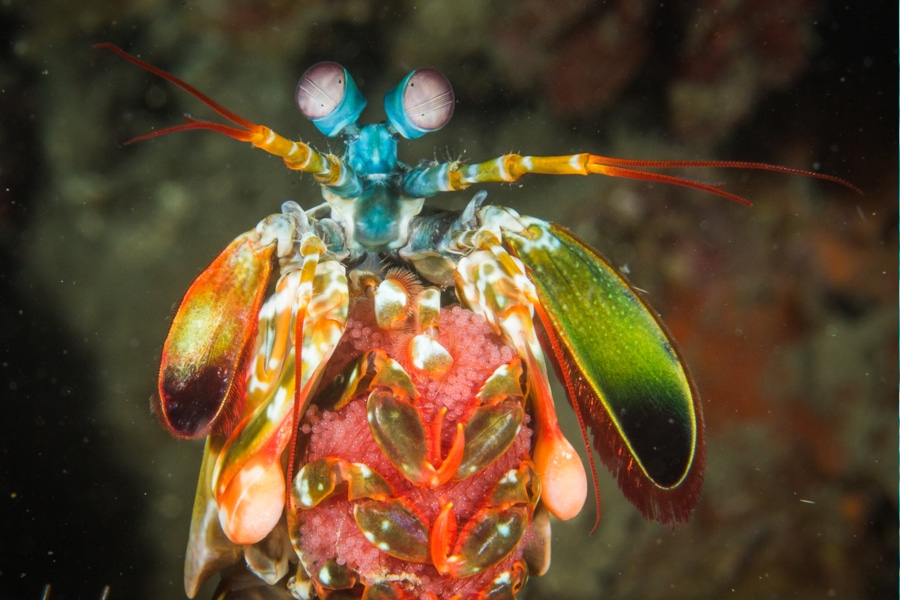
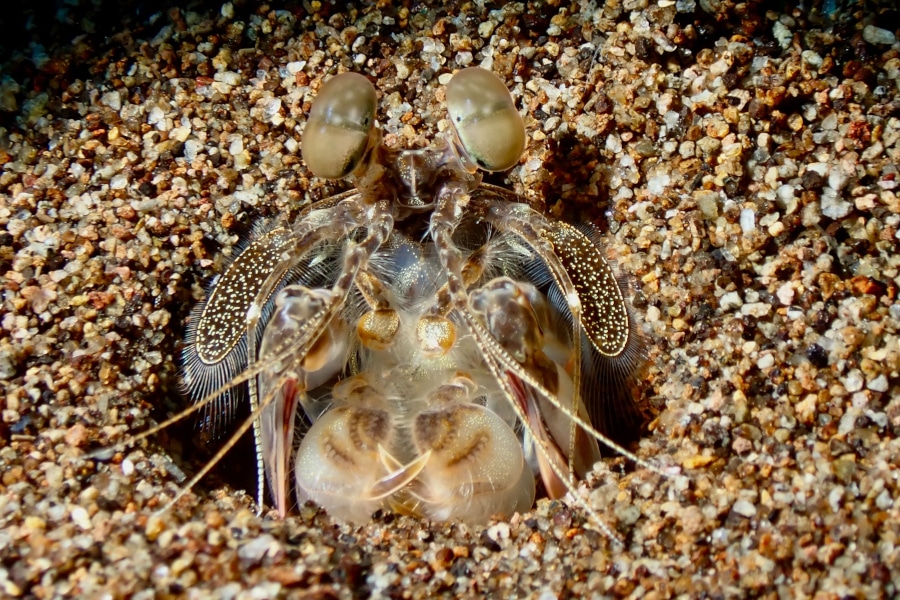
While dozens of mantis shrimp species inhabit the Indo-Pacific, the Peacock Mantis Shrimp is the superstar of local dive sites around Gili Meno.
Reaching up to 18 centimeters (7 inches) in length, they look like living jewels. Their carapaces feature vivid emerald green, iridescent royal blue, leopard-print margins, and bright orange antennal scales and legs.
Unusually Confident: Why Gili Mantis Shrimps Are a Diver’s Dream
In many dive destinations around the world, stomatopods are notoriously flighty. You might catch a half-second glimpse of a colorful tail before the animal shoots backward into its burrow and refuses to come out.
Around the Gili Islands, however, mantis shrimps are noticeably less shy. Whether acclimated to regular, respectful diver traffic or simply feeling secure in their rubble kingdoms, local mantis shrimps will often stay out in the open or remain perched right at the entrance of their dens.
Instead of vanishing in a blink, they will calmly inspect you with their swiveling eyes, continue bulldozing rubble from their doorway, or forage over the sand right in front of your mask—offering macro photographers and curious divers the rare chance to genuinely observe their behavior.
Where to Spot Them with Divine Divers
Mantis shrimps love coral rubble, mixed sandy slopes, and shell-littered plateaus where building an underground bunker is easy. Keep your eyes peeled at these sites:
-
Halik & Shallow Turbo: The gentle slopes and rubble beds at Halik and Shallow Turbo are prime hunting grounds for Peacock Mantis Shrimps. Keep a close watch as you drift over the stony patches—you will frequently catch them scurrying between rocks or boldly peeking out of freshly excavated dens.
-
Shark Point: While famous for reef sharks and passing pelagics, the shallower coral plateaus and rubble ridges at Shark Point conceal dozens of active mantis shrimp burrows. It’s a favorite stop for macro enthusiasts finishing their dives.
-
Hans Reef (Gili Air): The ultimate macro playground in the Gilis. Its rubble slopes and sandy pockets are peppered with active stomatopod burrows. Look for two swiveling eyes poking just above the lip of an excavated hole.
-
Meno Wall: Right on our home doorstep, the scattered coral patches and rubble beds regularly reveal hunting mantis shrimps roaming across the sand between feeding sessions.
-
Bounty Wreck & Surrounds: Around the base of the collapsed pontoon, loose debris creates an ideal hunting ground for invertebrates, making mantis sightings a regular treat during safety stops and macro searches.
Diver Etiquette: How to Watch a Mantis Shrimp
Encountering a peacock mantis shrimp out in the open is an exhilarating sight for underwater photographers. To enjoy the encounter respectfully:
-
Keep Your Hands to Yourself: Never stick fingers into a rubble hole to coax an eel or crustacean out. A smasher shrimp can easily crack a diver’s fingernail or deliver a painful laceration through thick neoprene gloves.
-
Give Them Space: If a mantis feels cornered while away from its burrow, it will rear up into an aggressive boxing stance, flaring its raptorial clubs. If you see this defensive threat display, back off slowly and let it retreat safely to its home.
-
Watch the Housework: If you find an occupied burrow, stay stationary for a few minutes. Because local individuals aren’t overly timid, you will often be treated to the hilarious sight of the shrimp bulldozing mounds of dead coral and shell fragments out of its front door using its flat tail and front legs.
Discover the Gili Reefs with Divine Divers
Ready to look beyond the big animals and uncover the fascinating, punchy macro wonders of our underwater world? From supersonic mantis shrimps and octopuses to serene sea turtles, our local dive guides know exactly where to find the hidden gems of the Gili Islands.
Book Your Dive with Divine Divers Gili Meno Today
Grab your mask, join our small-group guided dives, and discover the underwater magic waiting on our doorstep!