

If you enjoy looking for small marine life, the Gili Islands can keep you busy for a very long time.
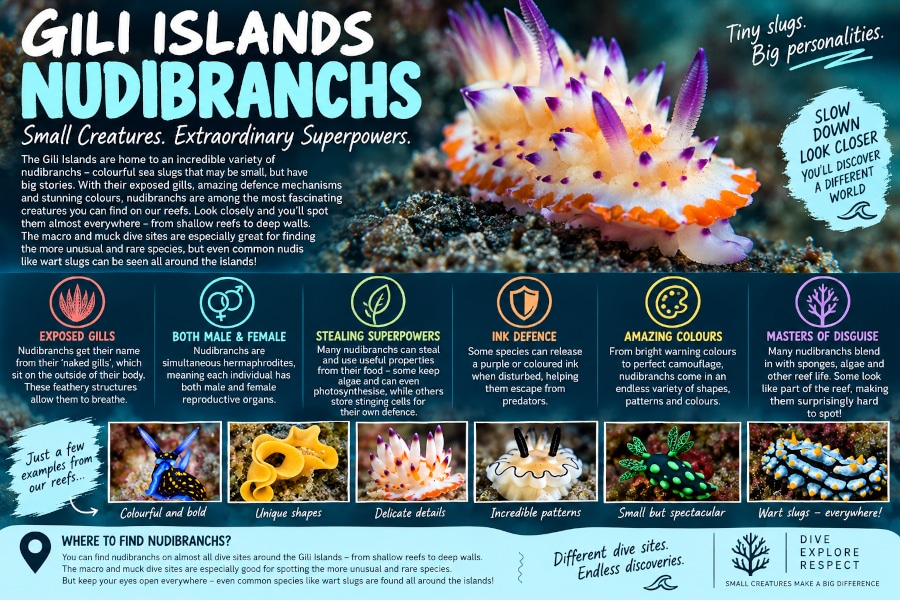
Nudibranchs are among the most fascinating creatures you can find underwater. These tiny sea slugs come in an incredible range of colours, patterns and shapes. Some are easy to spot. Others are so well camouflaged that you can swim past them without noticing.
And they are much stranger than they look.
Some nudibranchs can steal defensive chemicals from the animals they eat. Others can retain stinging cells from their prey and use them for protection. Some can even keep algae from their food and use the algae’s ability to photosynthesise.
They are also both male and female at the same time.
Once you start looking for nudibranchs, even an ordinary dive can turn into a search for tiny and unexpected creatures.
What is a nudibranch?
Nudibranchs are marine sea slugs found in oceans around the world.
They don’t have an external shell protecting their bodies as adults. Instead, they rely on camouflage, chemical defences, warning colours and other adaptations to survive.
Their appearance varies enormously.
Some have smooth bodies covered in striking patterns. Others have elaborate projections called cerata. Some look almost like tiny pieces of coral, algae or sponge.
Their colours aren’t simply there to make them attractive to divers. Depending on the species, they can help with camouflage or act as a warning to predators that the animal is unpleasant or dangerous to eat.
Why are they called nudibranchs?
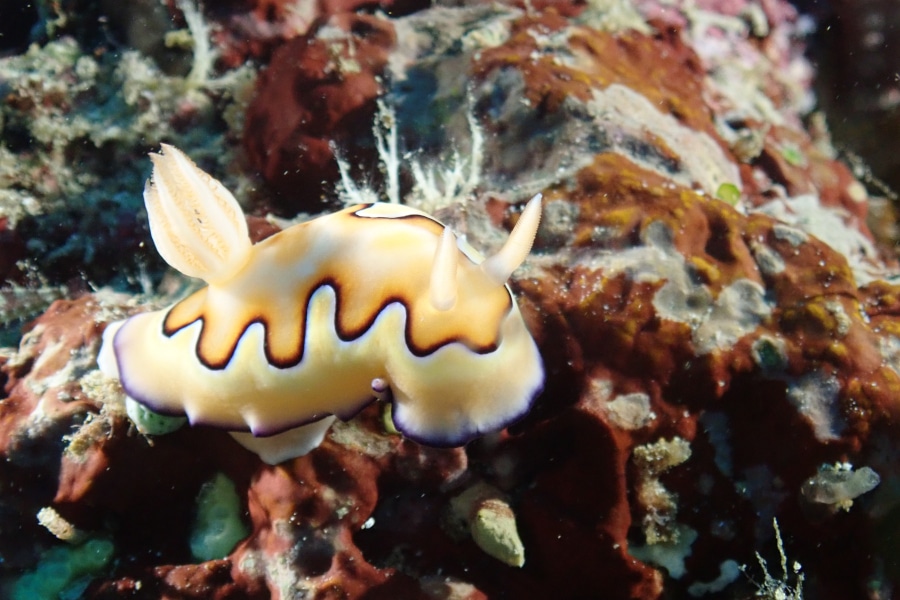
The name nudibranch comes from words meaning “naked gills.”
The name refers to one of their most unusual features: their gills are exposed on the outside of the body.
On many nudibranchs, you can see a beautiful plume or cluster of feathery structures towards the rear of the animal. These are the gills, which allow the nudibranch to exchange gases with the surrounding seawater.
The shape and arrangement of the gills varies between different nudibranchs.
They may look decorative, but they are an essential part of how these animals breathe.
They are both male and female
Nudibranch reproduction is another reason these animals are so unusual.
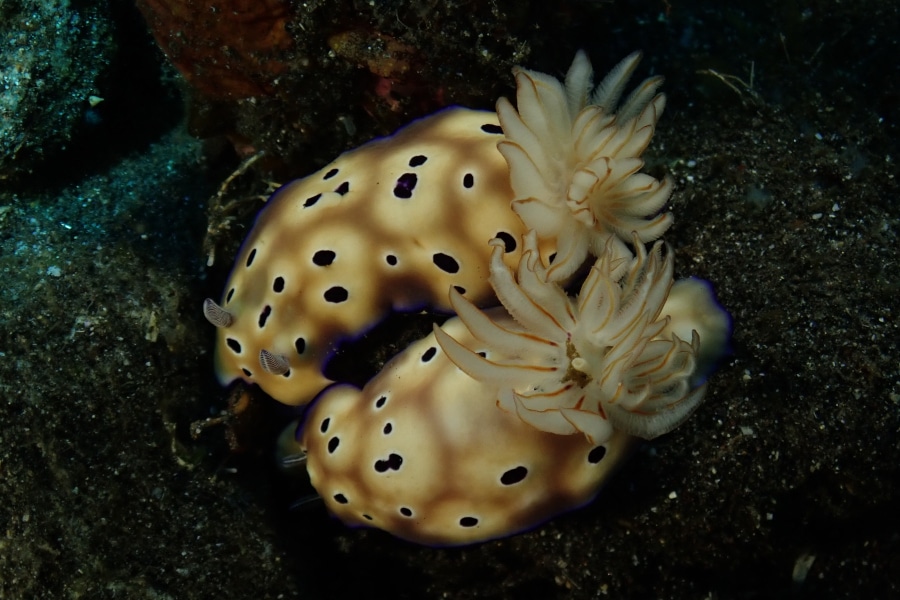
Nudibranchs are simultaneous hermaphrodites.
This means that an individual has both male and female reproductive organs.
When two nudibranchs mate, both can exchange sperm.
For a slow-moving animal living on the seafloor, this is useful. Finding another member of the same species can already be difficult. Being capable of functioning as either sex means that a suitable partner doesn’t have to be one particular sex.
They still generally need another individual to reproduce, but both animals can contribute to reproduction.
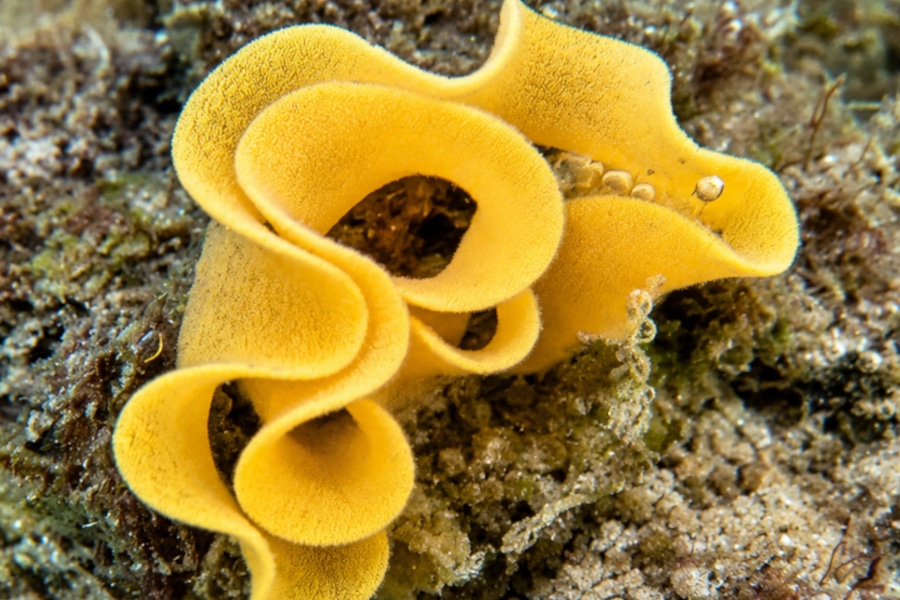
They steal useful properties from their food
Some nudibranchs have developed an extraordinary way of making their food work for them.
Rather than simply digesting everything they eat, they can retain useful compounds or structures from their prey.
This can give them additional protection or, in some species, even access to a source of energy.
It is one of the most unusual examples of animals using the biology of their food to their own advantage.
Some steal stinging cells
Some nudibranchs feed on animals such as hydroids that possess stinging cells.
Instead of destroying all of these cells during digestion, certain nudibranchs can retain them and move them into specialised structures on their own bodies.
The stolen stinging cells can then be used as a defence.
So the nudibranch effectively eats an animal with a weapon… and turns that weapon into its own defence.
It is an impressive strategy for an animal that otherwise looks almost completely defenceless.
Some can use stolen algae
Even stranger, some sea slugs can retain living photosynthetic organisms from the algae they eat.
The stolen algae can continue to photosynthesise inside the slug, producing energy that can benefit the animal.
This process is known as kleptoplasty.
It doesn’t occur in all nudibranchs, and not every sea slug that retains photosynthetic material does so in exactly the same way.
But the basic idea is remarkable: an animal eats algae and manages to keep part of the algae’s ability to produce energy.
Some can release ink
Not every nudibranch relies on camouflage or stolen defences.
Some species can release a coloured or inky substance when disturbed.
The release can help confuse or deter a potential predator, giving the nudibranch a chance to escape.
Again, this isn’t something every nudibranch can do. There is enormous variation between species, which is part of what makes studying them so interesting.
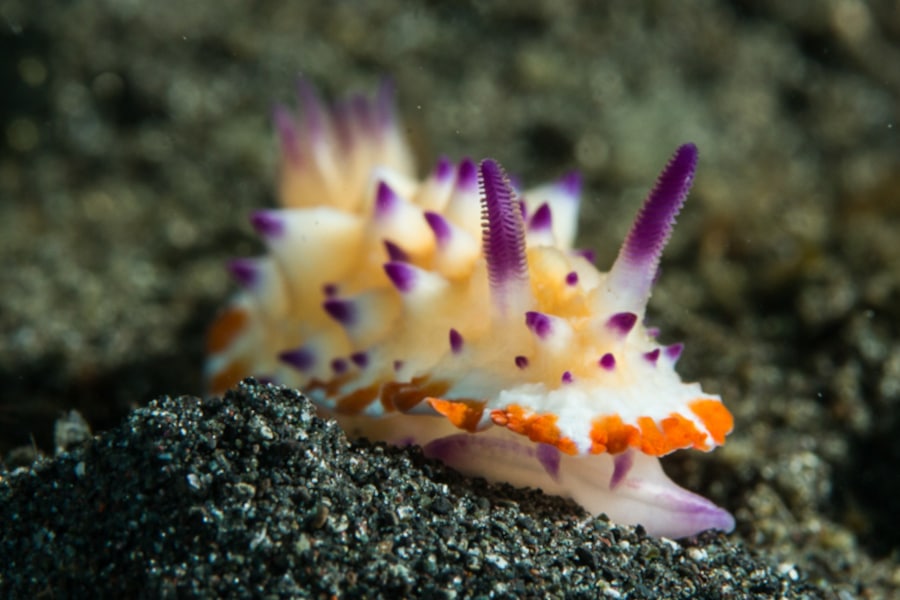
Why are nudibranchs so colourful?
Nudibranchs are famous among divers for their colours.
Bright yellow.
Electric blue.
Purple.
Orange.
Black and white.
Some have spots and stripes, while others have elaborate borders or intricate patterns.
But colour can have a purpose beyond looking spectacular.
Some nudibranchs use colours that help them blend into their food or surroundings. Others use bright colours as a warning that they are toxic, distasteful or otherwise protected.
In other words, that spectacular colour pattern you see through your macro lens may be a survival strategy.
Masters of camouflage
Some nudibranchs are incredibly difficult to see.
Their body shape can mimic the organisms around them, while their colours and textures help them disappear into the reef.
Others live directly on the animals they feed on, making them even harder to spot.
This is particularly impressive because nudibranchs are generally slow-moving. They cannot simply rely on speed to escape a predator.
Instead, they use a combination of camouflage and chemical or physical defences.
And this is exactly why having a good guide can make such a difference.
A nudibranch may be sitting directly in front of you while looking like nothing more than a piece of algae or reef growth.
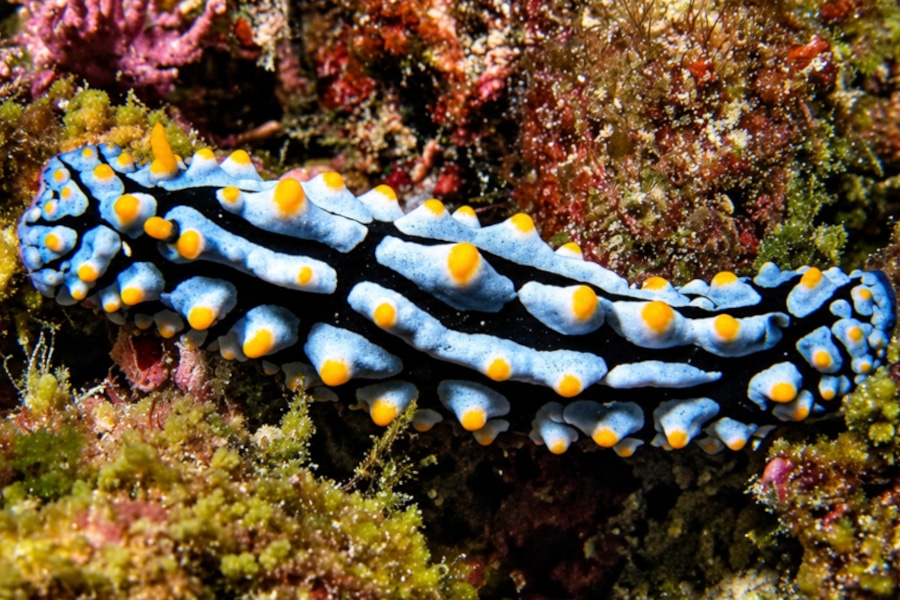
Wart slugs are everywhere
One of the nudibranchs you’re particularly likely to encounter around the Gili Islands is the wart slug.
They aren’t necessarily the rarest or most spectacular nudibranchs, but they are a great reminder that you don’t need to visit a dedicated macro site to find interesting small life.
Once you know what you’re looking for, you start seeing them on ordinary reef dives, alongside the corals and other marine life.
The more unusual nudibranchs are a different story. For those, slowing down and searching carefully in the right habitat can make a big difference.
What do nudibranchs eat?
Different nudibranchs have very different diets.
Depending on the species, they may feed on:
- Sponges
- Hydroids
- Corals
- Anemones
- Algae
- Other small marine organisms
- Other nudibranchs
This is one of the most useful things to understand when looking for them.
If you know what a particular nudibranch eats, you can start looking for its food rather than searching the entire reef at random.
A patch of sponge or hydroids may contain a nudibranch that would otherwise be almost impossible to find.
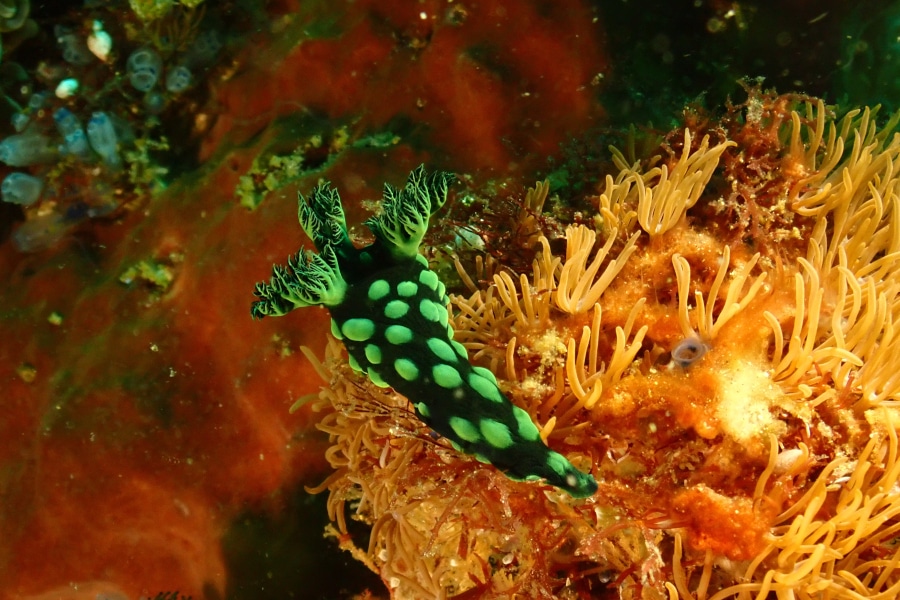
Where can you find nudibranchs around the Gili Islands?
The short answer is: almost everywhere.
Nudibranchs aren’t limited to specific dive sites around the Gili Islands. You can encounter them on shallow reefs, walls, slopes and other habitats.
Some species, such as wart slugs, are common enough to turn up on many different dives.
However, if you’re looking for the more unusual and less frequently seen nudibranchs, the macro and muck-diving sites are especially interesting.
Places such as Hans Reef, Bounty Wreck and Gili Air Harbour can be productive for small marine life. Around northwest Lombok, Kecinan, Mentigi Bay and Teluk Nare offer very different habitats where nudibranchs are among the many small creatures worth searching for.
You can explore more of these habitats in our Gili Islands Macro Marine Life guide and our guide to muck diving around the Gili Islands and Lombok.
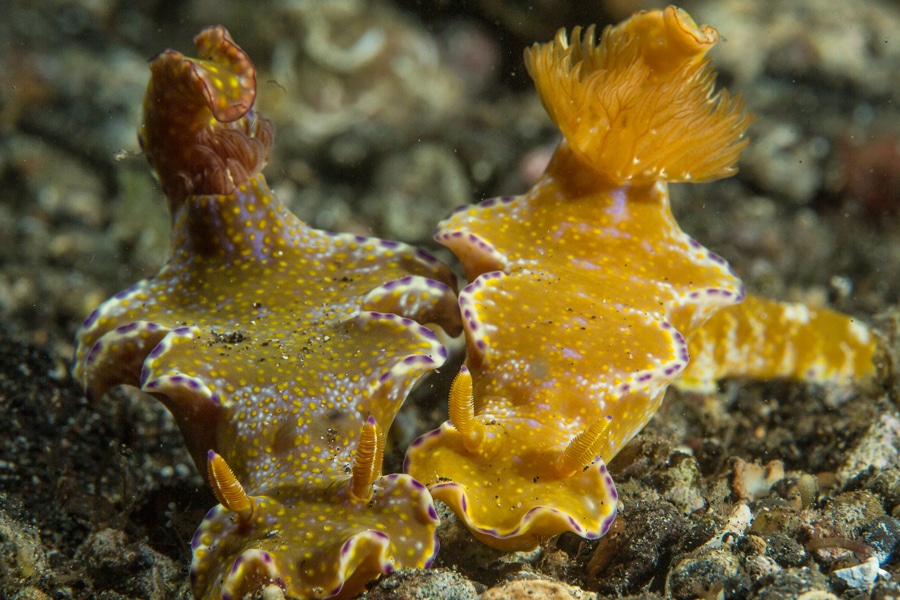
Nudibranchs and underwater photography
Nudibranchs are excellent subjects for underwater photography.
They are small, but their details can be incredible. The exposed gills, rhinophores, body textures and colourful patterns can all become visible in a macro photograph that you might barely notice with the naked eye.
Their slow movement also gives photographers time to compose an image.
But photography should never come at the expense of the animal.
Don’t touch a nudibranch or move it into a better position. Don’t disturb the reef to create a cleaner background.
Often, the best photograph is simply the one that shows the animal exactly where you found it.
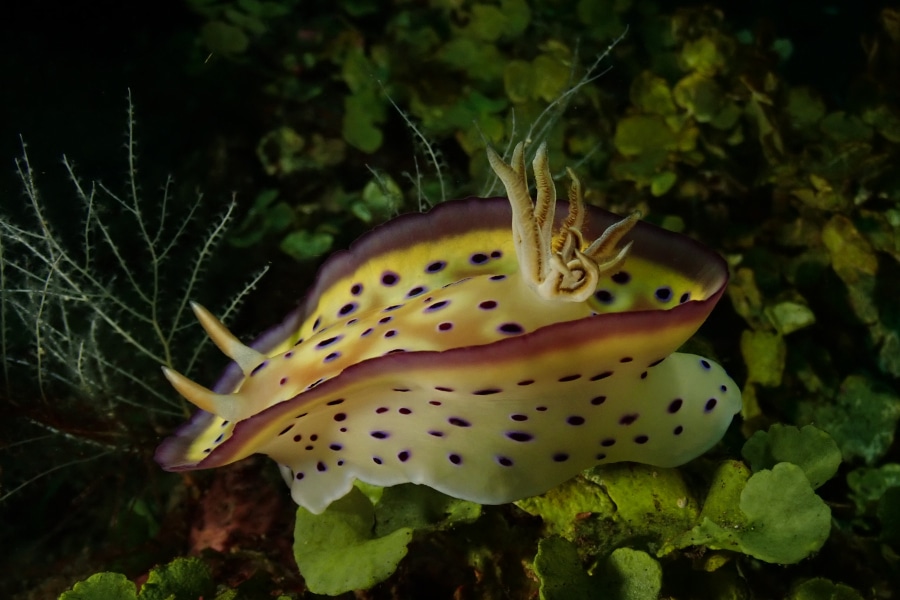
Why macro diving makes nudibranchs even more interesting
You don’t need to book a dedicated macro dive to see nudibranchs around the Gili Islands.
But macro-focused diving changes the way you look at the reef.
Instead of swimming from one large attraction to the next, you start searching individual pieces of coral, sponge, rubble and algae.
That’s when the unusual nudibranchs start to appear.
A species you have never seen before may be only a few centimetres long and sitting right beside something you’ve swum past dozens of times.
The macro and muck sites are particularly good for this style of diving because their habitats contain so many small and cryptic animals.
But the important thing is to keep looking everywhere.