

When most people think about scuba diving in the Gili Islands, they picture turtles, reef sharks, colourful coral and drift dives.
But the Gilis also have some fascinating wreck dives.
There are three main wrecks that stand out around the islands, and each offers a completely different experience.
The Bounty Wreck is the easiest and most accessible. It sits in recreational diving depth and has become a fantastic artificial reef and macro photography site.
The Glenn Nusa Wreck is deeper, sitting around 28–30 metres. It is a deliberately sunk tugboat that has quickly become an artificial reef and is now home to plenty of marine life.
Then there is the Japanese Wreck. At around 45 metres, this WWII wreck is well beyond normal recreational diving limits and is firmly in technical diving territory.
So whether you are looking for your first wreck dive, an advanced wreck dive or a serious technical wreck diving experience, the Gili Islands have something to offer.
Bounty Wreck: The Best Wreck Dive for Beginners
The Bounty Wreck is probably the most famous wreck dive in the Gili Islands.
And despite the name, it isn’t actually a shipwreck.
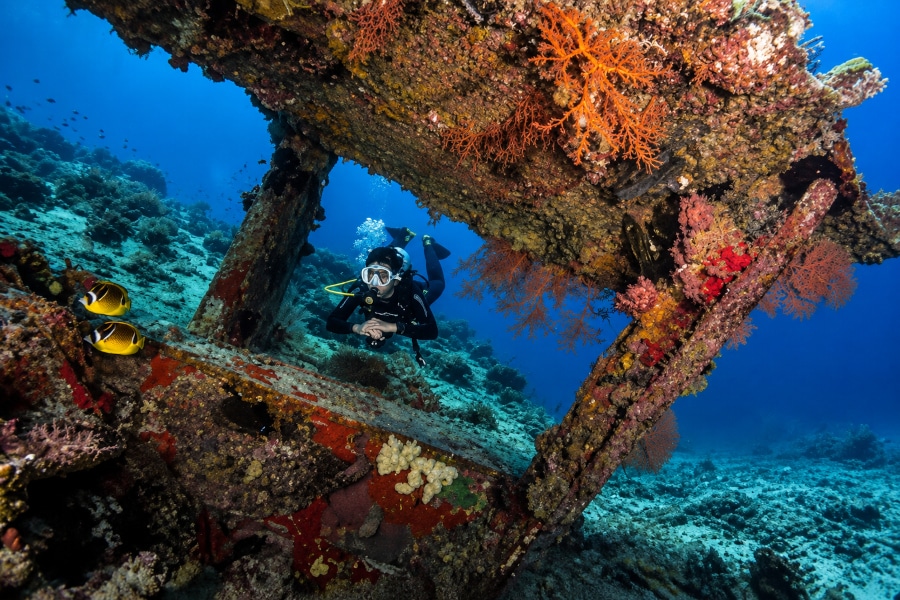
The Bounty started life as a floating wooden pier or pontoon off Gili Meno. During a storm, it was driven onto the seabed and eventually abandoned. Over the years, coral growth transformed the structure into a thriving artificial reef.
Today, the Bounty Wreck lies southwest of Gili Meno, with the shallowest parts around 8–9 metres and the deepest section around 18 metres. That puts the entire wreck comfortably within recreational diving depth.
For that reason, it is an excellent introduction to wreck diving for recreational divers.
What can you see at the Bounty Wreck?
The wreck itself is now heavily covered in coral.
Look carefully and you can find:
- Frogfish
- Scorpionfish
- Ghost pipefish
- Nudibranchs
- Peacock mantis shrimp
- Sweetlips
- Glassfish
- Damselfish
- Turtles
- Other small reef creatures
A large coral bommie next to the wreck is particularly impressive, with thousands of glassfish moving above it.
The wreck is also famous for the old bicycles on its southern side. Coral has grown over them, turning what was once an unusual piece of underwater debris into one of the site’s most recognisable features.
Bounty Wreck for macro photographers
If you enjoy macro diving, the Bounty Wreck is one of the best wreck sites in the Gili Islands.
The structure provides plenty of hiding places for small animals. Frogfish can sit almost completely motionless against the wreck, while ghost pipefish disappear among crinoids and coral growth.
It is the kind of dive where slowing down makes a big difference.
Rather than simply swimming around the wreck, take your time and search the structure carefully.
Can beginners dive the Bounty Wreck?
Yes.
The Bounty is accessible to Open Water divers, although conditions such as current, visibility and surface conditions should always be considered on the day.
It is also an excellent site for photographers because there is plenty to see without needing to go deep. PADI lists the site as suitable for all levels, with a maximum depth of 18 metres.
The Bounty also works very well as a night dive, when many of the smaller animals become more active.
Glenn Nusa Wreck: A Deeper Artificial Reef
The Glenn Nusa Wreck offers a completely different type of wreck dive.
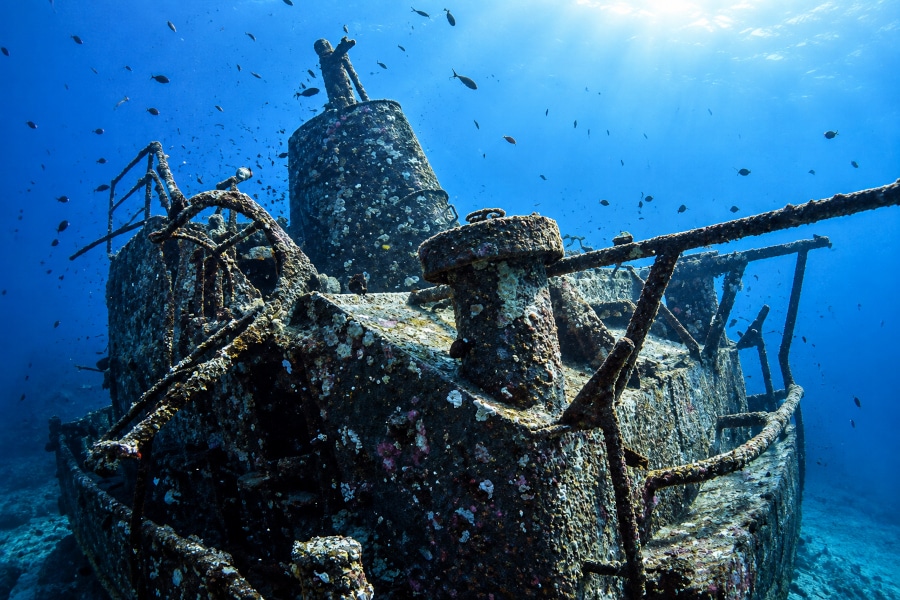
The Glenn Nusa I was a 22-metre tugboat deliberately sunk in 2016 to create an artificial reef. It lies between Halik Reef and Shark Point, off the northwestern side of Gili Trawangan.
The wreck sits at approximately 28–30 metres, making this an advanced dive rather than a typical beginner wreck dive.
What can you see at Glenn Nusa?
The wreck has already become well established as an artificial reef.
Schools of fish move around the superstructure, while larger predators can be seen in the surrounding blue water.
One of the site’s biggest attractions is the resident whitetip reef sharks, which are often found resting beneath the stern. Trevally, snappers and sweetlips are also commonly associated with the wreck.
Moray eels and other reef animals have also taken advantage of the openings in the structure.
Can you enter the Glenn Nusa?
The wreck has openings and passageways that can be explored by appropriately trained wreck divers.
But there is an important difference between looking inside a wreck and conducting a proper wreck penetration.
Once you enter an overhead environment, the risks change considerably. Entanglement, silt-outs, loss of visibility and navigation problems become serious considerations.
If you want to penetrate the Glenn Nusa, proper wreck-diving training and suitable equipment are essential.
For divers who stay outside, there is still plenty to explore.
Japanese Wreck: WWII History at 45 Metres
For experienced technical divers, there is a much more serious wreck dive further away from the main Gili dive sites.
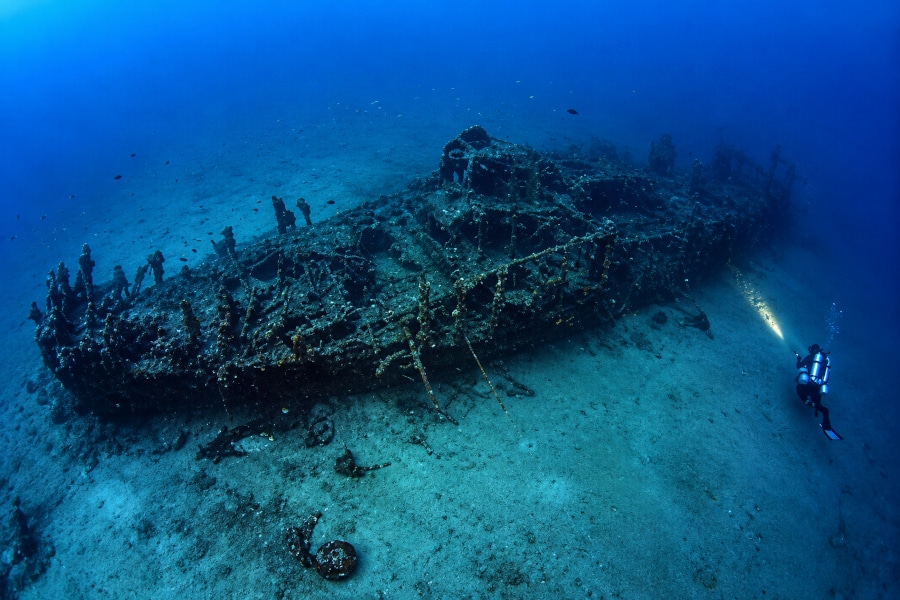
The Japanese Wreck lies at approximately 45 metres in the channel between the Gili Islands and Lombok. It is a WWII-era Japanese patrol vessel, approximately 20–22 metres long. Technical-diving sources identify the wreck as the Hayabusa Maru, sunk in 1945.
This is not a normal recreational wreck dive.
At around 45 metres, the Japanese Wreck is well beyond standard recreational diving limits and requires appropriate technical training and decompression procedures.
A real WWII shipwreck
The Japanese Wreck is particularly interesting because of its history.
The vessel was used as a Japanese submarine patrol boat during World War II. Exactly how it sank is less certain, with accounts suggesting that it was either attacked or scuttled towards the end of the war.
The wreck remained largely unknown for decades before its location was rediscovered through information from a local fisherman.
Today, it sits alone on the sandy seabed.
There is no shallow reef immediately around it.
That isolation makes the descent particularly impressive. You leave the surface and descend through blue water until the wreck gradually appears below you.
What can you see on the Japanese Wreck?
Despite its depth, the wreck has become heavily colonised by marine life.
Divers have reported:
- Lionfish
- Scorpionfish
- Frogfish
- Nudibranchs
- Groupers
- Sweetlips
- Moray eels
- Large schools of fish
- Trevally and jacks
- Other macro life
The wreck is also interesting for divers who enjoy historical artefacts. Reports describe ammunition and other remnants associated with the vessel, including the captain’s area and propeller.
Gili Islands Wreck Diving at a Glance
| Wreck | Depth | Type | Experience | Highlights |
|---|---|---|---|---|
| Bounty Wreck | 8–18 m | Sunken pier/pontoon | Open Water | Macro, frogfish, ghost pipefish, glassfish |
| Glenn Nusa | ~28–30 m | Sunk tugboat | Advanced | Whitetip shark, schools of fish, wreck structure |
| Japanese Wreck | ~45 m | WWII patrol vessel | Technical | WWII history, macro, fish life, deep wreck |
Which Gili Islands Wreck Dive Is Right for You?
The three wrecks are very different, so the best one depends on your experience and what you want from the dive.
For your first wreck dive
Choose the Bounty Wreck.
It is shallow, easy to explore from the outside and packed with marine life.
You don’t need to spend most of your dive managing depth or decompression. Instead, you can concentrate on the wreck and everything living on it.
For deeper recreational wreck diving
Choose Glenn Nusa.
At around 28–30 metres, it is a very different experience from the Bounty.
You get a genuine tugboat wreck, deeper water, larger marine life and the possibility of seeing the resident whitetip reef shark.
For wreck penetration
Glenn Nusa offers opportunities for appropriately trained wreck divers to explore parts of the interior.
But proper wreck-diving training should come first. Seeing an opening does not automatically make it safe to enter.
For technical wreck diving
Choose the Japanese Wreck.
At around 45 metres, this is the most serious of the three Gili Islands wreck dives.
It is a technical decompression dive and should be approached with the appropriate training, gas planning, equipment and experience.
Wreck Diving and Wreck Diver Training
If wreck diving is something you want to explore further, a PADI Wreck Diver Specialty is a natural next step.
A wreck course teaches much more than simply swimming around a sunken structure. It covers wreck-diving planning, navigation, lines and reels, hazards, buoyancy and, where appropriate, limited penetration techniques.
This is particularly relevant if you want to explore the interior of wrecks such as Glenn Nusa.
For the Japanese Wreck, however, recreational wreck training alone is not enough. The depth means you need the appropriate technical diving and decompression training for the planned profile.
Wreck diving is not your thing? Explore the complete Gili Islands dive-site guide