


If there is one animal that can make a diver stop mid-dive and stare, it is the cuttlefish.
Intelligent, curious and almost impossibly good at camouflage, cuttlefish are among the most fascinating marine creatures you can encounter beneath the surface. Around Gili Meno, they are a regular sight at several of our dive sites — although, as with all marine life, there are never any guarantees.
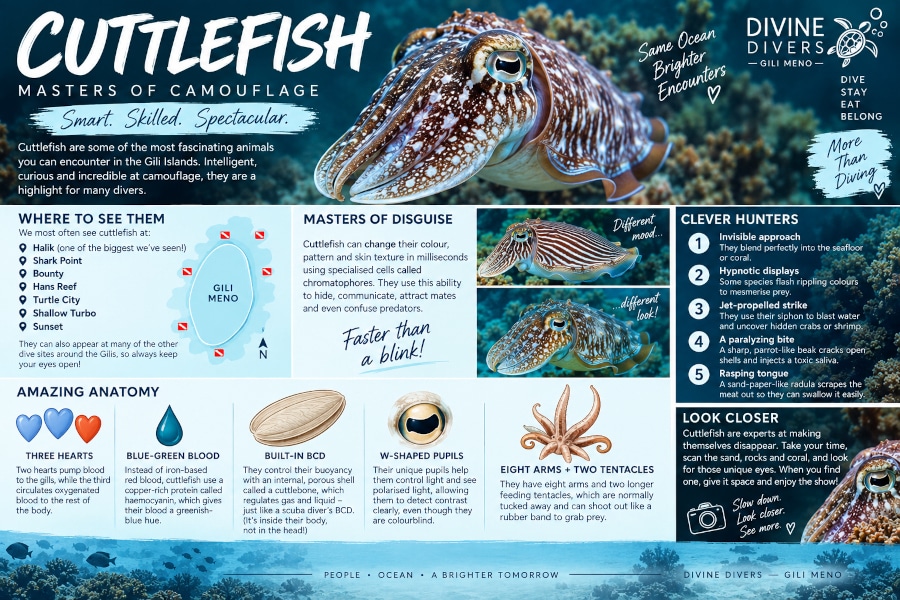
We most often encounter cuttlefish at Halik, Shark Point, Bounty, Hans Reef, Turtle City, Shallow Turbo and Sunset. They can also turn up at many of the other dive sites around the Gilis, so it is always worth keeping your eyes open.
And if you are hoping to see a really big one, keep an especially close eye on Halik. Some of the biggest cuttlefish we have ever seen have been there.
A master of disguise
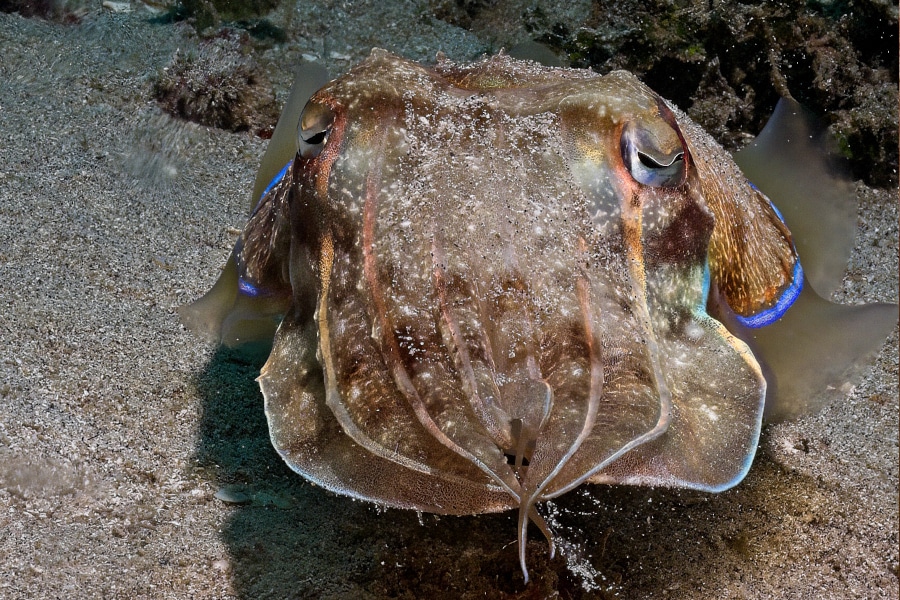
Cuttlefish are famous for their incredible ability to change their appearance. Their skin contains specialised cells called chromatophores, along with other structures that allow them to rapidly alter their colours and patterns.
They can go from relatively plain to covered in dramatic stripes, spots or contrasting patterns in an instant. They can also alter the texture of their skin, helping them blend into rocks, sand, coral or algae.
And they do not simply use this ability to hide.
Cuttlefish can use spectacular displays to communicate with each other, warn competitors, attract mates and confuse predators. When you watch one changing patterns while hovering over a reef, you are seeing a remarkably sophisticated form of visual communication.
Three hearts and blue-green blood
Same as octopus, cuttlefish have three hearts.
Two hearts pump blood through the gills, where it picks up oxygen, while the third pumps oxygenated blood around the rest of the body.
Their blood is also very different from ours. Instead of using iron-based haemoglobin to transport oxygen, cuttlefish use a copper-containing protein called haemocyanin. This gives their blood a blue-green colour.
So, yes — the animal hiding beside your dive mask has three hearts and blue-green blood.
Their built-in BCD
One of the most remarkable pieces of cuttlefish anatomy is the cuttlebone.
Despite its name, it is not a bone and it isn’t located inside the head. It is an internal, lightweight structure inside the cuttlefish’s body that contains a network of tiny chambers.
By controlling the amount of gas and liquid within these chambers, the cuttlefish can regulate its buoyancy and control its position in the water.
For divers, the easiest comparison is a natural BCD.
The cuttlebone allows a cuttlefish to hover effortlessly above the reef without constantly swimming to stay at the same depth.
Those incredible eyes
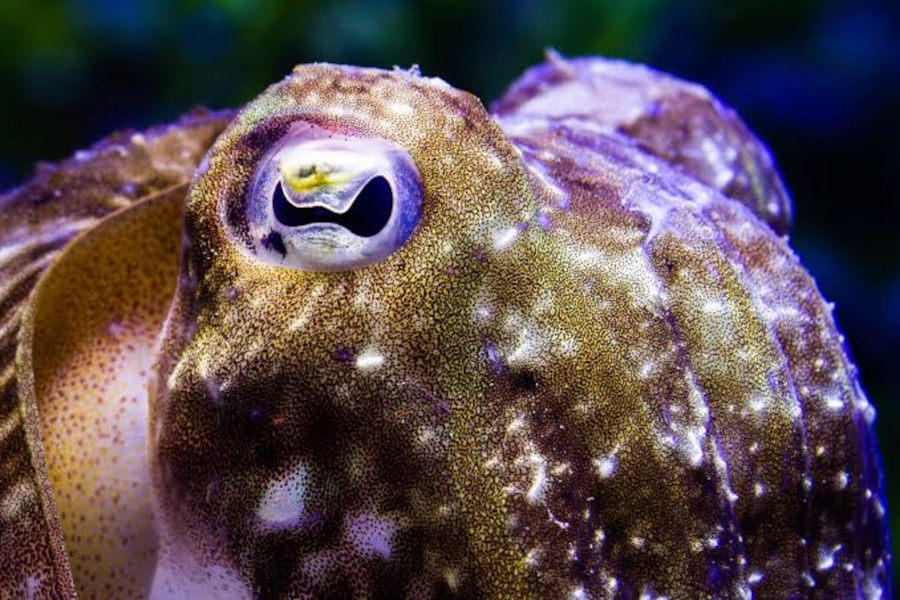
Take a close look at a cuttlefish’s eyes and you will notice something unusual: their pupils have a distinctive W shape.
Their vision is highly developed, and they are particularly good at detecting contrast and movement. Cuttlefish can also perceive polarised light, something humans cannot see naturally.
Interestingly, despite their sophisticated visual system, cuttlefish are generally considered to have limited colour vision compared with humans. Instead, they rely heavily on contrast, brightness and polarisation to interpret their surroundings.
And when you see how precisely they match the reef around them, it is hard to believe they are not seeing the world exactly as we do.
Eight arms… and two hidden tentacles
Cuttlefish have eight arms and two longer feeding tentacles.
The two tentacles are normally kept tucked away. When the opportunity presents itself, they can shoot out incredibly quickly to grab prey.
Once caught, the prey is brought towards the mouth, where the cuttlefish uses a powerful, parrot-like beak to bite through its food.
And it doesn’t stop there.
Inside the mouth is a rough, rasping structure called a radula, which helps process the food.
Just like something we see in Alien movies!
Their hunting technique can be fascinating to watch. A cuttlefish may slowly approach while perfectly matching the surrounding environment before suddenly striking. Some will also use their siphon to blast water across the seabed, exposing hiding prey such as small crustaceans.
The secret weapon of male cuttlefish
Cuttlefish reproduction comes with some surprisingly complicated behaviour.
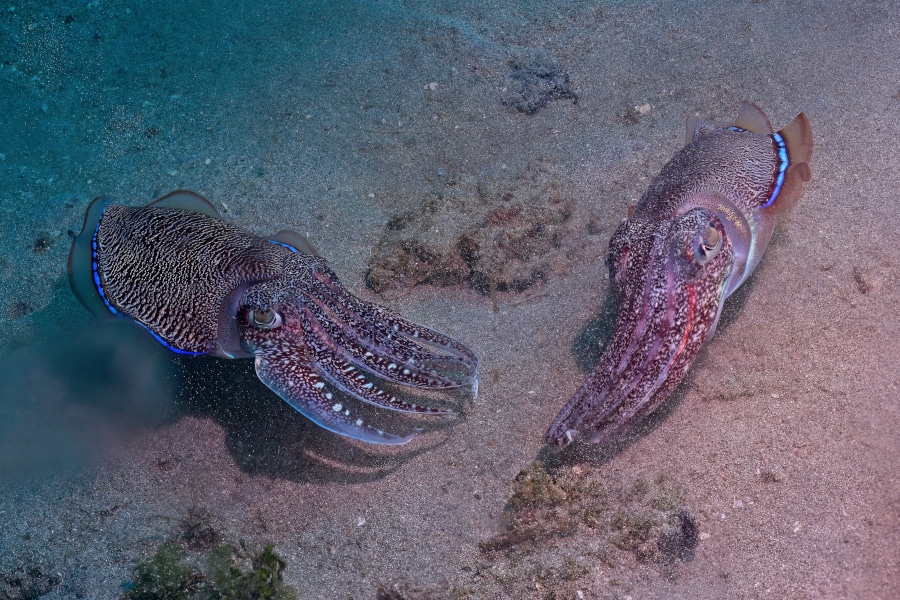
Male cuttlefish have one specialised arm known as a hectocotylus, which is adapted for transferring sperm packets to the female.
But mating isn’t simply a matter of finding a female and swimming up to her.
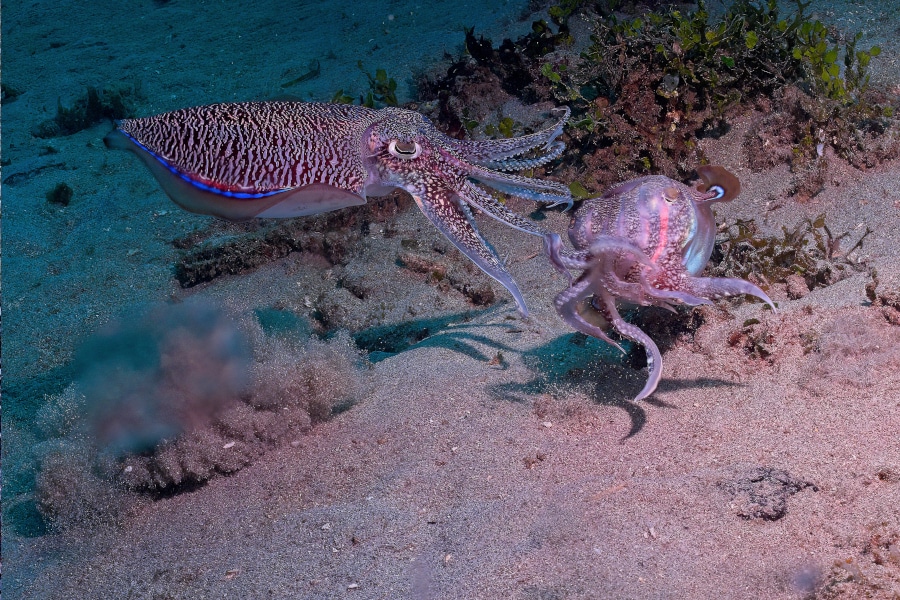
Competition between males can be intense, and smaller males have been observed using an extraordinary strategy: disguising themselves as females.
By changing their colours, patterns and body posture, a smaller male can sometimes fool a larger rival male into thinking there is no competition. He can then approach the female while the dominant male is distracted.
Look closely on your next dive
The challenge with finding a cuttlefish is that they are exceptionally good at making themselves disappear.
One moment you can be looking directly at one. The next, it seems to have vanished into the reef.
This is why we encourage divers to slow down and look carefully. Scan the sand, rocks and coral rather than only looking for movement. Sometimes the only clue is a pair of unusual eyes looking back at you.
And when you do find one, don’t rush.
Give it some space and watch.
You may see it change colour. Maybe you’ll see it communicating with another cuttlefish. You may watch it hunting, hovering effortlessly above the reef or simply staring curiously back at you.