

If you enjoy finding tiny marine life, pipefish are easy to become obsessed with.
They are slender, almost impossibly thin fish that often disappear completely into their surroundings. Around the Gili Islands, we encounter them at several dive sites, including Hans Reef, Bounty Wreck, Kecinan, Teluk Nare and Mentigi Bay. They are particularly common around Gili Air Harbour, where the shallow, sheltered habitat provides plenty of places for them to hide.
Pipefish are close relatives of seahorses, and once you know what to look for, the family resemblance becomes obvious.
But pipefish have their own fascinating behaviours — including a rather unusual approach to courtship where the female can be the one trying to impress the male.
What are pipefish?
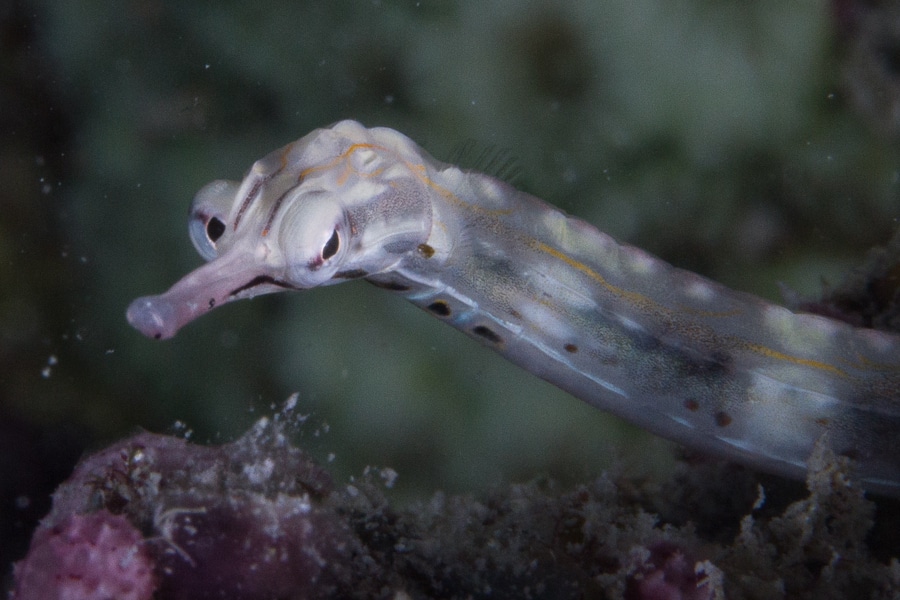
Pipefish are slender marine fish belonging to the same family as seahorses, Syngnathidae.
Like seahorses, they have hard bony plates beneath their skin rather than conventional fish scales. Their bodies are long and narrow, and they have a distinctive tube-shaped snout.
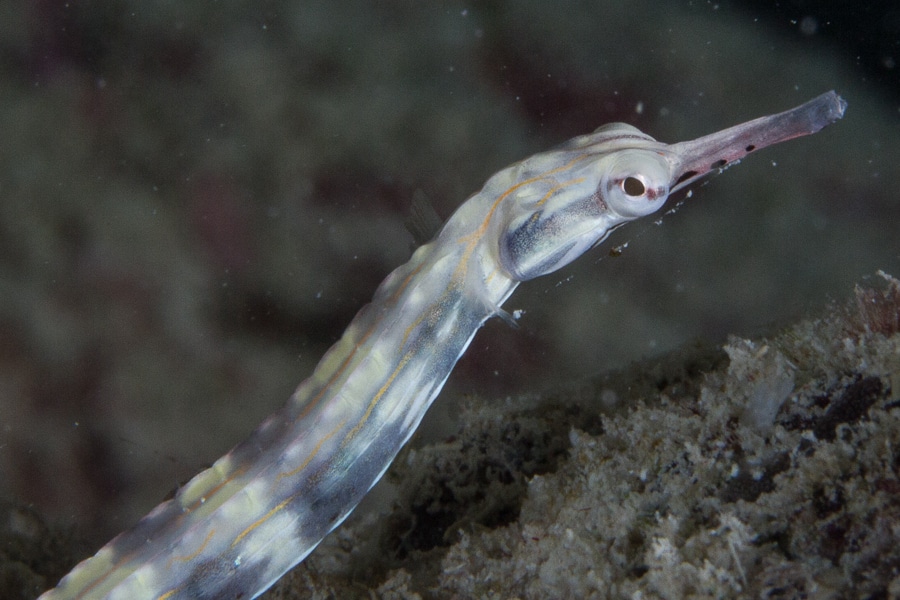
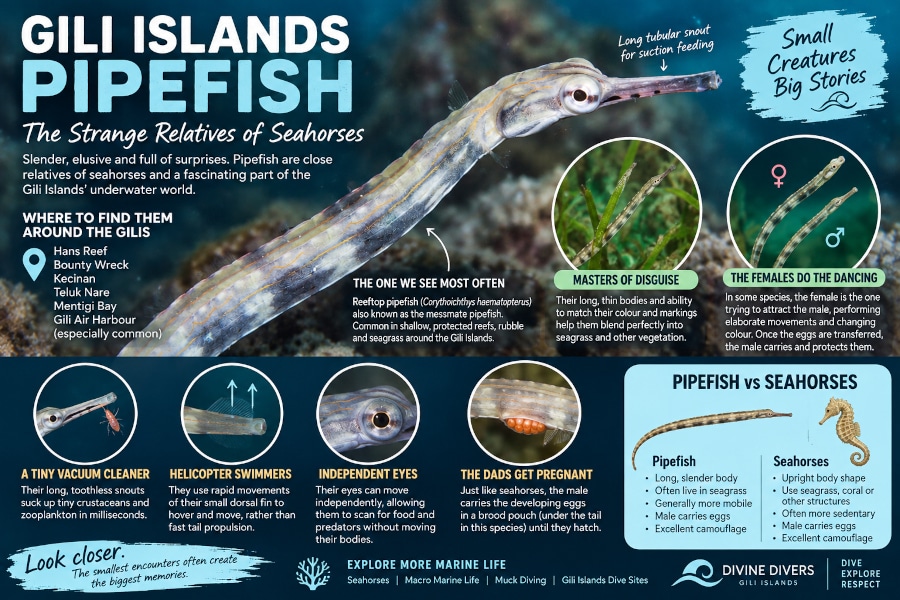
The pipefish we see most often around the Gili Islands appears to be the reeftop pipefish (Corythoichthys haematopterus), also known as the messmate pipefish or yellow-streaked pipefish.
The species is widespread across the tropical Indo-Pacific, including Indonesia, and is particularly associated with shallow, protected rubble and sandy areas. It can reach almost 20 cm in length and is often found in pairs or small groups (source: FishBase)
The photograph above shows the type of pipefish we encounter most frequently.
Its pale body, fine markings and long tubular snout make it surprisingly easy to miss against the reef.
Where can you find pipefish around the Gili Islands?
We encounter pipefish at several locations around the islands.
Hans Reef and Bounty Wreck can produce pipefish encounters while exploring the reef, rubble and surrounding structures. Bounty Wreck is particularly interesting for macro photographers because the artificial reef and surrounding sandy areas harbour a wide variety of small marine life.
Around Kecinan and Mentigi Bay, the combination of seagrass, rubble and sheltered shallow habitat creates particularly good conditions for small cryptic animals.
Teluk Nare is another good place to search, especially when exploring the shallower areas around the pier and harbour environment.
And then there is Gili Air Harbour, where pipefish are particularly common.
The harbour is a good example of why you shouldn’t judge a dive site by appearances alone. Working harbour areas can look unremarkable from above, yet underwater they can contain an impressive variety of small marine life.
The dads get pregnant
One of the biggest similarities between pipefish and seahorses is their reproductive strategy.
The male carries the developing eggs.
In the reeftop pipefish, the male carries the eggs in a brood pouch underneath the tail. The developing young remain there until they are ready to hatch.
So, just like their seahorse relatives, pipefish turn the usual fish-parenting arrangement upside down.
Dad does the pregnancy.
And the story gets even more interesting when you look at how some pipefish choose their partners.
The females do the dancing
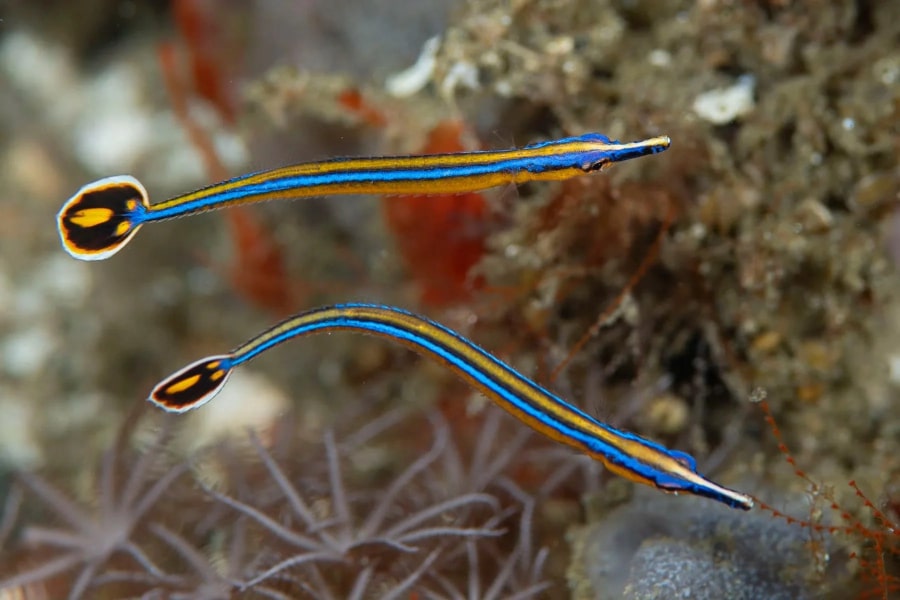
One of the more unusual things about pipefish is that the female can take the active role in courtship.
According to our marine biologist, females can try to attract males through elaborate movements and changes in colour.
The female may swim around the male, displaying her body and changing her appearance as part of the courtship.
It is a fascinating reversal of what we often see in the animal world.
Once the eggs are transferred to the male, he is the one investing in their development.
In other words, the female has to convince the male that she is worth becoming the father.
Courtship behaviour varies between pipefish species, so this isn’t something we would apply universally to every pipefish. But when you are lucky enough to witness it, it is an extraordinary underwater performance.
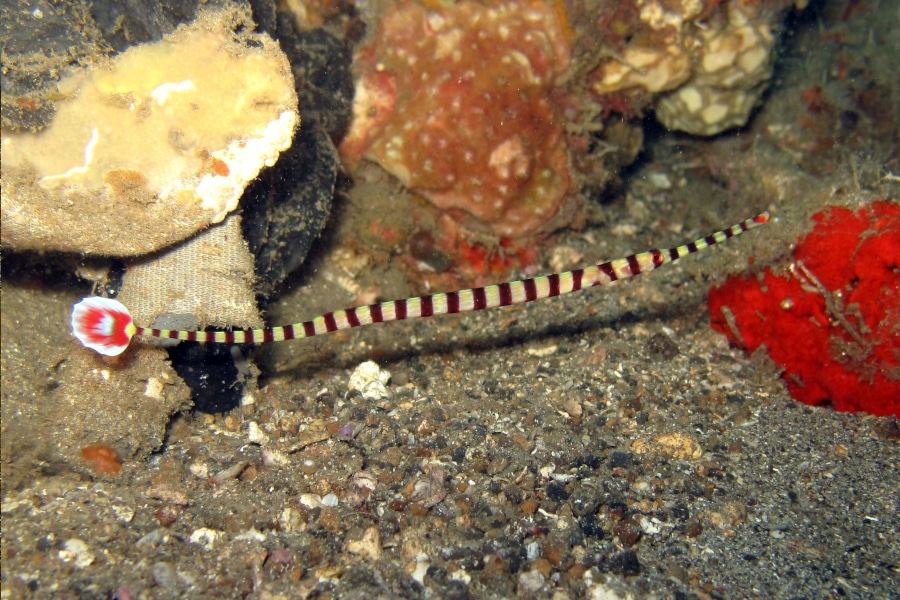
Masters of disguise
Pipefish don’t have the dramatic camouflage abilities of an octopus, but they are exceptionally good at something much simpler:
looking like seagrass.
Their long, straight bodies and narrow heads allow them to disappear among vegetation.
They may hold themselves vertically and move with the surrounding plants, making them difficult for predators to distinguish from their habitat.
Some pipefish can also alter their colour and markings, adding another layer to their camouflage.
For divers, it creates a very specific problem.
You aren’t necessarily looking for a fish.
You’re looking for a piece of seagrass that moves differently from all the other pieces.
A tiny underwater vacuum cleaner
That long, narrow snout isn’t just for their cute appearance.
Pipefish feed on tiny prey such as small crustaceans and zooplankton.
They are suction feeders. When prey comes within range, they rapidly draw it into their mouths using a powerful suction created by the expansion of structures around the mouth.
The whole process happens incredibly quickly.
For such a slow-looking animal, the feeding strike is anything but slow.
Their long snout is therefore a highly specialised feeding tool — essentially a tiny underwater suction system attached to a fish that looks like a piece of grass.
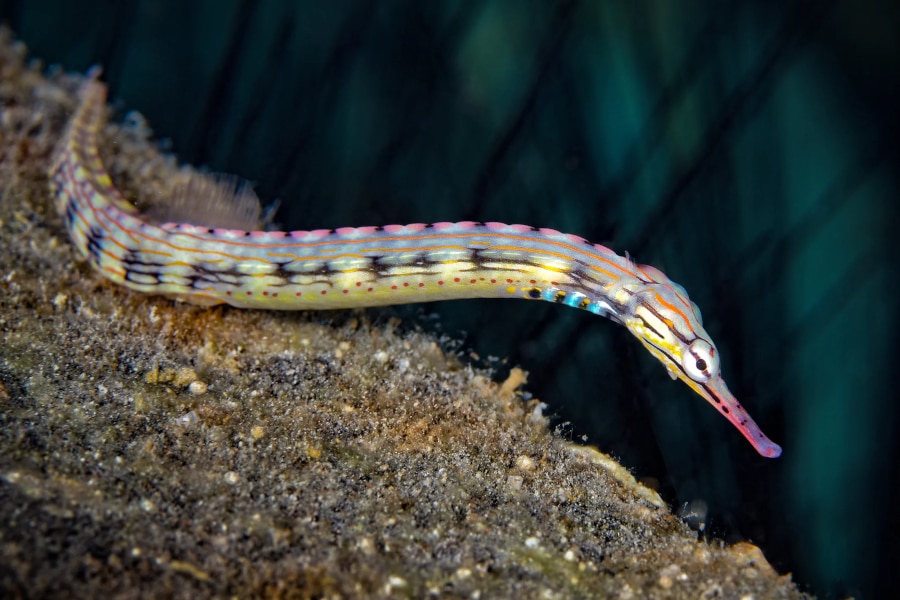
They don’t need to swim like other fish
Another strange feature of pipefish is the way they move.
Their bodies are not built for fast swimming. Instead, they can remain almost stationary while using their dorsal fin to make rapid, delicate movements.
The effect can look almost like a tiny helicopter hovering in place.
This is particularly useful when they are living among seagrass.
Rather than charging through the water, they can make tiny adjustments while remaining close to their hiding place.
For an animal whose survival depends on not being noticed, that’s a pretty good strategy.
Their eyes can work independently
Pipefish also have remarkably mobile eyes.
Their eyes can move independently, allowing them to watch what is happening around them without having to turn their entire body.
A pipefish can keep its body aligned with the seagrass while scanning its surroundings for both predators and potential prey.
It doesn’t have to choose between staying hidden and looking around.
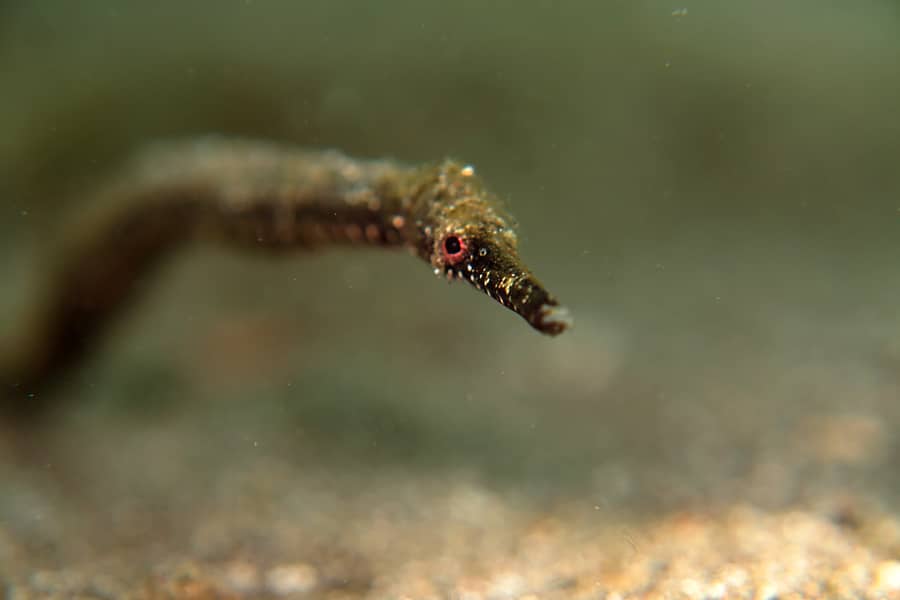
Pipefish and the Gili Islands’ macro life
Pipefish are part of the enormous variety of small animals that make the Gili Islands interesting for macro divers.
They share these habitats with seahorses, nudibranchs, ghost pipefish, frogfish, shrimp, crabs, gobies and many other small creatures.
Our Gili Islands Macro Marine Life guide brings many of these tiny animals together, while the broader Gili Islands Marine Life guide covers everything from macro creatures to turtles, sharks and rays.
If you enjoy searching through sand, rubble and seagrass for unusual animals, our guide to muck diving is also worth exploring.
Pipefish vs seahorses
Pipefish and seahorses may look very different at first, but they share some remarkable characteristics.
| Pipefish | Seahorses |
|---|---|
| Long, slender body | Upright body shape |
| Long tubular snout | Long tubular snout |
| Bony plates beneath the skin | Bony plates beneath the skin |
| Male carries developing eggs | Male carries developing eggs |
| Excellent camouflage | Excellent camouflage |
| Often live among seagrass | Many species use seagrass, coral or other structures |
| Generally more elongated and mobile | Often more sedentary |
The similarities make sense once you realise they are close relatives.
But pipefish have evolved their own distinctive way of living — one based on slender bodies, camouflage, specialised feeding and an unusual reversal of traditional courtship roles.
A photographer’s challenge
Pipefish can also be fascinating subjects for underwater photographers.
The challenge is that they are small, thin and often surrounded by vegetation, which can make focusing difficult.
A good photograph usually comes from patience rather than chasing the animal.
If the pipefish is holding position among seagrass, wait for it to settle and look for a clean angle. Its long body can make for a beautiful composition when it separates clearly from the background.
Like seahorses, pipefish are a reminder that some of the most interesting underwater encounters happen when you stop looking for big animals and start paying attention to the tiny ones.